Carrion Crow or Large-Billed Crow?
Here's how to tell the difference
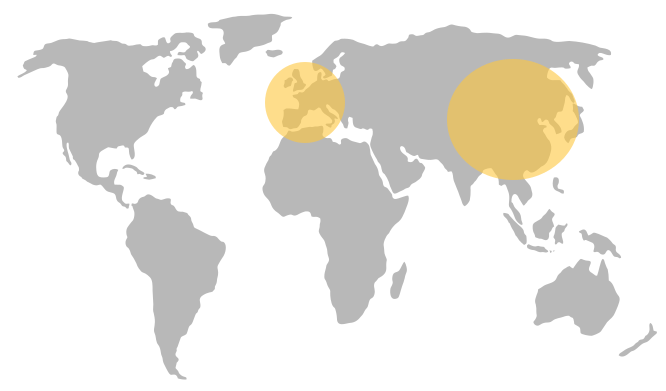


Carrion Crow

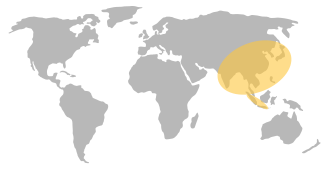
Large-Billed Crow
Carrion Crow
Corvus corone
General appearance
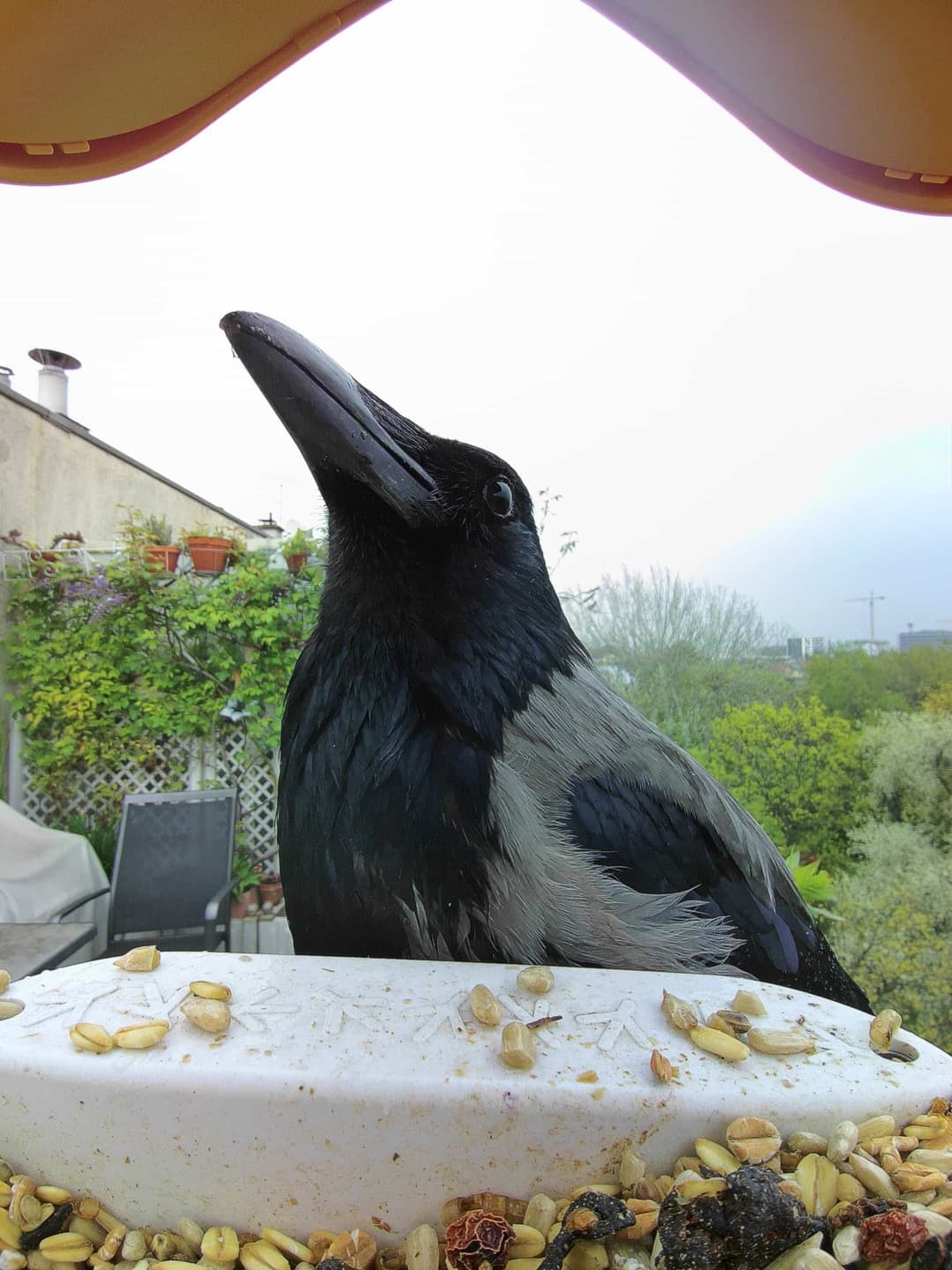
The Carrion Crow is roughly 46-51 cm long with a wingspan of 93–104 cm. It has a pure black plumage, slightly glossy, with a strong, black bill, and black legs. Its eyes are dark brown or grey. It flies with a slow heavy flapping, and has a distinct 'cash' sound.
Male vs female
Males are slightly larger than females, but otherwise, the sexes are very similar in appearance. Generally, females may have a slightly lighter build, but it is challenging to distinguish between the two based solely on physical appearance.
Juvenile
Juvenile Carrion Crows are remarkably similar to adults, still black but slightly less glossy. Their eyes initially are blue, gradually changing to brown in the first year. They lack the ruffled plumage around the neck seen in adults.
Size
18.9 - 20.9 in/14.0 - 21.2 oz
There's more to learn about Carrion Crow
View full detailsLarge-Billed Crow
Corvus macrorhynchos
Also known as: Thick-Billed Crow
General appearance
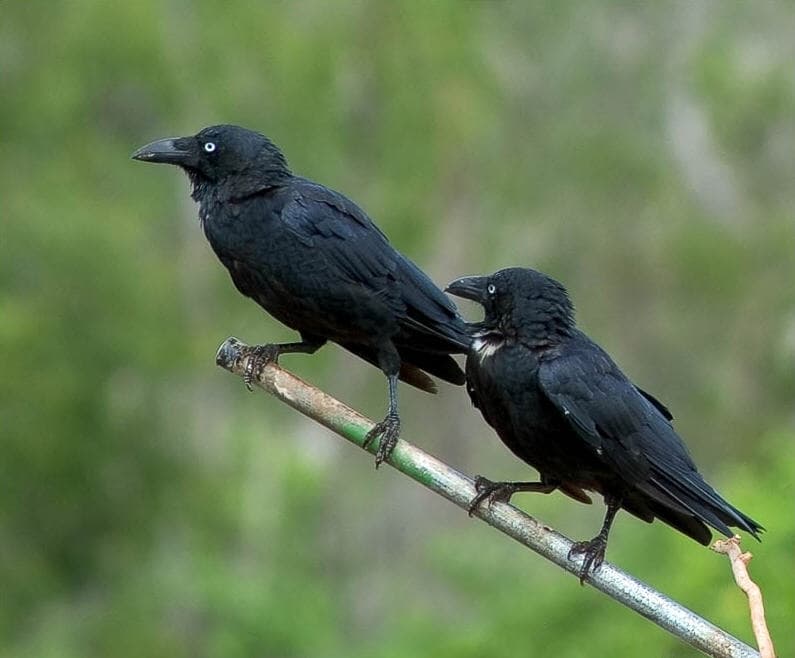
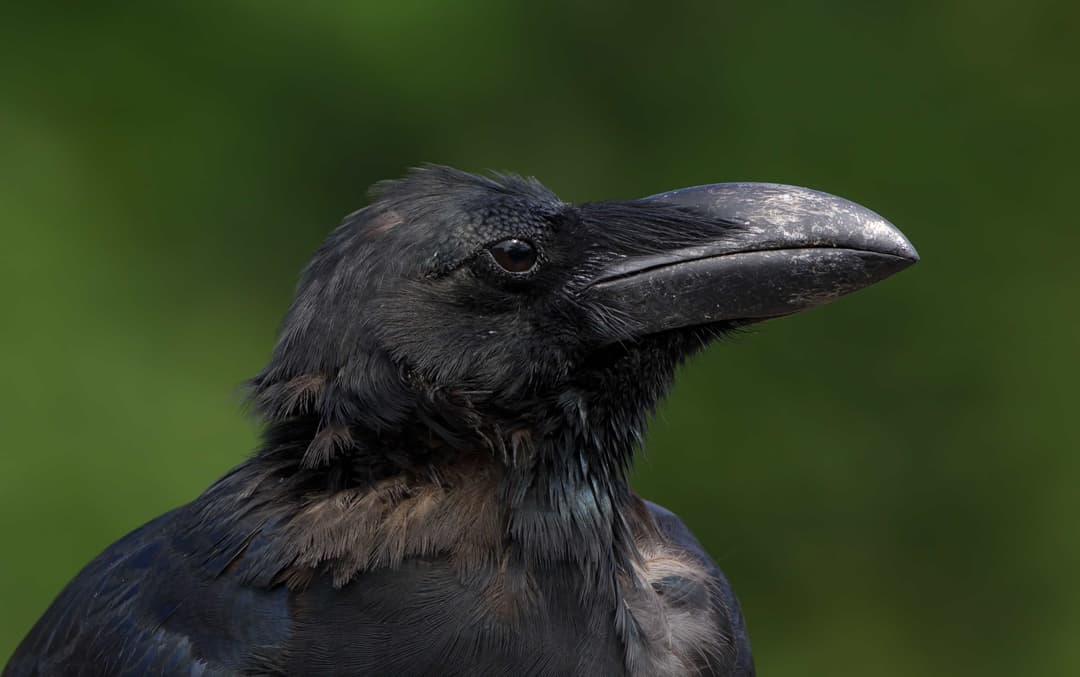
The large-billed crow, as the name suggests, is notable for its relatively large beak. These crows are generally black, even though a gray or silver sheen may appear over the feathers in bright sunlight. Their eyes are often a stark contrast in a striking shade of white or pale blue.
Male vs female
Sexual dimorphism is less prominent in large-billed crows, making it difficult to distinguish males from females based on physical appearance alone. Both genders share similar coloration and size, although males tend to be slightly larger.
Juvenile
Juvenile large-billed crows resemble adults but tend to have lighter-colored eyes, usually a duller blue or gray. Additionally, juveniles may be identified by the comparatively smaller size of their beaks, which gradually increase as they age.
Size
18.1 - 23.2 in/15.9 - 35.3 oz
There's more to learn about Large-Billed Crow
View full detailsHow to tell the Carrion Crow from the Large-Billed Crow
Visual differences
Carrion Crows (18-21 inches) are smaller and have a smaller, strong black beak. Their plumage is pure black and slightly glossy, with dark brown or grey eyes. Large-Billed Crows (18-23 inches) are similar in size but heavier (scarce overlap in weight range), with noticeably larger beaks. Their feathers may have a gray or silver sheen in sunlight, and they possess striking white or pale blue eyes. Both species show minimal sexual dimorphism, but juveniles differ slightly in eye color.
Key differences and behavior
The Carrion Crow (Corvus corone) and Large-Billed Crow (Corvus macrorhynchos) both showcase impressive adaptability, yet exhibit distinct behaviors. Carrion Crows, found in Western Europe and Eastern Asia, are wary of humans and thrive in varied climates, including urban areas and farmlands. Their courtship involves aerial acrobatics and lifelong pair bonds. Large-Billed Crows, native to South and Southeast Asia, display complex vocal courtship and can adapt to tropical and temperate environments. Both species are omnivorous, but Large-Billed Crows have a broader food range, extending from forests to urban settings. Nesting habits are similar, using tree sites and human-made materials. They are social yet opportunistic feeders, utilizing bird feeders for seeds and scraps.
Still not sure? Here are more lookalikes!




Carrion Crow vs [Select a bird]

[Select a bird]
Pick a bird to compare
Large-Billed Crow vs [Select a bird]
[Select a bird]
Pick a bird to compare