Large-Billed Crow or House Crow?
Here's how to tell the difference
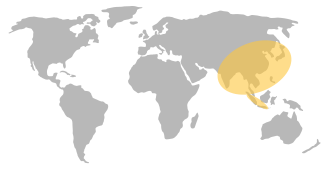


Large-Billed Crow

House Crow
Large-Billed Crow
Corvus macrorhynchos
Also known as: Thick-Billed Crow
General appearance
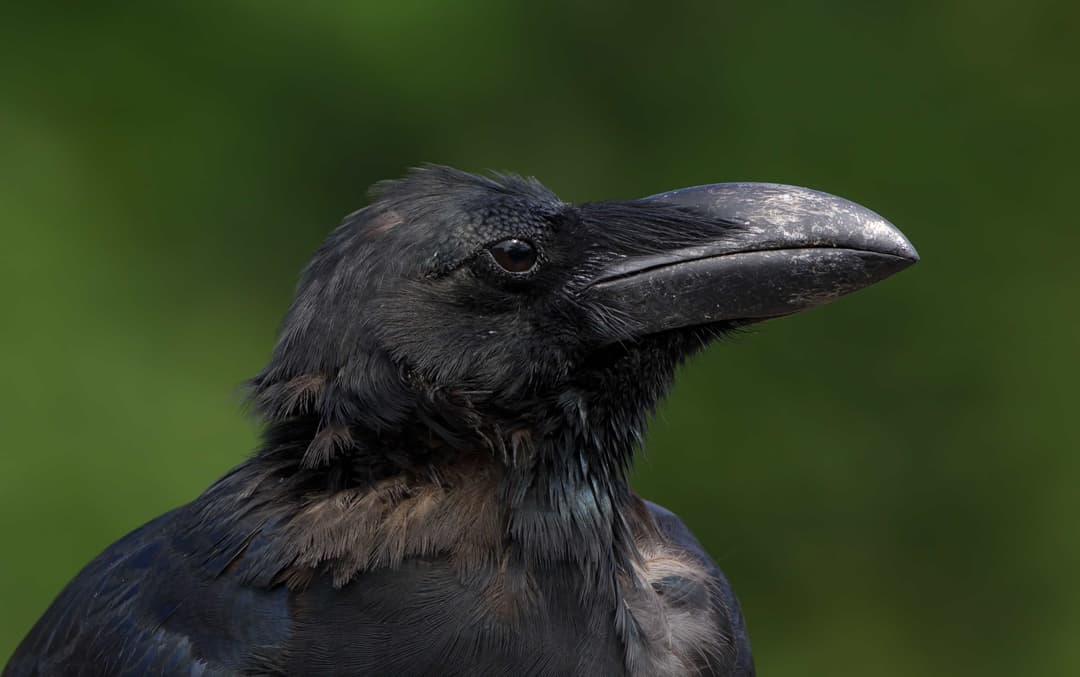
The large-billed crow, as the name suggests, is notable for its relatively large beak. These crows are generally black, even though a gray or silver sheen may appear over the feathers in bright sunlight. Their eyes are often a stark contrast in a striking shade of white or pale blue.
Male vs female
Sexual dimorphism is less prominent in large-billed crows, making it difficult to distinguish males from females based on physical appearance alone. Both genders share similar coloration and size, although males tend to be slightly larger.
Juvenile
Juvenile large-billed crows resemble adults but tend to have lighter-colored eyes, usually a duller blue or gray. Additionally, juveniles may be identified by the comparatively smaller size of their beaks, which gradually increase as they age.
Size
18.1 - 23.2 in/15.9 - 35.3 oz
There's more to learn about Large-Billed Crow
View full detailsHouse Crow
Corvus splendens
Also known as: Indian Crow, Graynecked Crow, Greynecked Crow, Ceylon Crow, Colombo Crow
General appearance
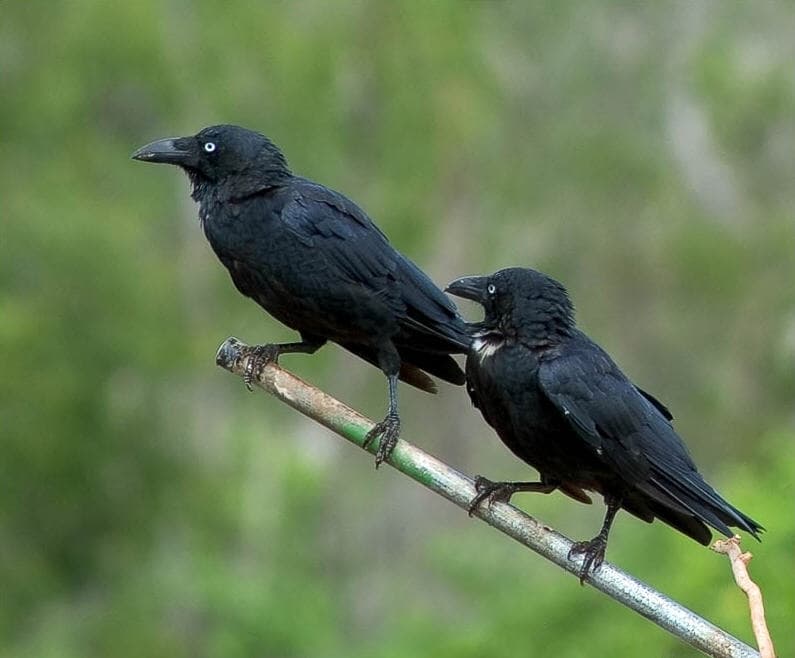
The house crow, also known as the Indian, greynecked, or Ceylon crow, has a glossy black color with a greyish neck and breast. It features a strong, stout bill and a tail longer than other crows. Dominatingly omnivorous, it has a versatile diet. It stands out with its distinctive cawing sound.
Male vs female
Males and females of the house crow species look identical with no significant difference in coloration or size, a trait known as sexual monomorphism. Both sexes have similar black and grey coloration. Still, males may be slightly larger and have a slightly thicker bill, which is not easily noticeable.
Juvenile
Juvenile house crows look much like the adults but have slightly duller coloration. Their feathers lack the glossy sheen seen in adults and they have a lighter-grey neck and breast. Juveniles also have brownish eyes, which darken with age, and their bills and legs are not as strongly black as in adults.
Size
15.7 - 16.9 in/8.6 - 13.1 oz
There's more to learn about House Crow
View full detailsHow to tell the Large-Billed Crow from the House Crow
Visual differences
The Large-Billed Crow is larger, weighing 1-2.2 lbs and measuring 18-23 inches, with glossy black plumage and a substantial beak. It may display a gray sheen in sunlight. Contrast this with the House Crow, which is lighter at 0.54-0.82 lbs and shorter at 16-17 inches. The House Crow is distinguished by its gray neck and breast, a stout bill, and a longer tail. Additionally, the Large-Billed Crow has striking pale blue or white eyes, while the House Crow has darker eyes.
Key differences and behavior
The Large-Billed Crow and House Crow exhibit notable behavioral differences. Large-Billed Crows are adaptable foragers, consuming a wide range of food including insects and small mammals, and are known for using tools, showcasing high intelligence. They prefer diverse habitats, from forests to urban areas, and engage in aerial courtship displays. House Crows, conversely, thrive primarily in human-altered environments like cities and agricultural zones. They are more social, forming large roosts and displaying brash, loud behavior. House Crows exhibit complex courtship with males presenting food to females. Both species build nests in tall trees and use urban materials but differ in foraging; Large-Billed Crows are opportunistic feeders while House Crows are more scavenger-like, frequenting urban areas for scraps. Large-Billed Crows are larger, weighing 16-35 oz and measuring 18-23 in, compared to the smaller House Crow at 8.6-13 oz and 16-17 in.
Still not sure? Here are more lookalikes!


Large-Billed Crow vs [Select a bird]

[Select a bird]
Pick a bird to compare
House Crow vs [Select a bird]

[Select a bird]
Pick a bird to compare