
Large-Billed Crow
Large-Billed Crow
Also known as: Thick-Billed Crow
Corvus macrorhynchos
Quick Identification guide
Quick Identification guide
- •
Features a large, robust beak, appearing thicker and more pronounced than other crows
- •
Exhibits glossy black plumage with a slight green or purplish sheen under bright light
- •
Possesses a strong, stout body build with a relatively long tail, creating a distinctive profile
Description
Did you know large-billed crows' scientific name is Ancient Greek for "large beak"? These big birds are known for their smarts, and have been documented using tools. They're the opposite of a picky eater: alive or dead, if it looks edible, it's getting eaten!
The large-billed crow can weigh between 450to1000grams and be from46to59centimeters tall.
The large-billed crow typically lives for up to 20 years. This is longer than the lifespan of other crow species, such as the American crow which lives for about 7-8 years in the wild. Compared to the common raven, another related species which can live up to 13 years in the wild, the large-billed crow demonstrates a relatively extended lifespan.
Did you know?
Most popular questions about large-billed crow
How to recognise a large-billed crow?
General appearance
The large-billed crow, as the name suggests, is notable for its relatively large beak. These crows are generally black, even though a gray or silver sheen may appear over the feathers in bright sunlight. Their eyes are often a stark contrast in a striking shade of white or pale blue.
Male vs female
Sexual dimorphism is less prominent in large-billed crows, making it difficult to distinguish males from females based on physical appearance alone. Both genders share similar coloration and size, although males tend to be slightly larger.
Juvenile
Juvenile large-billed crows resemble adults but tend to have lighter-colored eyes, usually a duller blue or gray. Additionally, juveniles may be identified by the comparatively smaller size of their beaks, which gradually increase as they age.
Often mistaken for
American Crow vs Large-Billed Crow
The American Crow is similar to the Large-Billed Crow but generally has a smaller bill and is slightly smaller in overall size. The voice and call of the American Crow are also distinguishable, with a more harsh 'caw' compared to the deeper call of the Large-Billed Crow.

Carrion Crow vs Large-Billed Crow
The Carrion Crow resembles the Large-Billed Crow but has a smaller bill and slightly different plumage that can be more uniformly black without the glossy sheen typical of the Large-Billed Crow. Regional distribution is also a key factor, as Carrion Crows are more common in Europe.

Torresian Crow vs Large-Billed Crow
The Torresian Crow can be distinguished from the Large-Billed Crow by its white eyes and slightly smaller size. The vocalizations are also different, with the Torresian Crow being more likely to produce a nasal call.
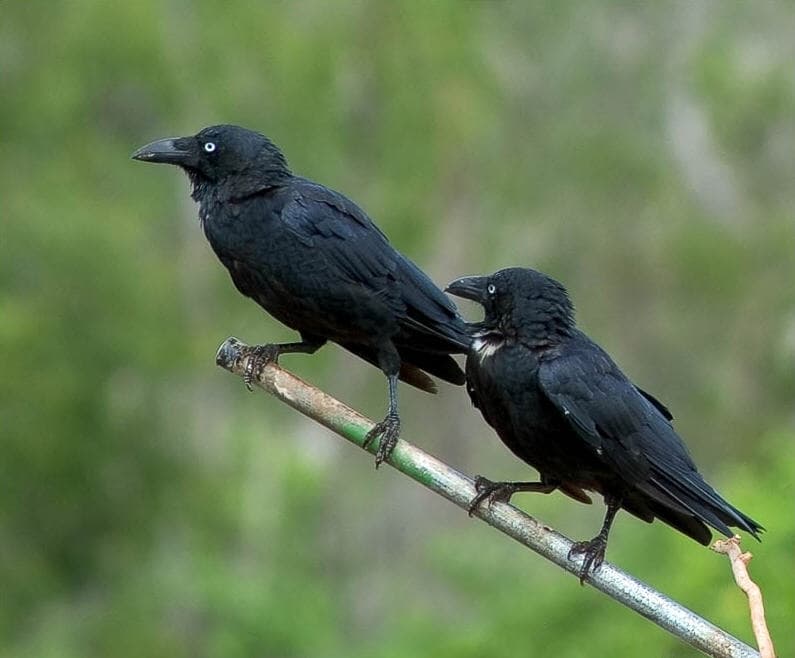
House Crow vs Large-Billed Crow
The House Crow is smaller than the Large-Billed Crow and can be identified by its grey neck and breast which contrast with its black head and wings. Their native range is also a helpful identifier as House Crows are more common in urban areas in South Asia.

Breeding and nesting habits of the large-billed crow
Mating behaviors
Large-billed crows perform complex courtship rituals involving vocal calls and aerial displays. These behaviors help to establish pair bonds and select suitable mates, ensuring a strong genetic lineage.
Nesting details
Nests are typically built high in trees, occasionally found in urban gardens. They use twigs, leaves, and sometimes human-made materials. To encourage nesting in gardens, consider planting tall trees and providing safe spaces away from predators.
Eggs and chick-rearing
The female lays 3-5 eggs, incubating them for about 17-19 days. Both parents partake in feeding the chicks, which fledge in approximately 35 days, during which they are taught foraging skills and survival tactics.
What does a large-billed crow like to eat?
Berries
Bird eggs
Carrion
Flowers
Fruits
Insects
Nectar
Seeds
Small animals
Natural diet
The large-billed crow is omnivorous, feeding on a diverse array of natural foods. Its diet primarily consists of insects, small mammals, fruits, grains, and carrion. It is also known to consume eggs and nestlings of other birds. It forages in a variety of habitats, including forests, fields, and urban areas, demonstrating great adaptability in its dietary habits.
Bird feeders
At bird feeders, the large-billed crow is attracted to a range of offerings. It commonly consumes seeds, nuts, and suet. These birds may also take advantage of kitchen scraps, such as bread and meat, provided at feeders. Their adaptable nature allows them to exploit various food sources found around human habitation.
Attracting large-billed crows with favorite snacks
Large-billed crows are omnivores, so they enjoy a myriad of foods. However, they particularly love nuts, seeds, and fruits. Try leaving Bird Buddy seeds (expert selected per season) on a tray or directly on your yard to entice these intelligent birds.
Choosing the right feeder
Large-billed crows prefer a feeding platform that they can land on firmly. Opt for a sturdy tray or platform feeder. Feel free to also use a bird table. These crows are curious and intelligent, they will quickly learn how to use a new feeder.
Fun tricks to encourage visits
Interacting with these birds can be a fun experience due to their intelligence. Use a specific call each time you leave food out. Over time, the crows may associate that sound with feeding time. You can also leave shiny objects as crows are known for their love of objects with a glint. Their curiosity might just make your yard their new favourite spot!
Best seeds to use
Employ Bird Buddy seeds for the best results. These seeds are chosen by experts for each season, making them ideal and nutritious for large-billed crows. This can aid in regularly attracting them to your yard or feeder.
Where can you find large-billed crows?

Primary habitat
The large-billed crow is native to South and Southeast Asia. It prefers tropical climates but can also adapt to various environments like forests, grasslands and human settlements.
Additional range
Sometimes this species extends its range north to the Russian Far East and Japan, likely due to increased availability of food resources.
Do they migrate?
The large-billed crow is generally non-migratory and tends to stay in one place throughout the year. This species, found across much of East and South Asia, including countries such as India, Japan, China, and Indonesia, prefers to inhabit diverse environments ranging from forests to urban areas. While most large-billed crows do not migrate, there can be some local movements depending on food availability and environmental conditions. These movements are typically short-range and do not constitute true migration. In areas where seasonal changes affect food abundance or habitat conditions, the crows may move within a region to find better foraging opportunities. Overall, the large-billed crow displays greater sedentary tendencies compared to other bird species that migrate seasonally over long distances. Its ability to adapt to various habitats, including urban settings, supports its year-round residency in its native range.
What is the role of large-billed crows in nature and how to protect them?
Conservation status
The large-billed crow is classified as "Least Concern" by the IUCN, indicating it is common and not currently at risk of extinction. This adaptable bird thrives in various habitats across Asia, including urban areas, which contributes to its stable population. However, localized threats exist, such as habitat destruction and persecution due to its association with crop damage. Key conservation efforts focus on habitat preservation and managing human-wildlife conflict. The bird's adaptability helps it withstand some environmental changes, but continued monitoring is essential to address potential future threats.
Ecological role of large-billed crows
Its role in the ecosystem
The large-billed crow or the jungle crow, often found in Asian countries, performs key roles in maintaining the ecological balance. Its dietary habits contribute significantly to pest control as it feeds on various invertebrates, including harmful insects, which could otherwise damage the vegetation and spread diseases. Furthermore, the crow plays a vital part in scavenging, preventing the accumulation and spread of disease from decaying matter. Another significant ecological role is seed dispersal. Through its diet of fruits and nuts, the jungle crow inadvertently disperses seeds through its droppings across wide areas, thereby aiding in vegetation growth and forest regeneration. Lastly, as a smart and adaptable bird, the large-billed crow functions as an indicator species, informing on environmental changes and ecosystem health. Its existence in an area can help us understand the ecological dynamics and maintain biodiversity.
How to help protect large-billed crows
Preservation tips
Habitat preservation strategies
Support large-billed crow conservation by protecting and creating suitable habitats. Avoid deforestation or construction in regions inhabited by these birds. Plant native tree species to attract populations. Engage with regulatory bodies to ensure their habitats are recognized and secured under local and national wildlife protection laws.
Community science initiatives
Get involved in community science projects. Participate and encourage others to join in bird species surveys, habitat assessments, and the monitoring of nesting sites. This data contributes to understanding their population trends and aids in implementing effective conservation strategies. Report sightings and encourage schools and community groups to develop educational programs about these species.