Hepatic Tanager or Summer Tanager?
Here's how to tell the difference

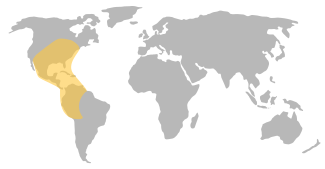
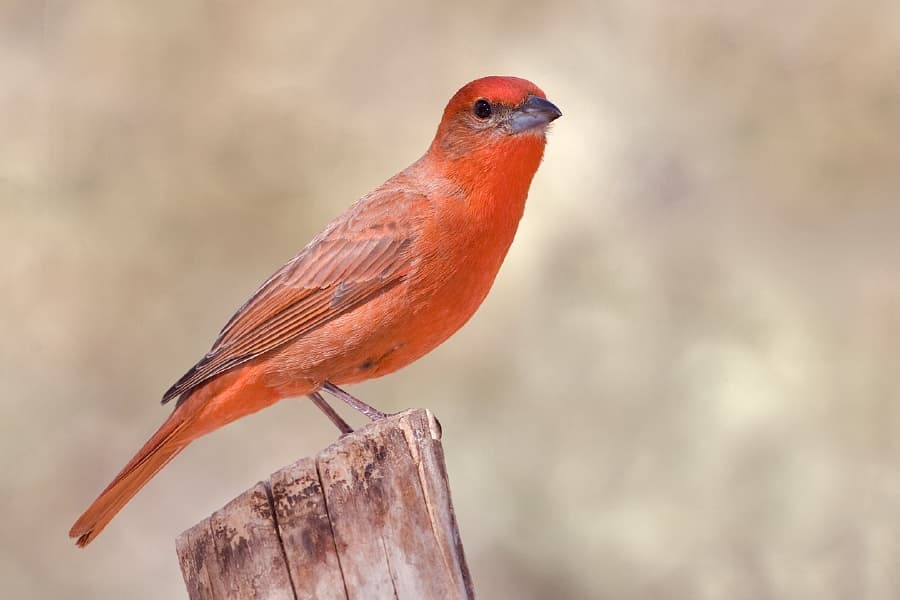
Hepatic Tanager



Summer Tanager
Hepatic Tanager
Piranga flava
General appearance
The hepatic tanager generally exhibits a size range of 7-8 inches (18-20 cm) with a distinctive brick-red, orange-red, or mustard-yellow coloration. They sport rounded wings, a tail that can be notched, rounded, or square-tipped, and usually a darker bill. The cheeks of the bird contrast with their predominant color and are typically gray. The bird is similar in size to a Robin or a Sparrow.
Male vs female
Sexual dimorphism is prevalent in the hepatic tanager. Males primarily boast a brick-red or orange-red plumage. In comparison, females predominantly flaunt a mustard-yellow coloration, providing an easy method for differentiating the two.
Juvenile
Young or juvenile hepatic tanagers share similar characteristics with adult females, chiefly the mustard-yellow coloration. This similarity aids in camouflage, offering protection to the young from predators until they reach adult size and coloration.
Size
3.9 - 7.9 in/0.8 - 1.7 oz
There's more to learn about Hepatic Tanager
View full detailsSummer Tanager
Piranga rubra
General appearance
The summer tanager is around 7-8 inches or 18-20 centimeters, similar to a robin or sparrow. Its body is colorful with black, green, red, and yellow hues. Its wings are rounded, and the tail showcases notched, rounded, or square-tipped characteristics. Furthermore, the summer tanager is notable for its large light-colored bill and non-patterned wings.
Male vs female
A prominent distinction exists between male and female summer tanagers. Adult males possess an exquisite rosy red color that remains consistent throughout the year, while females have a rich yellow coloration, which is less greenish compared to the female Scarlet tanager. The other distinctive trait of females is the paler and proportionately bigger bill.
Juvenile
Young males, or juvenile summer tanagers, exhibit a slightly different appearance than adults. They may appear patchy yellow and red rather than a uniform rosy red. These color variations can serve as a visual cue to differentiate between adults and juveniles in the wild.
Size
6.3 - 7.1 in/1.0 - 1.1 oz
There's more to learn about Summer Tanager
View full detailsHow to tell the Hepatic Tanager from the Summer Tanager
Visual differences
The Hepatic Tanager typically exhibits a darker, brick-red to orange-red plumage in males, with a darker bill, while Summer Tanagers are uniformly rosy-red with a lighter bill. Female Hepatic Tanagers are mustard-yellow, contrasting with the richer yellow of female Summer Tanagers. Juvenile Summer Tanagers can be patchy yellow and red. Hepatic Tanagers have gray cheeks contrasting with their body color, unlike the uniform coloration of Summer Tanagers. Both species are similar in size, around 7-8 inches, but Summer Tanagers have a slightly larger and paler bill.
Key differences and behavior
Hepatic and Summer Tanagers exhibit distinct behavioral and habitat differences. Hepatic Tanagers prefer open mountain forests with oaks and pines, while Summer Tanagers breed in dry open woods and winter in tropical lowlands. Both tanager species engage in courtship with males displaying vibrant plumage, with the Hepatic Tanager also utilizing flutter flights. In terms of diet, Hepatics mainly consume insects like caterpillars and beetles, whereas Summers target bees and wasps through aerial capture and branch beating. While both birds eat berries, Summer Tanagers are more likely to visit bird feeders offering insect-based foods. Nesting heights differ, with Hepatics choosing 5-50 feet in trees like oaks or pines, while Summers opt for 10-30 feet on horizontal branches.
Still not sure? Here are more lookalikes!
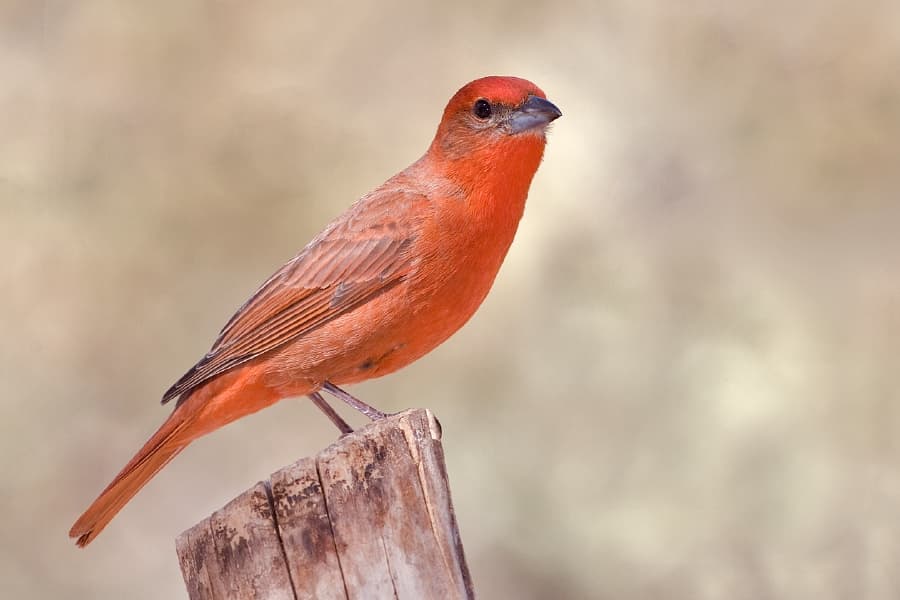
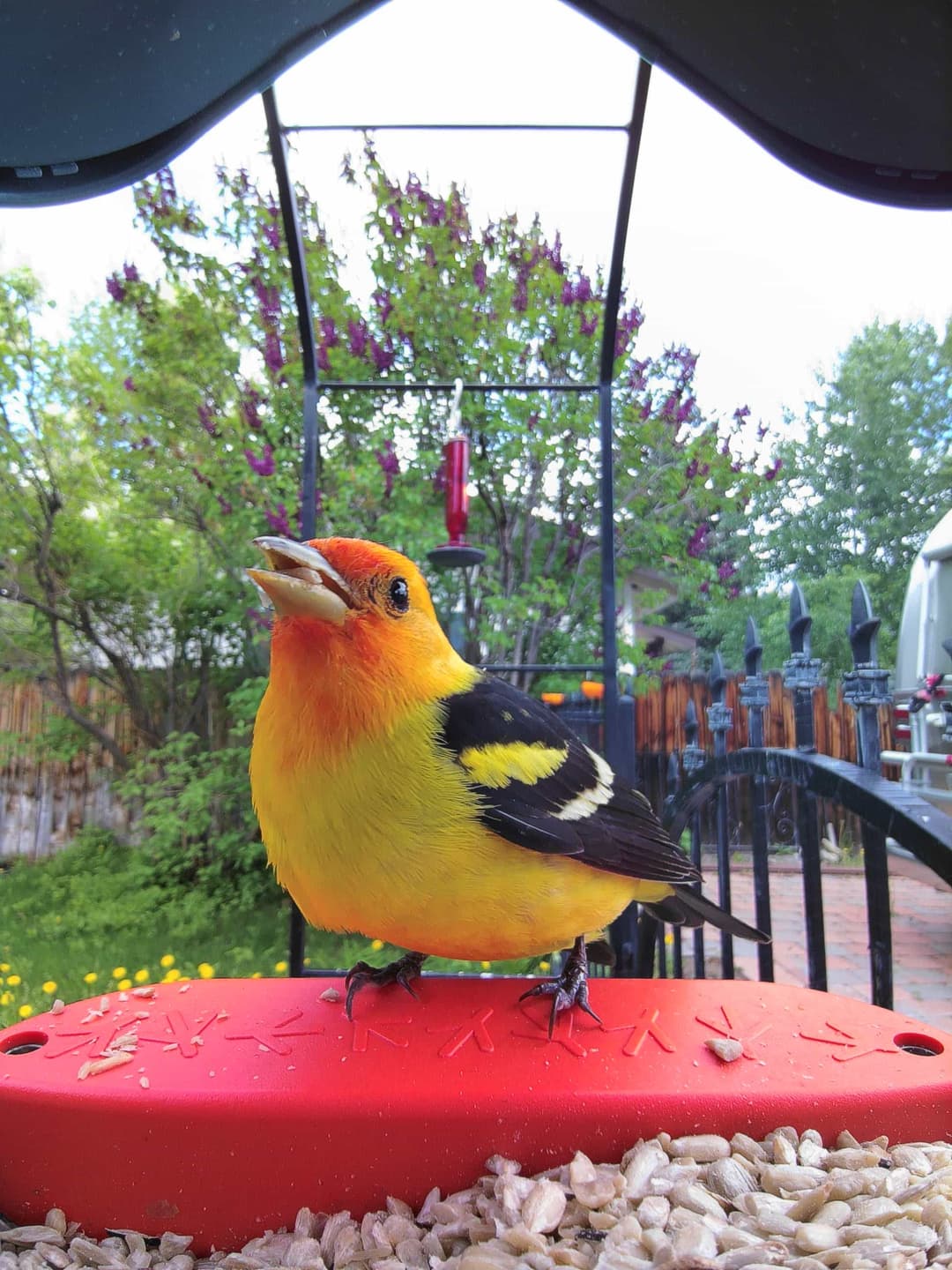
Hepatic Tanager vs Northern Cardinal



Summer Tanager vs Northern Cardinal
Hepatic Tanager vs [Select a bird]

[Select a bird]
Pick a bird to compare
Summer Tanager vs [Select a bird]
[Select a bird]
Pick a bird to compare