Crow or Rook?
Here's how to tell the difference
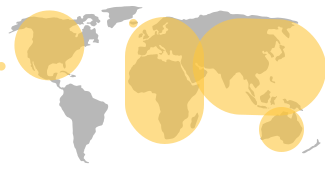


Crow


Rook
Crow
Corvus
General appearance
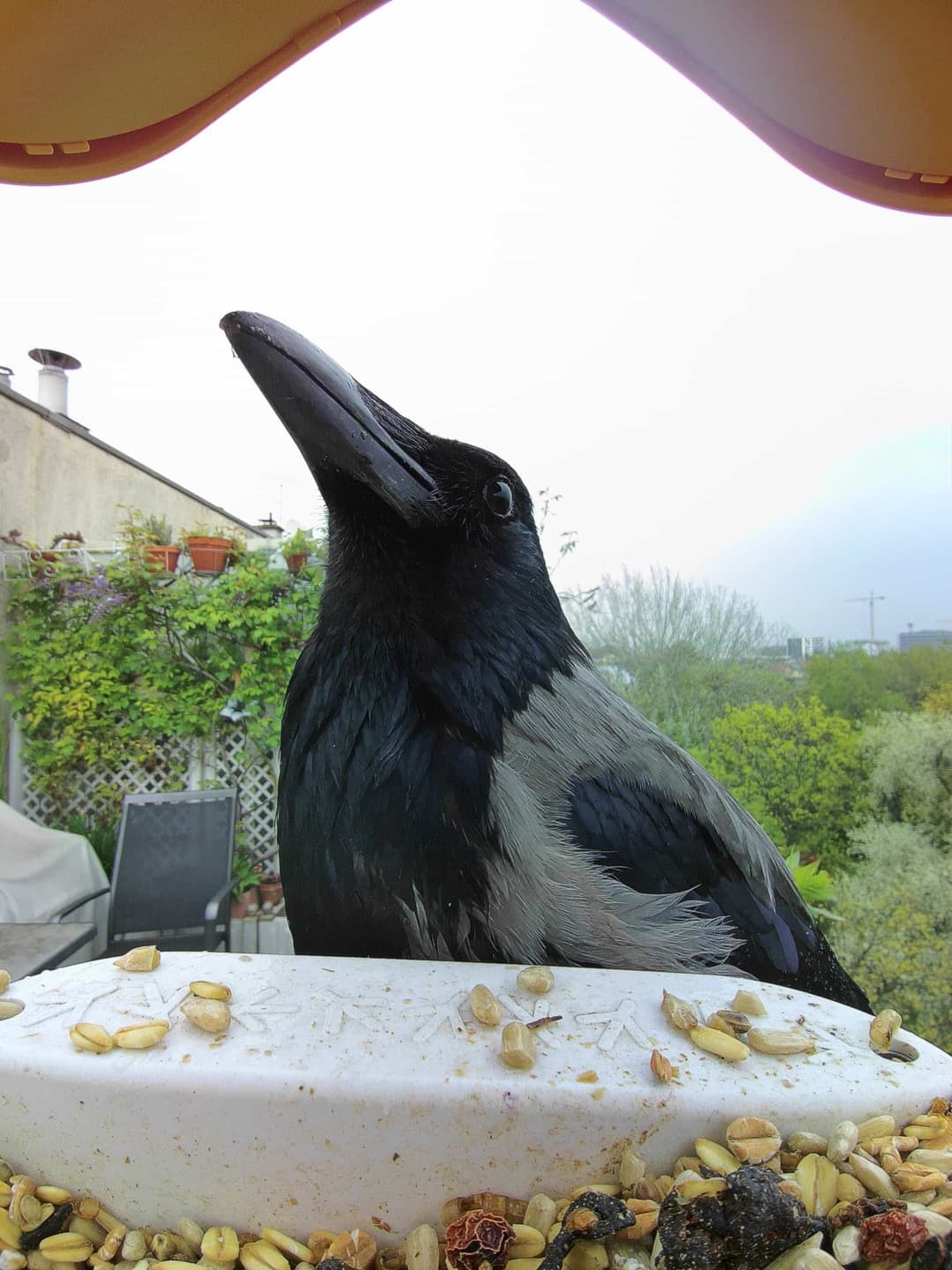
Crows are easily identifiable by their entirely black hue, from beak to tail. They're a medium to large bird, with a strong stout build, and distinctive fan-shaped tail. Their feathered bodies often have a purple or blue iridescent gloss in sunlight.
Male vs female
Sexual dimorphism, which is the physical differences between males and females of the same species, is not noticeable in crows. Both genders share the same black colouration and similar size. Identification of sex can only be definitively determined through DNA testing or observation of parental behavior.
Juvenile
Juvenile crows still maintain the characteristic all-black plumage. However, their eyes are initially blue before turning brown and finally black as they mature. Their feathers often appear scruffy compared to the glossy coat of adults, and the tail is shorter and less fan-shaped.
Size
13.4 - 27.2 in/8.1 - 57.3 oz
There's more to learn about Crow
View full detailsRook
Corvus frugilegus
General appearance
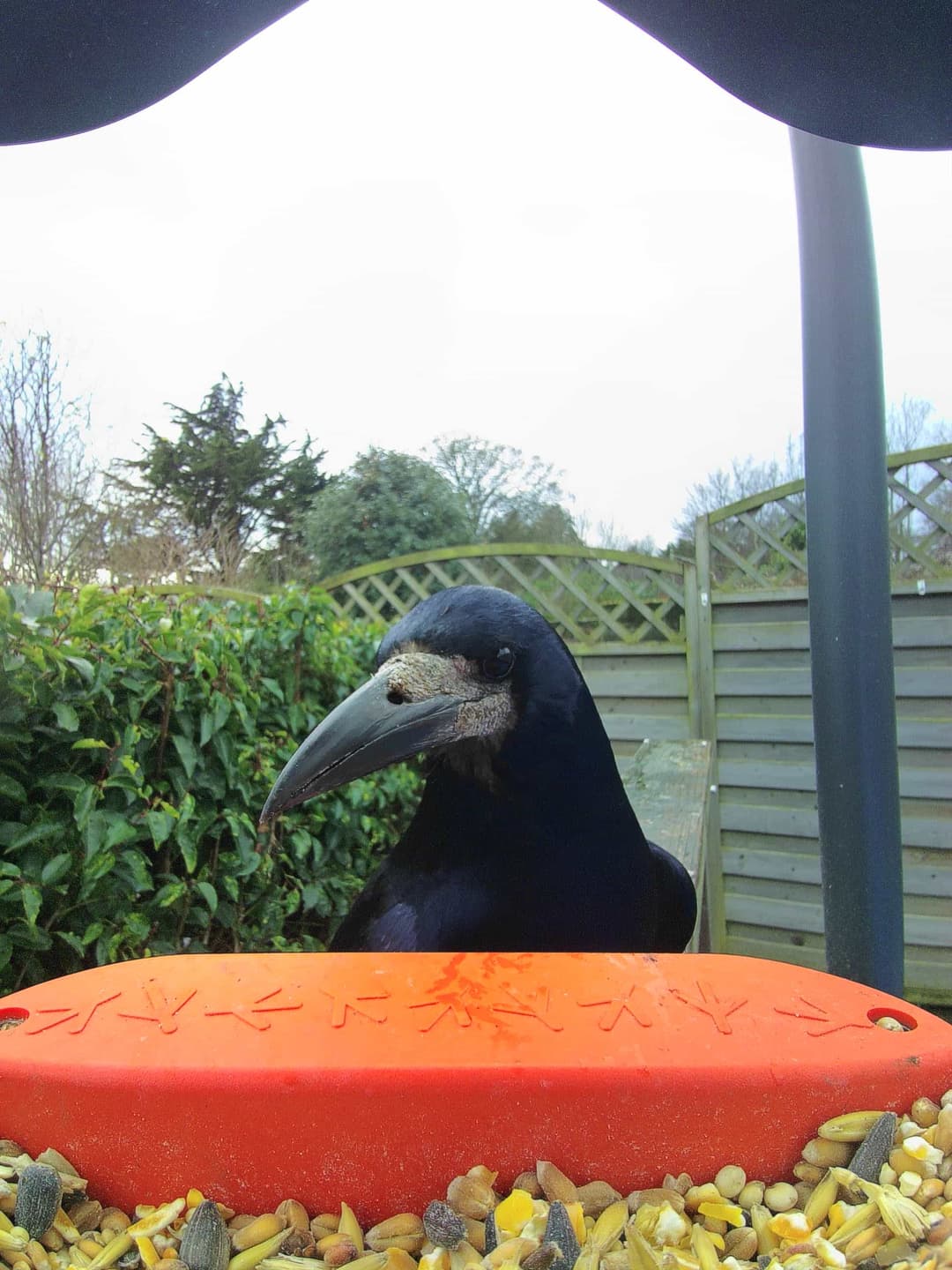
Rooks are generally about 45-47 cm in length, with dark feathery coloration, often appearing black with a purple or blue sheen in sunlight. They exhibit a prominent bare area around the base of their beak and on their face, which is grey-white in color. The bird also has uniquely fringed thigh feathers, long pointed wings, and a wedge-shaped tail.
Male vs female
Sexual dimorphism is not significant in rooks, making it difficult to distinguish males from females by appearance alone. Both genders share the same coloration and size. Behavioral observations during the breeding season may provide clues, as males tend to display more assertive posturing and are known to engage in aerial shows of acrobatics to attract mates.
Juvenile
Juveniles are similar in size to adults, but they can be distinguished by their fully feathered faces. This feature differentiates them from mature rooks, who have developed the distinctive bare patch. Juveniles may also exhibit lighter, more brownish feather coloration, transitioning to the adult's glossier black as they mature.
Size
17.3 - 18.1 in/11.5 - 20.1 oz
There's more to learn about Rook
View full detailsHow to tell the Crow from the Rook
Visual differences
Crows and rooks are both black with a purple or blue sheen, but crows are larger (13-27 inches) compared to rooks (17-18 inches). Crows have a fan-shaped tail and fully feathered faces, while rooks have a wedge-shaped tail and a distinctive bare, grey-white patch around their beak. Rooks also display fringed thigh feathers and pointed wings. Juvenile rooks, unlike mature rooks, have fully feathered faces.
Key differences and behavior
Crows and rooks, both intelligent and adaptable, exhibit distinct behaviors and habitats. Crows are social and playful, often seen playing and problem-solving. They thrive in diverse environments, from urban areas to woodlands worldwide, and are particularly resourceful in finding food, including scavenging human refuse. In contrast, rooks are also social but form large colonies known as rookeries for nesting, primarily in rural and suburban areas across Europe, western Asia, and northern Africa. While both species are omnivorous, crows have a more varied diet that includes scavenging, whereas rooks primarily probe the ground for insects and grains. During mating, crows display courtship through mutual preening, while rooks engage in aerial acrobatics. Crows participate equally in chick-rearing, while rook males may show more assertive behavior during the breeding season. Despite visual similarities, these behavioral traits help distinguish them in the field.
Still not sure? Here are more lookalikes!




Crow vs [Select a bird]

[Select a bird]
Pick a bird to compare
Rook vs [Select a bird]
[Select a bird]
Pick a bird to compare