Francolin or Gray Francolin?
Here's how to tell the difference
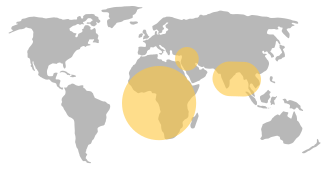

Francolin


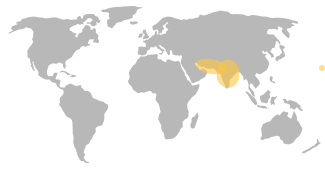
Gray Francolin
Francolin
Pternistis, Scleroptila, Francolinus
General appearance
Francolins are known for their plump bodies, short tails, and strong, short legs. Adult birds often have a distinctive pattern of dark brown, black, and white feathers on the body, with a darker or more solid color on the head. They also have a hooked beak perfect for their omnivorous diet.
Male vs female
Male francolins are usually slightly larger and more brightly colored than females. In addition, males usually have spur on their legs which females lack. Also, their faces could have bolder patterns and may bear more red or orange around the neck compared to females.
Juvenile
Juvenile francolins tend to have a more muted coloration than adults, often appearing a dull brown. Their body feathers may exhibit less contrast and pattern in the plumage, and their beak and legs might not have developed fully. Also, young birds lack the leg spurs seen in adults, particularly the males.
Size
9.8 - 16.9 in/7.4 - 56.1 oz
There's more to learn about Francolin
View full detailsGray Francolin
Ortygornis pondicerianus
Also known as: Gray Partridge
General appearance
The gray francolin, also called the 'teetar,' has a medium-sized body with a rounded form. Its plumage is predominantly gray-brown and features fine barring in shades of buff. Fine dark streaks cover the neck and head, and a distinctive pale eye stripe enhances its features. The bird's underparts are whitish with a hint of buff, and the wings showcase a complex pattern of brown and white.
Male vs female
Males and females are similar in appearance, though males are slightly larger. Both sexes have the characteristic barred plumage, but males have added features like spurs on their legs. These spurs, more pronounced as the bird ages, are a key identifier. Females typically have subtler patterns and lack spurs, making them appear more delicate.
Juvenile
Juvenile gray francolins exhibit more muted coloration than adults, with a generally browner hue and less distinct barring. Their plumage lacks the well-defined patterns seen in mature birds, and they do not have spurs. Young francolins gradually develop adult characteristics as they mature, making them distinguishable from adults by their less refined markings.
Size
11.8 - 13.8 in/7.1 - 14.7 oz
There's more to learn about Gray Francolin
View full detailsHow to tell the Francolin from the Gray Francolin
Visual differences
Francolins (Pternistis, Scleroptila, Francolinus) are larger (10-17 inches, 0.5-3.5 lbs) with plump bodies, varied dark brown, black, and white plumage, and hooked beaks. Males often exhibit more vibrant colors and leg spurs. Gray Francolins (Ortygornis pondicerianus) are smaller (12-14 inches, 0.4-0.9 lbs), medium-sized with gray-brown barred feathers, subtle dark streaks on the neck and head, and a pale eye stripe. Both sexes look similar, but males have leg spurs. Gray Francolin plumage is more uniform and subdued compared to the more distinct and varied patterning in Francolins.
Key differences and behavior
Francolins (Pternistis, Scleroptila, Francolinus) and Gray Francolins (Ortygornis pondicerianus) differ behaviorally and ecologically. Francolins are more adaptable to human presence and diverse habitats, from semi-urban areas to grasslands, whereas Gray Francolins prefer farmland and bushy areas. Both species are ground-dwellers but Francolins favor a varied omnivorous diet including seeds and insects, while Gray Francolins consume more seeds, grains, and insects seasonally. Gray Francolins are known for their speed on land and loud territorial calls, while Francolins may share nests and run instead of flying when startled. In breeding, Gray Francolins form monogamous bonds and mostly the female incubates eggs, while Francolins often share incubation duties. Both species prefer concealed ground nesting, but Francolins also adapt to gardens.
Still not sure? Here are more lookalikes!


Francolin vs [Select a bird]


[Select a bird]
Pick a bird to compare
Gray Francolin vs [Select a bird]
[Select a bird]
Pick a bird to compare