Gray Francolin or California Quail?
Here's how to tell the difference
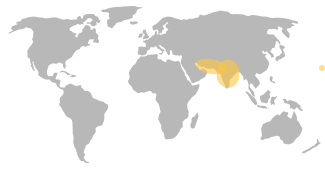



Gray Francolin
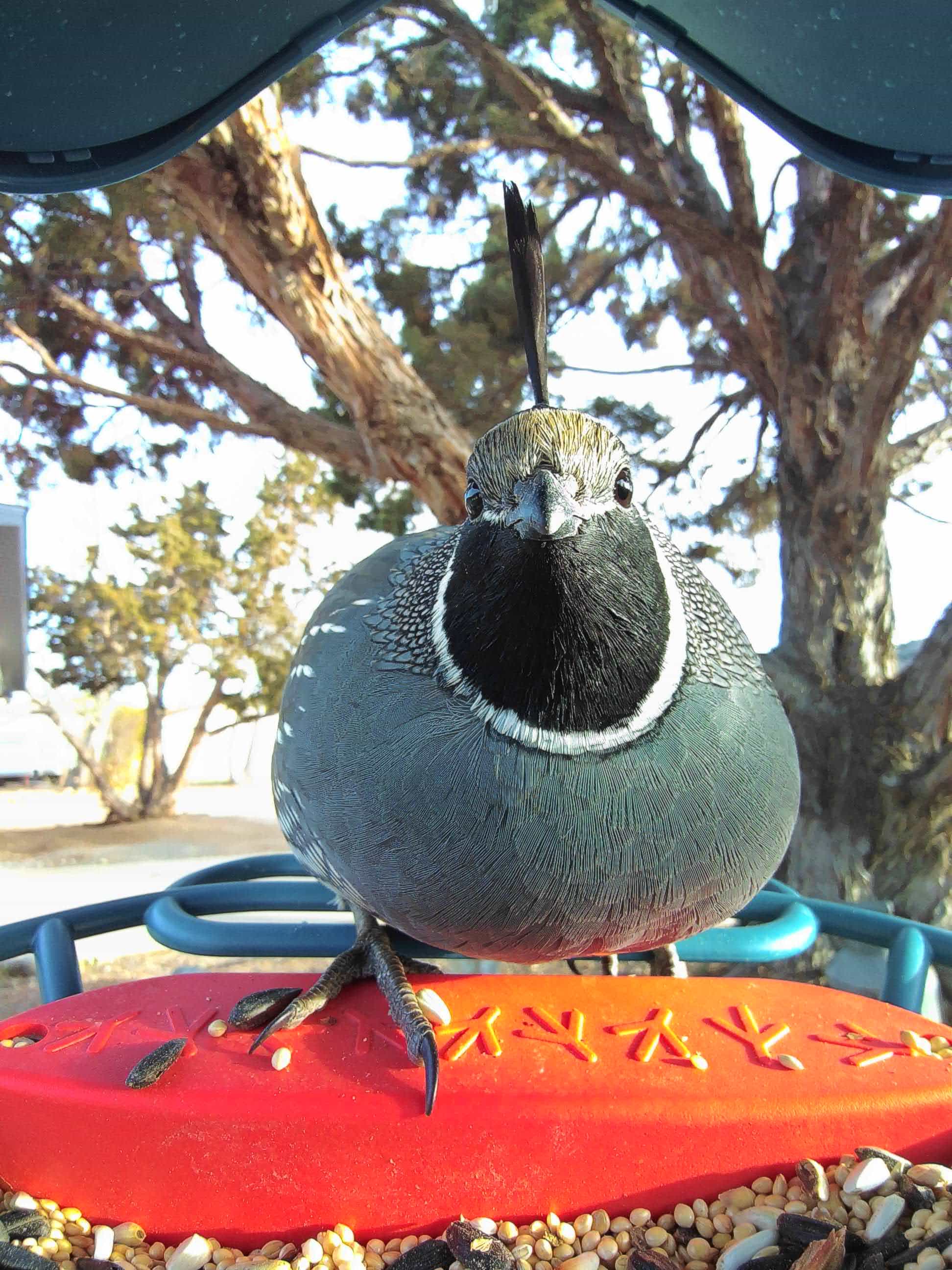


California Quail
Gray Francolin
Ortygornis pondicerianus
Also known as: Gray Partridge
General appearance
The gray francolin, also called the 'teetar,' has a medium-sized body with a rounded form. Its plumage is predominantly gray-brown and features fine barring in shades of buff. Fine dark streaks cover the neck and head, and a distinctive pale eye stripe enhances its features. The bird's underparts are whitish with a hint of buff, and the wings showcase a complex pattern of brown and white.
Male vs female
Males and females are similar in appearance, though males are slightly larger. Both sexes have the characteristic barred plumage, but males have added features like spurs on their legs. These spurs, more pronounced as the bird ages, are a key identifier. Females typically have subtler patterns and lack spurs, making them appear more delicate.
Juvenile
Juvenile gray francolins exhibit more muted coloration than adults, with a generally browner hue and less distinct barring. Their plumage lacks the well-defined patterns seen in mature birds, and they do not have spurs. Young francolins gradually develop adult characteristics as they mature, making them distinguishable from adults by their less refined markings.
Size
11.8 - 13.8 in/7.1 - 14.7 oz
There's more to learn about Gray Francolin
View full detailsCalifornia Quail
Callipepla californica
Also known as: California Valley Quail, Valley Quail
General appearance
The California quail is a small, plump bird with a short neck and a distinctive forward-curving black plume on top of its head. Its body is gray-brown with a scaled pattern on the belly, and the flanks are marked with white and chestnut streaks. The bird has a short, square tail and a stout bill. Its stocky build and unique topknot make it easily recognizable in its habitat.
Male vs female
Male California quails have bold, black and white facial markings with a black throat and a bright brown crown, which contrasts with their blue-gray body. They also possess a more prominent crest. Females have a more subdued coloration with brown tones, a smaller, darker crest, and generally lack the male's black throat and bold facial markings.
Juvenile
Juvenile California quails have a mottled appearance with a predominantly brown body and faint streaks. They lack the distinctive crest seen in adults and have more subtle facial patterns. As they mature, their plumage becomes more defined and the crest develops. Juveniles also exhibit a more uniform color, which gradually differentiates into the adults' distinct markings.
Size
9.4 - 10.6 in/4.9 - 8.1 oz
There's more to learn about California Quail
View full detailsHow to tell the Gray Francolin from the California Quail
Visual differences
The Gray Francolin measures 12-14 inches long and weighs 7-15 ounces, with a rounded gray-brown body featuring fine buff barring and dark streaks. It has a pale eye stripe but no crest. The California Quail, smaller and lighter at 9.5-10.5 inches and 5-8 ounces, has a gray-brown body with a scaled belly pattern and a distinctive forward-curving black plume on its head. Males have black and white facial markings, unlike the francolin's subtle head patterning.
Key differences and behavior
The Gray Francolin and California Quail exhibit distinct behavioral and ecological differences. Gray Francolins are agile runners, using loud calls to attract mates and deter rivals, while California Quails travel in communal "coveys" and engage in cooperative brooding, enhancing chick survival. Gray Francolins prefer open fields and farmlands, especially in agricultural areas, whereas California Quails thrive in diverse habitats, including woodlands and suburban zones. For food, both birds consume seeds, but the California Quail also favors acorns and is more inclined to visit bird feeders. In breeding, Gray Francolins form monogamous pairs, with concealed ground nests, while California Quails nest in depressions, with larger clutch sizes and communal chick care. Overall, Gray Francolins are more territorial and engage in elaborate courtship, contrasting with the social and cooperative nature of California Quails.
Still not sure? Here are more lookalikes!


Gray Francolin vs [Select a bird]

[Select a bird]
Pick a bird to compare
California Quail vs [Select a bird]
[Select a bird]
Pick a bird to compare