
Blue Jay
Blue Jay
Cyanocitta cristata


Quick Identification guide
Quick Identification guide
- •
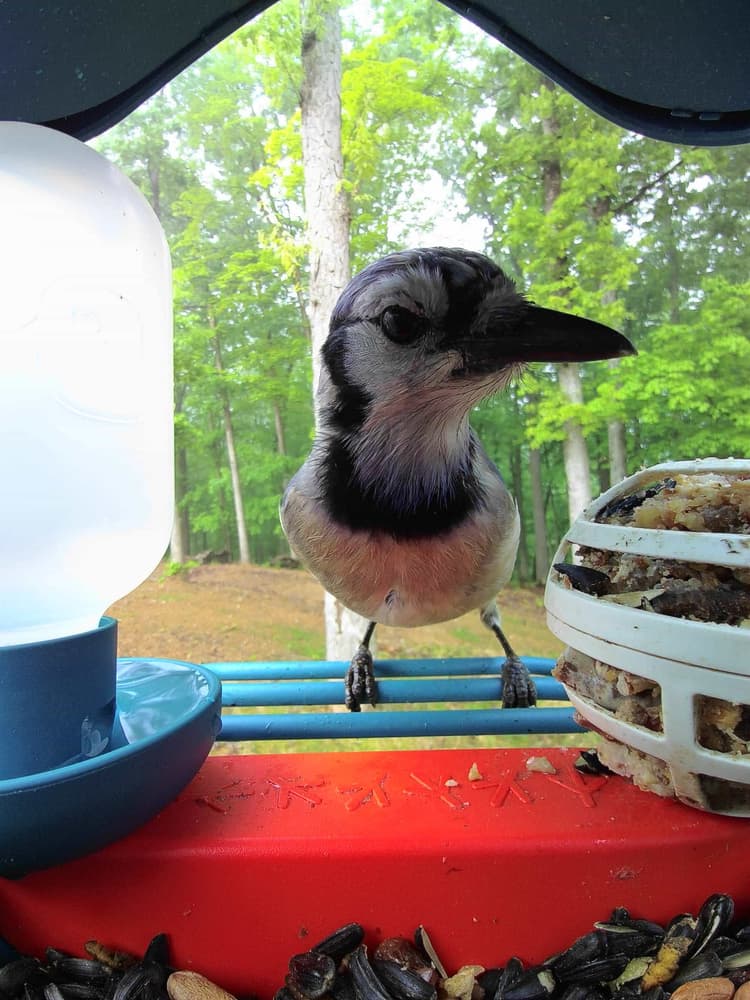
Exhibits vivid blue upperparts with white face and underparts, accentuated by a prominent black necklace
- •
Features a sturdy, black beak that is sharply pointed and slightly curved at the tip
- •
Recognizable by its crested head, stocky build, and a long tail with white edges
What does a blue jay sound like?
The vocalizations of the blue jay are varied and rich, including a cacophonous jay-jay, harsh cries, and a host of other calls. Remarkably, one such call is nearly identical to the scream of the Red-shouldered Hawk and the Broad-winged Hawk. Other characteristic sounds include a melodious queedle-queedle. Its call patterns descend in pitch and can be categorized as flat. The types of sounds blue jays emit include chirps, rattles, raucous screams, and whistles.


Description
These birds are very smart and do something known as anting. Before eating ants, they first rub them on their feathers. This removes the ants' formic acid while preserving all their nutrients, undoubtedly making for a tastier snack. They love, love, love acorns and played a big role in helping spread oak trees after the last glacial period.
The blue jay can weigh between 70to100grams and be from25to30centimeters tall.
The average lifespan of a blue jay is 7 years, although the eldest recorded lived to be 26. This lifespan is quite long compared to other North American songbirds, but similar to fellow corvids - the American crow may live up to 14 years, while the common raven can reach 20 years. Factors affecting blue jay lifespan include predation, disease, environmental stressors, and human interference.
Did you know?
Most popular questions about blue jay
How to recognise a blue jay?
General appearance
Blue Jays have a distinctive appearance with a size similar to a crow. Their dull blue-gray back contrasts with their bright blue wings and tail. They have a prominent crest, a black necklace and white patterns on their wing-bars and tail corners. The bird's wings are broad, fingered and rounded, possessing a long, rounded and wedge-shaped tail.
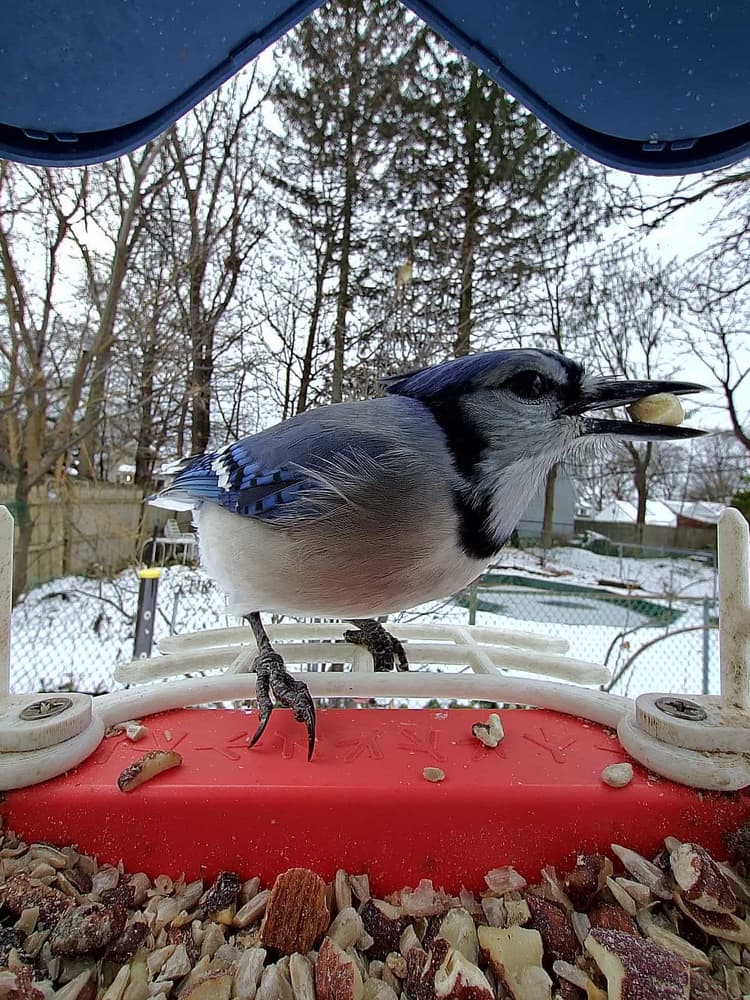
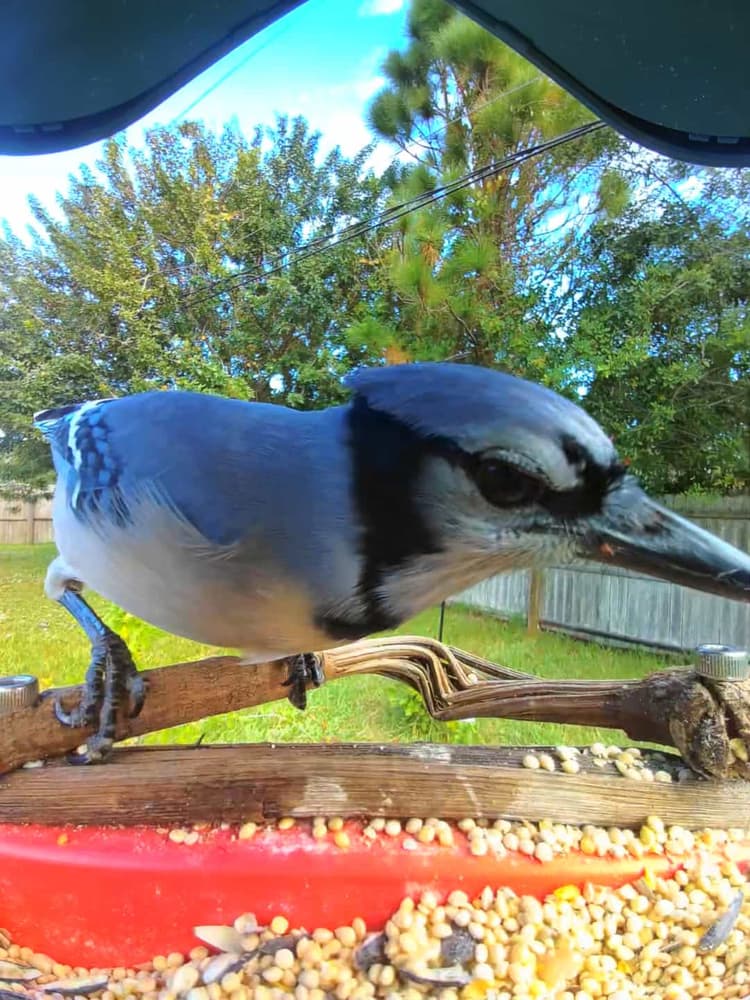
Male vs female
Interestingly, there is little to no difference in the physical appearance between male and female Blue Jays. Both sexes exhibit the same coloration and patterns. Any differences are minimal and often indistinguishable to the untrained eye.
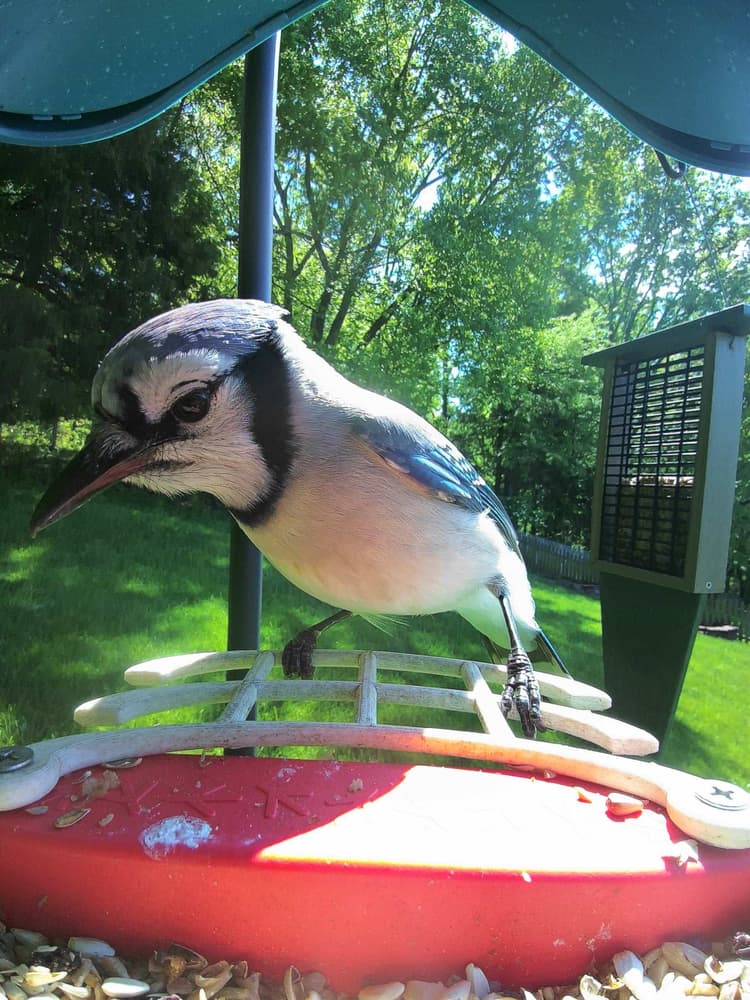
Male Blue Jay
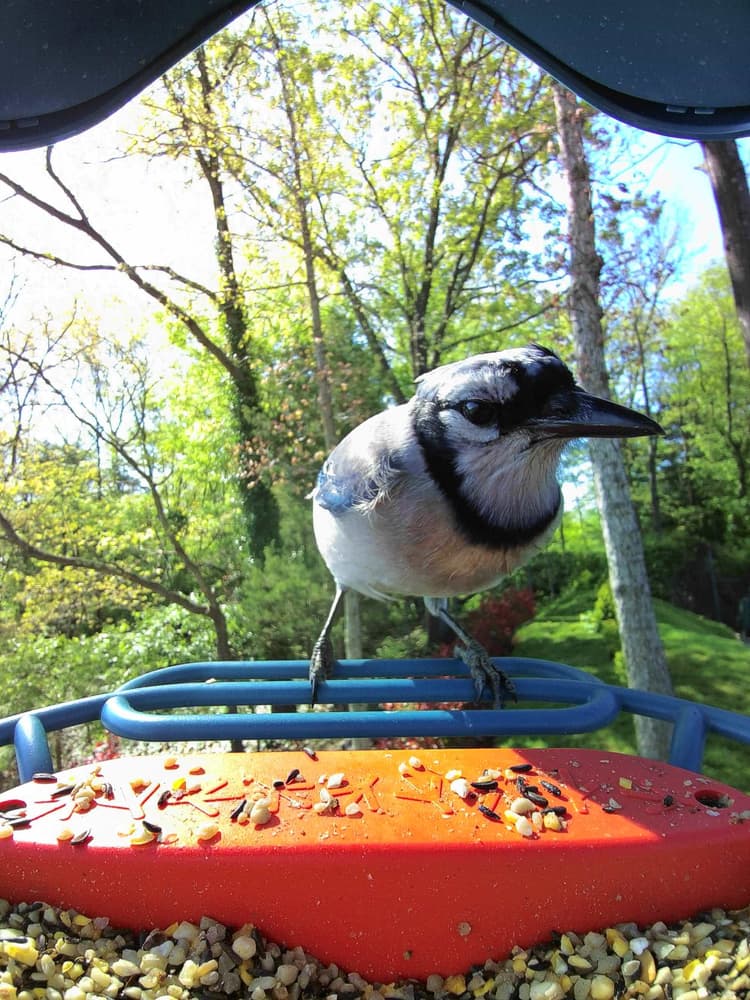
Female Blue Jay
Juvenile
Juvenile Blue Jays are similar in appearance to adults but may be slightly duller in color. They also lack the full crest of adult birds until they mature. Still, their inherent blue hue combined with gray, black and white patterns provides a good marker for identification.
Often mistaken for
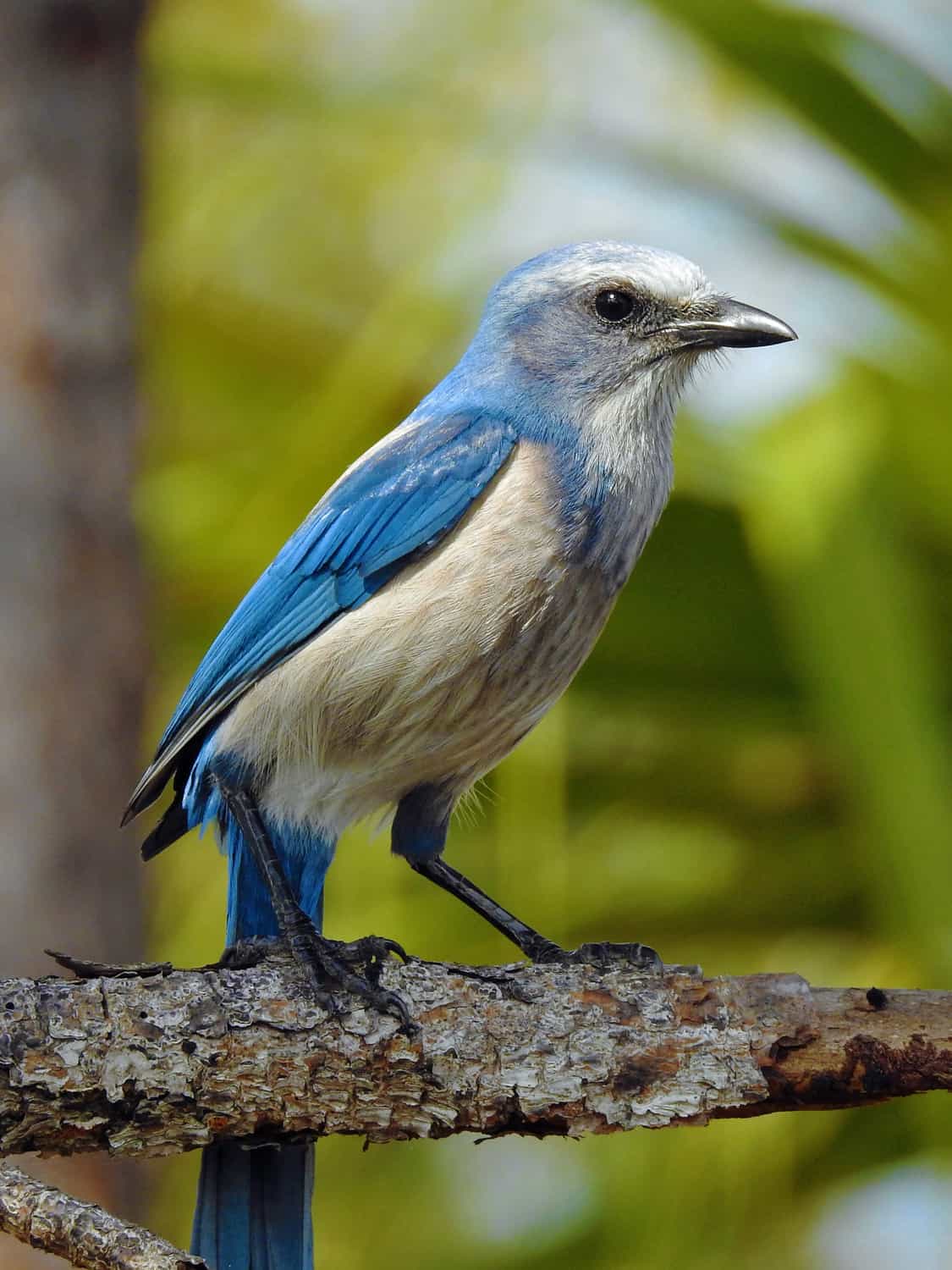
Florida Scrub-Jay vs Blue Jay
Blue Jays are larger, with more vibrant blue and white plumage on their wings and tail. Florida Scrub-Jays lack the Blue Jay's characteristic crest and have more of a grayish body. Look for the Blue Jay's black necklace, absent in Scrub-Jays.
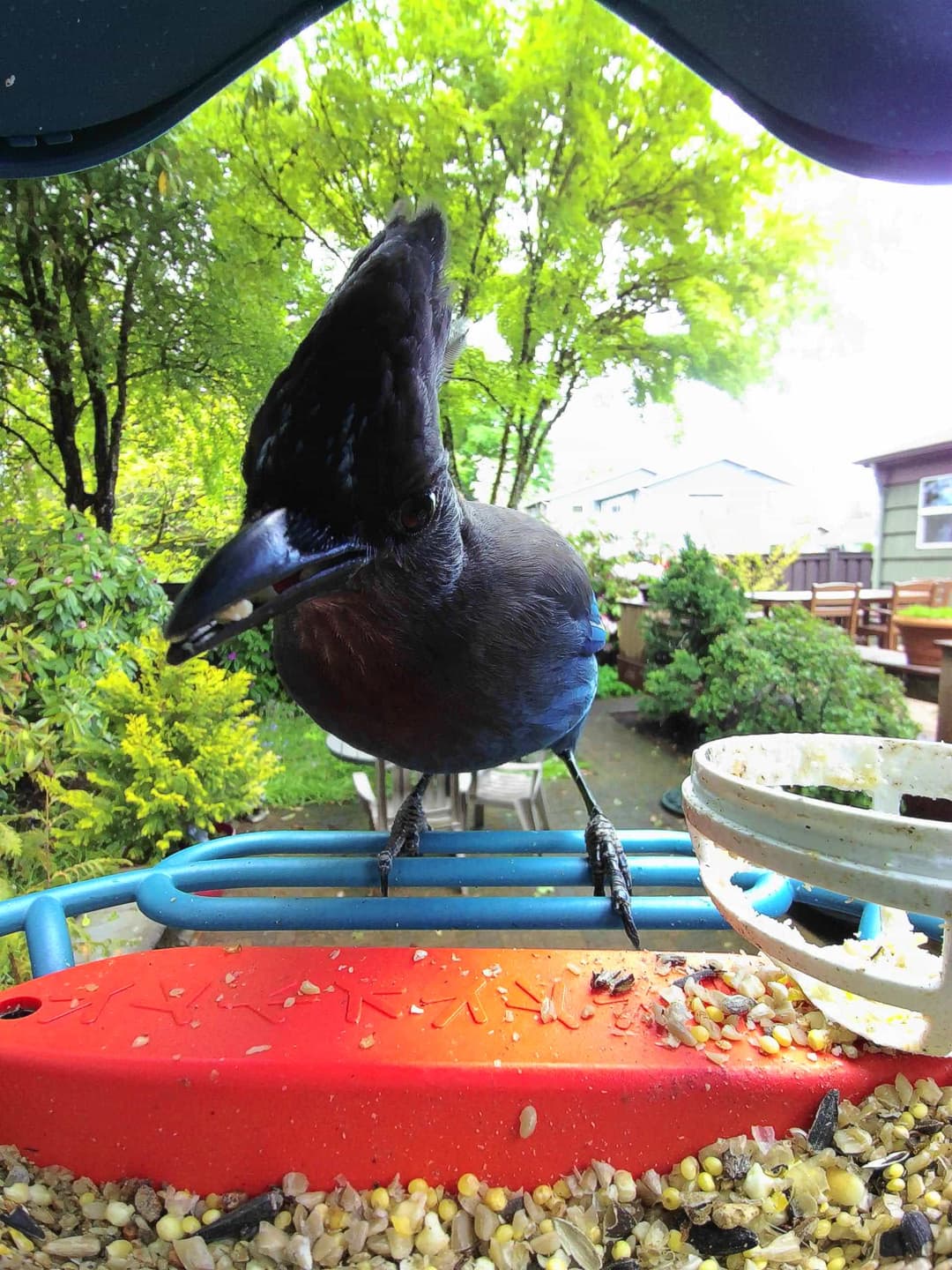
Steller’s Jay vs Blue Jay
Steller’s Jays have a darker, more sooty overall appearance, with a distinct blue crown. Blue Jays are lighter blue with a prominent white chest and face patches. Steller’s Jays reside in western forests, while Blue Jays are eastern birds.
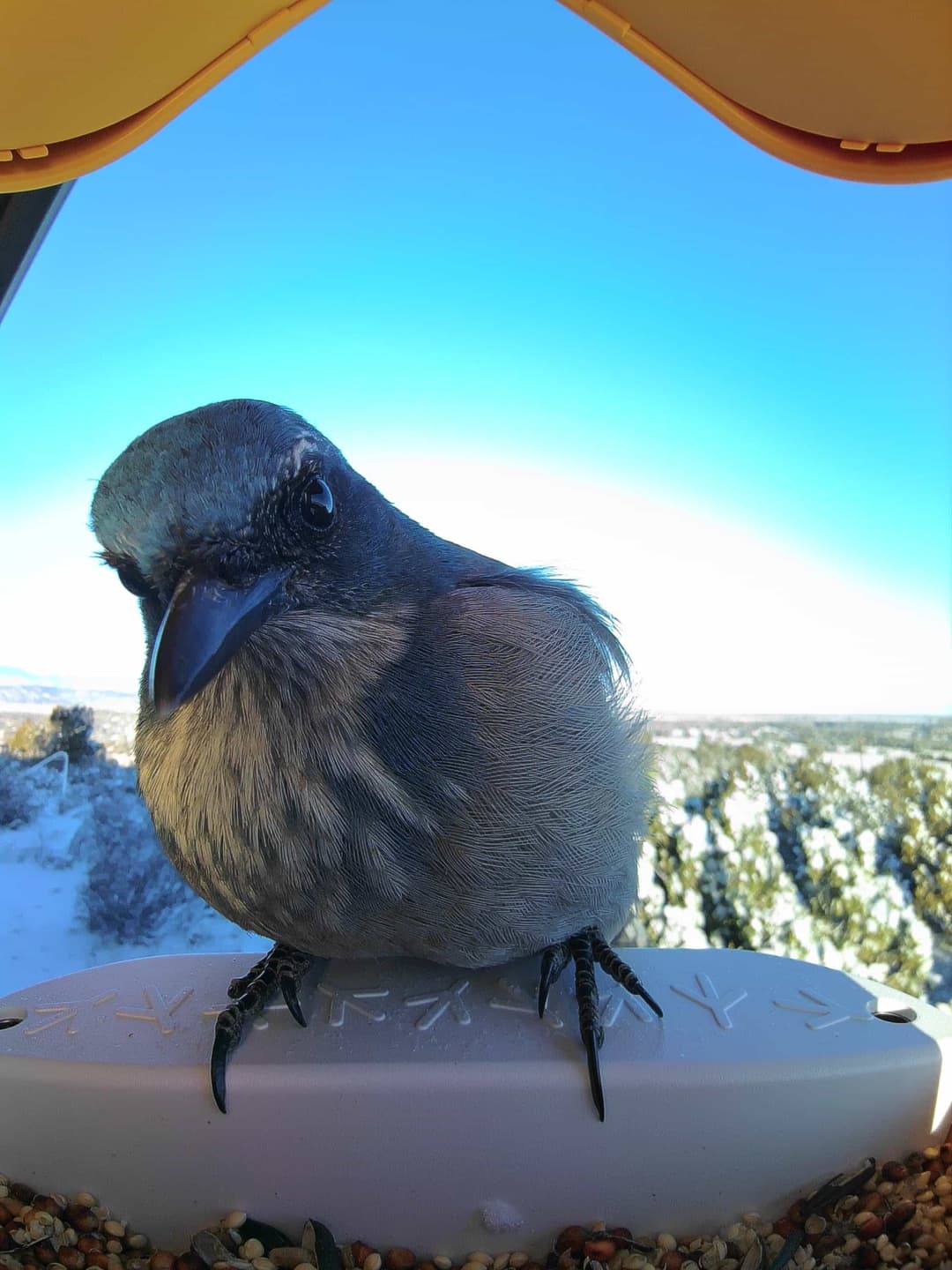
Woodhouse’s Scrub-Jay vs Blue Jay
Blue Jays display more vibrant blues and white, whereas Woodhouse’s Scrub-Jays exhibit duller blues with a more earth-toned body. The distinct crest and intricate wing patterns of Blue Jays set them apart.
California Scrub-Jay vs Blue Jay
California Scrub-Jays have muted colors, lacking the Blue Jay’s distinct black necklace and vibrant wing pattern. Blue Jays possess a prominent crest and a unique mix of sky-blue and white, which is absent in the Scrub-Jay.

Breeding and nesting habits of the blue jay
Mating behaviors
During courtship, Blue Jays may engage in aerial chases, and the male might feed the female to strengthen their pair bond.
Nesting details
Nests are bulky open cups made from twigs, grass, weeds, bark, and moss, sometimes held with mud. They are lined with rootlets and fine materials, often adorned with paper, rags, or string. Nests are typically located in coniferous or deciduous trees, 8-30 feet above ground in a vertical crotch of the trunk or horizontal fork of a limb.
Eggs and chick-rearing
Blue Jays become quiet and inconspicuous around their nests but defend them with loud calls if threatened. Specific details on egg-laying and chick-rearing practices are not provided, though it can be inferred that both sexes participate in nest building.
What does a blue jay like to eat?
Bird eggs
Carrion
Fruits
Insects
Nuts
Scraps
Seeds
Small animals
Spiders
Natural diet
The blue jay is omnivorous, primarily consuming a diet with a significant portion of vegetable matter. Up to 75% of its diet consists of acorns, beechnuts, other nuts, along with various seeds, grains, berries, and small fruits. In winter, this percentage is higher. Additionally, it eats cultivated fruits. The blue jay's diet also includes many insects like caterpillars, beetles, and grasshoppers, as well as spiders, snails, and occasionally bird eggs, small rodents, frogs, baby birds, carrion, and other items.
Bird feeders
At bird feeders, blue jays are commonly seen eating sunflower seeds, peanuts, and suet. They are known for their bold behavior, often dominating the feeding stations they visit.
Luring the blue jay with snacks
Blue Jays love seeds and suet, so fill your feeders with these treats for the best chances of attracting these birds. They are particularly fond of hard nuts, such as acorns, which they love to pound open with their bills. Bird Buddy seeds are recommended as they are expertly chosen for the season, making them exceptionally attractive to Blue Jays.
Choosing the right feeder
Blue Jays are known to forage in trees, shrubs, and on the ground, so your feeder should be easily accessible in one of these areas. Place the feeder at a safe height that is visible and accessible from the branches of trees or shrubby areas.
Fun tricks to keep the blue jays around
Try creating a space for them to store their food. Since Blue Jays are known to harvest acorns and store them in holes in the ground, creating a small pit filled with nuts might keep them coming back. Plus, you'll get to enjoy their distinct song, turning your backyard into a lively concert!
Where can you find blue jays?
Based on Birdbuddy sighting data. The heatmap shows where Birdbuddy users have spotted this species.
Embed this map
This map shows the full native range based on scientific range data.
Primary habitat
Blue Jays prefer deciduous or mixed woods with oak or beech trees. They avoid exclusively coniferous forests.
Additional range
They can also be found in suburban gardens, city parks, groves and towns, sometimes even well-wooded suburbs or low, scrubby forest in their southern range.
Do they migrate?
The blue jay exhibits a partially migratory behavior, meaning that its migration patterns can vary among individual birds. While blue jays are present throughout the year in most parts of their range, certain populations undertake a southward migration during the fall. This migration is characterized by irregularity, with some years witnessing significant southward flights involving thousands of blue jays, while in other years, fewer birds may move. Notably, blue jays do not migrate beyond the boundaries of the United States. During their migration, which takes place during daylight hours, blue jays may travel from northern regions of their range in parts of southern Canada and the northern United States to more southern locales within the U.S., particularly moving towards areas with milder climates and greater food availability. Key locations in their migratory path can vary, but popular regions include states along the eastern United States down to the mid-Atlantic and southeastern areas. Despite this migratory movement, a substantial number of blue jays remain in their northern territories throughout the winter, capitalizing on abundant local resources. This flexibility in behavior allows blue jays to adapt to varying environmental conditions efficiently.
What is the role of blue jays in nature and how to protect them?
Conservation status
The blue jay initially faced a decline with the clearing of eastern forests but adapted to urban environments by nesting in cities. It is now common and expanding its range northwest. The species is not currently considered vulnerable or endangered. Key conservation efforts focus on maintaining urban habitats and monitoring environmental changes that could impact their population. Significant threats include habitat loss due to urban development and potential diseases affecting bird populations. Continued habitat preservation and awareness are essential to ensure the blue jay's thriving status.
Ecological role of blue jays
Its role in the ecosystem
The blue jay is ecologically significant due to its omnivorous diet, which comprises up to 75% vegetable matter including acorns, beechnuts, other nuts, seeds, grains, berries, and small fruits. This makes the blue jay a key vector for seed dispersal, contributing to the growth and diversification of plant species in its ecosystem. A smaller but critical portion of its diet includes insects such as caterpillars, beetles, grasshoppers, spiders, snails, and even birds' eggs, small rodents, frogs, baby birds, and carrion. By consuming these creatures, the blue jay helps to control pest populations and maintains balance in food chains. Additionally, its behavior of storing foods like acorns in the ground may also inadvertently result in tree propagation. Its nesting habits, often high in trees, encourage tree growth and health. Finally, in reacting loudly to threats, blue jays help alert other fauna to the presence of predators, indicating their role as a sentinel species.
How to help protect blue jays
Preservation tips
Habitat preservation strategies
Maintain a mix of mature trees, shrubs, and meadows as Blue Jays prefer these habitats. Reduce deforestation and urban development which destroy their habitats. Install nest boxes to provide additional shelter. Promote policies that protect large areas of forest, their primary habitat.
Community science initiatives
Organize community bird-watching activities and surveys to collect data on Blue Jay populations. Engage local students in projects on Blue Jay behavior and ecology. Share findings with conservation agencies to aid their efforts. Advocate for public awareness and education on the importance of Blue Jays to the ecosystem.