
Steller’s Jay
Steller’s Jay
Also known as: Long-Crested Jay, Mountain Jay, Pine Jay
Cyanocitta stelleri


Quick Identification guide
Quick Identification guide
- •
Features a dark, pointed crest atop its head, which sets it apart from other jays
- •
Exhibits deep blue body coloration with a contrasting black head and upper body
- •
Has a sturdy, compact build with bold, thick legs for added presence
What does a Steller's jay sound like?
The Steller's Jay vocalizes with a harsh shack-shack or chook-chook call, indicating its presence. Its diverse call types include buzzes, chirps, rattles, raucous tones, screams, and whistles, often imitating the screams of hawks. Its call patterns are generally falling and flat. These vocalizations are critical to communication within its species.


Description
We could refer to Steller's jays as one of the narrators of the forest because of how vocal they are! These incredibly social birds travel in groups and like to play and chase each other. How adorable! They aren't as sweet with everybody; they have been known to destroy and eat the eggs of smaller birds, as well as steal their food.
The Steller's jay can weigh between 100to140grams and be from30to34centimeters tall.
The Steller's jay typically lives up to 16 years in the wild, with the longest recorded lifespan being 26 years. It surpasses the average lifespan of its close relative, the Blue Jay, which typically reaches around 7 years. Despite its long lifespan, it falls short compared to the American crow, another relative, that can live up to 20 years.
Did you know?
Most popular questions about Steller's jay
How to recognise a Steller's jay?
General appearance
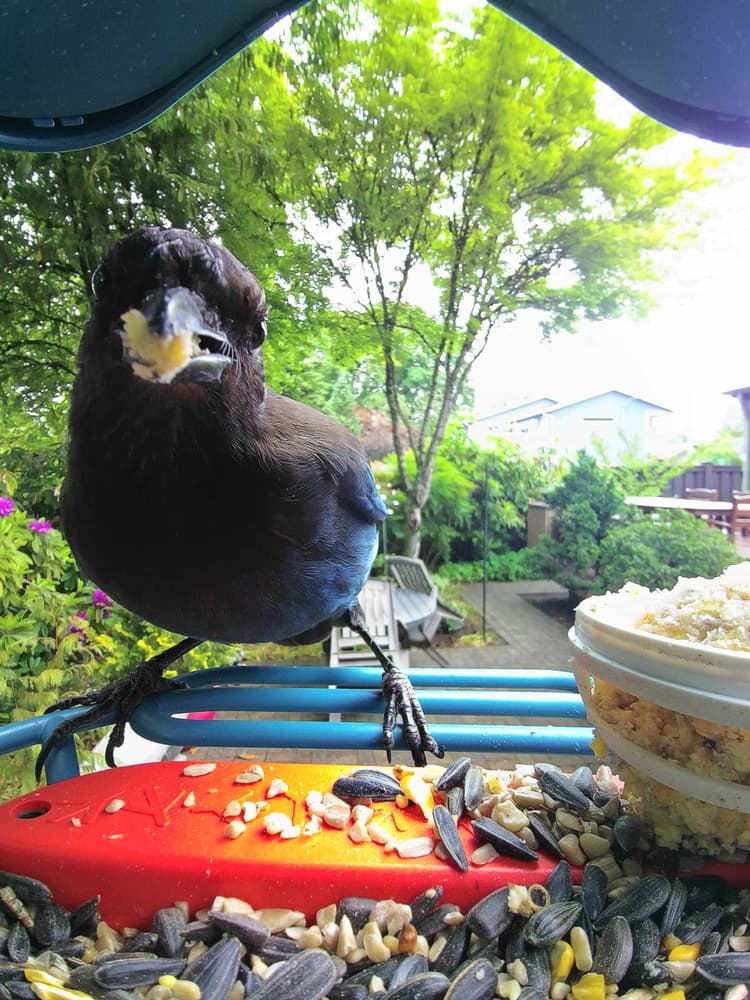
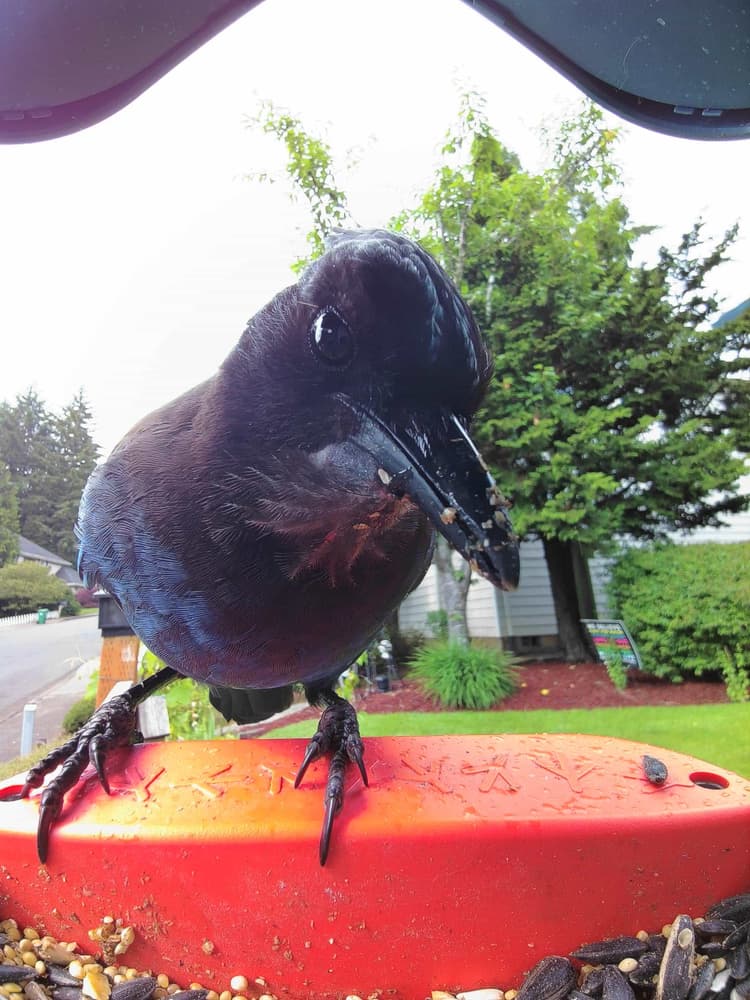
Steller's jay has a striking appearance with a mix of blue and black plumage. The head, crest, and upper body are a glossy black, while the lower body and wings feature vibrant blue tones. Its distinct, pointed crest and sharp, straight bill further accentuate its appearance. In flight, their broad wings and long tail are clearly visible, adding to their distinctive look. They have white or light blue streaks on their cheek patches.
Male vs female
Steller's jay males and females are similar in coloration and size, making it challenging to distinguish them visually. Both sexes have the same bold black and blue coloration, slightly accentuated by environmental factors and lighting. Any noted differences are subtle, as the plumage color intensity is generally consistent between genders.
Juvenile
Juvenile Steller's jays resemble adults but have duller plumage. Their black crests and head are less distinct, and their overall body coloration is paler, with less vibrant blue. Juveniles often lack the defined facial streaks until they mature. As they grow, their plumage becomes richer and more aligned with adult characteristics.
Often mistaken for
California Scrub-Jay vs Steller’s Jay
Steller’s Jay is distinguishable by its crest, unlike the California Scrub-Jay which lacks one. Steller's has a striking black and blue color with no white underparts, while the Scrub-Jay has a white belly and a more uniform blue tone.

Woodhouse’s Scrub-Jay vs Steller’s Jay
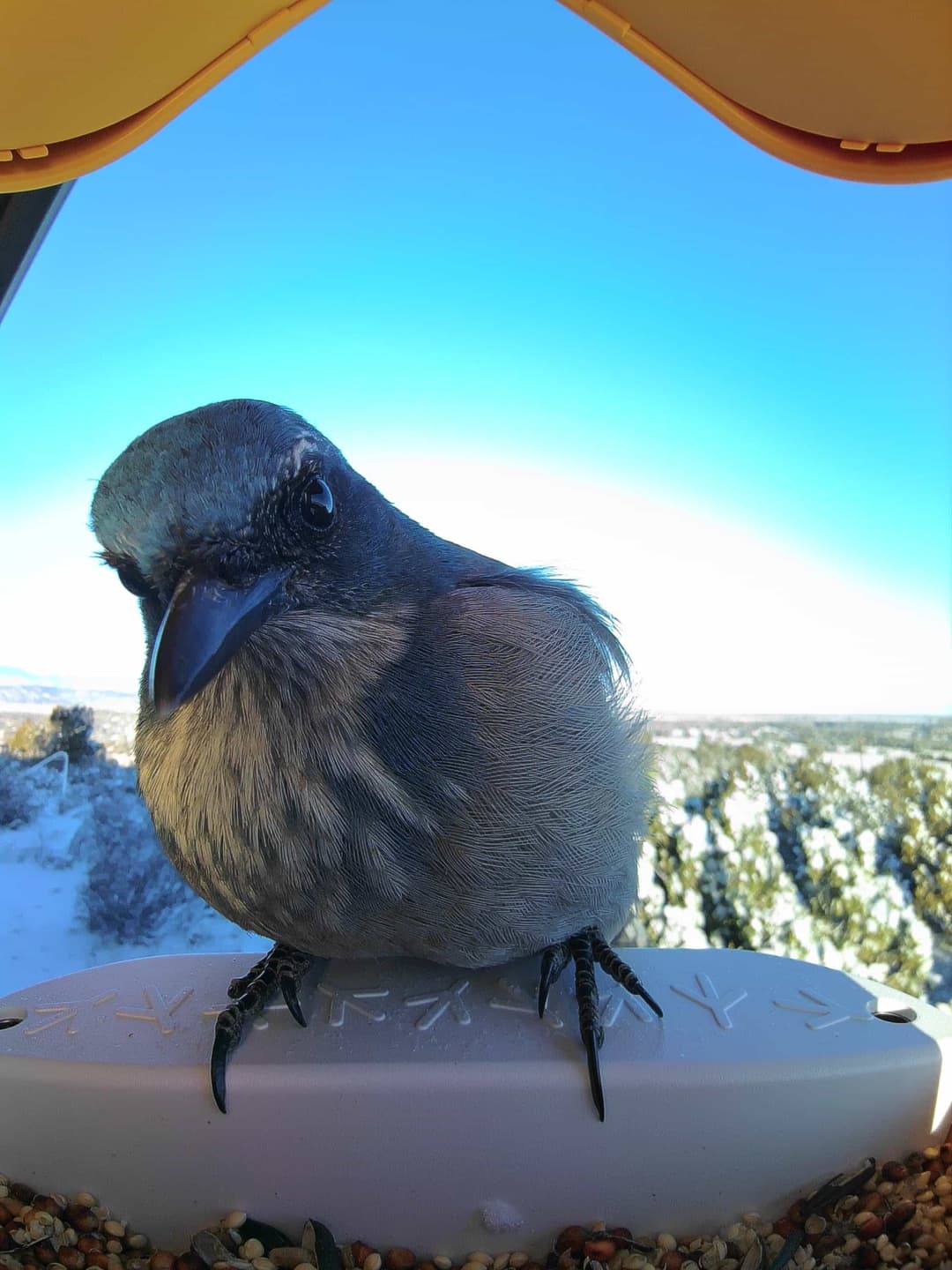
To differentiate, note that Steller’s Jay boasts a prominent crest and darker overall coloration, while Woodhouse’s displays muted blue tones and a lack of the crest. The Steller’s has no white breast compared to Woodhouse's grayish undersides.
Pinyon Jay vs Steller’s Jay
Steller’s Jay features a crest and a more distinct black head, contrasting with the Pinyon Jay’s uniformly blue plumage and lack of crest. Also, Pinyon Jays have thicker bills suited for seed cracking.
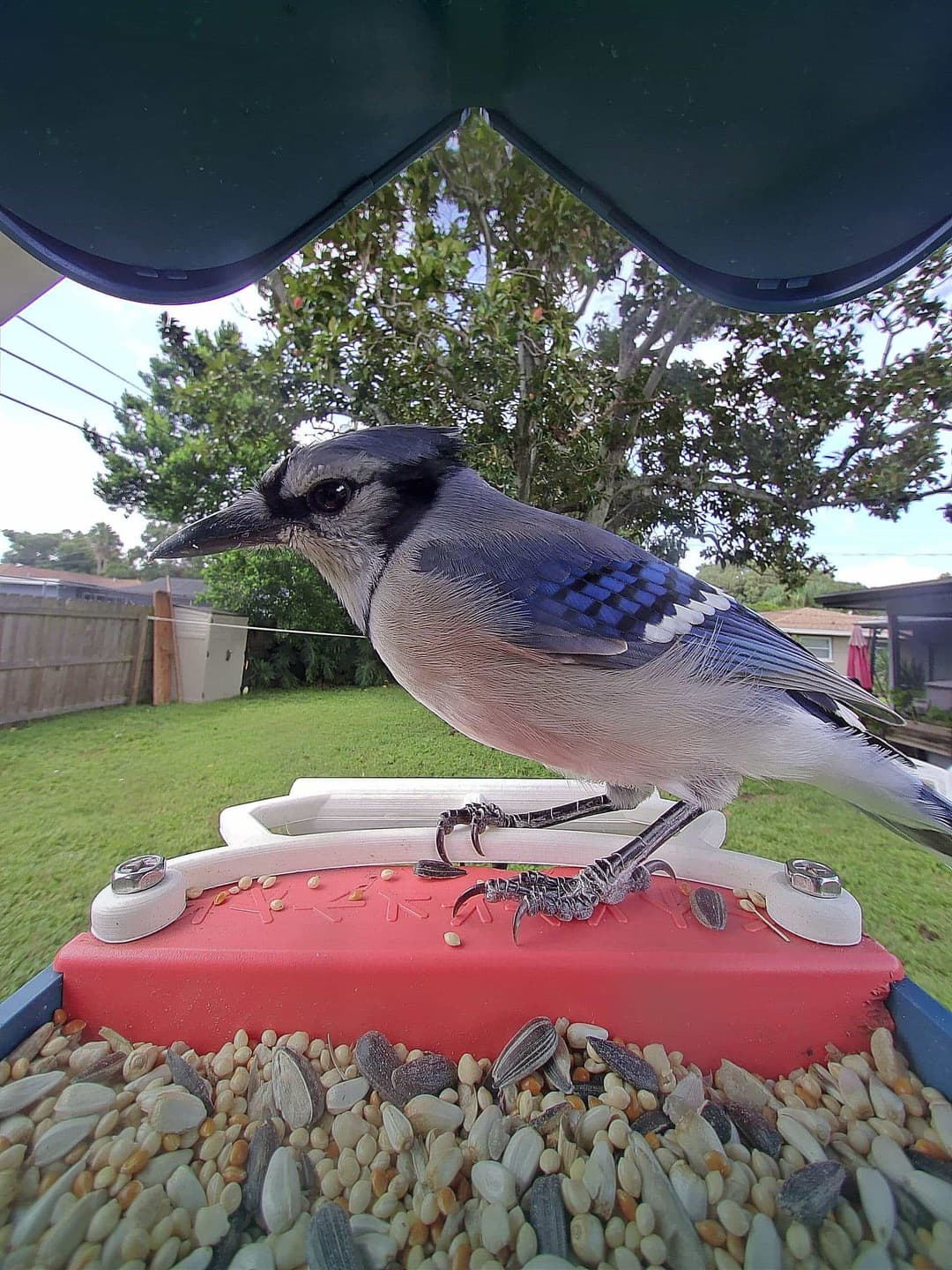
Blue Jay vs Steller’s Jay
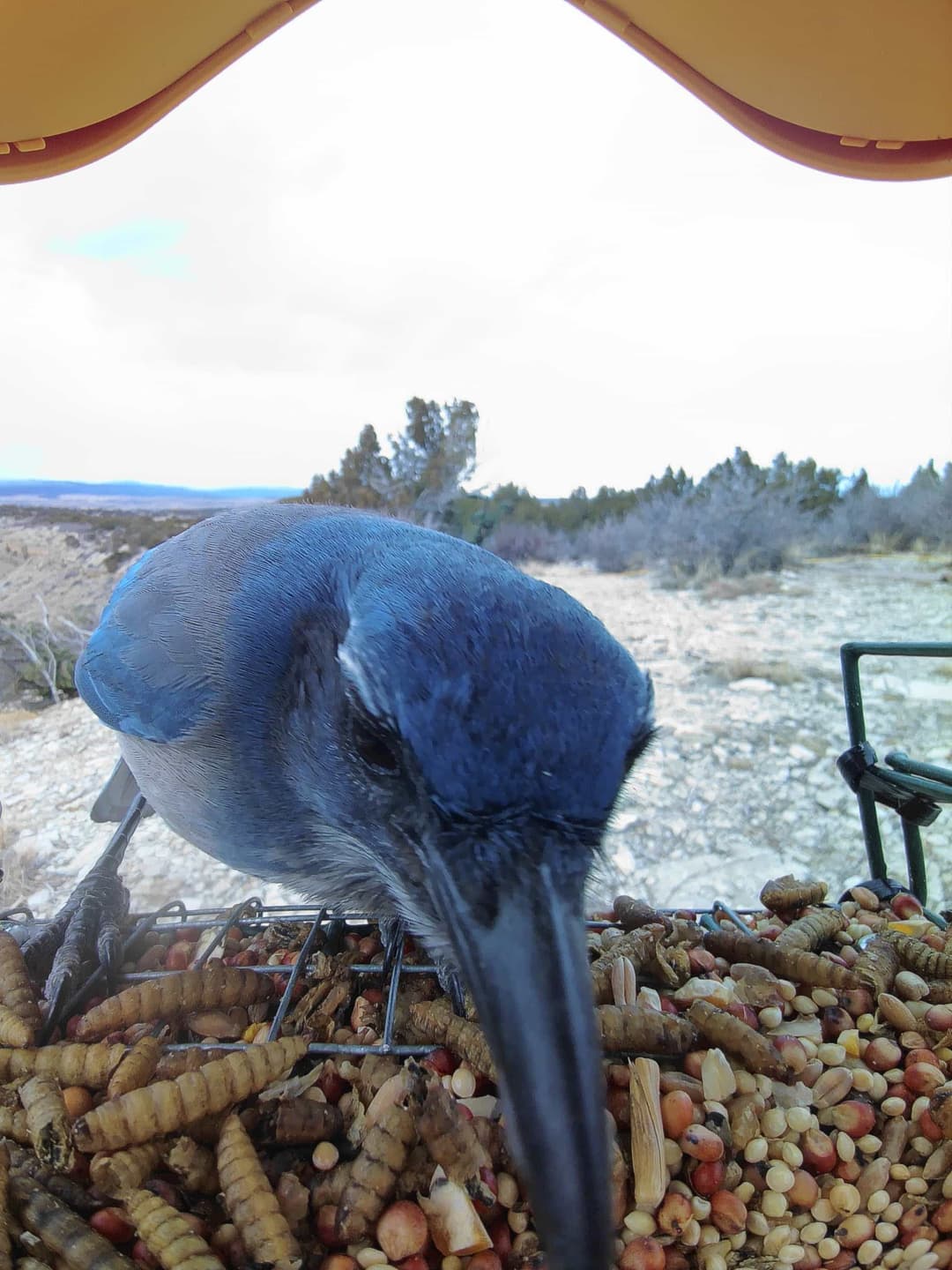
Notable differences include Steller’s Jay’s crest and darker, nearly black head. Blue Jays have brighter blue upper parts and white underparts, along with distinctive black barring and face markings absent in Steller’s.
Breeding and nesting habits of the Steller's jay
Mating behaviors
During courtship, male Steller’s jays feed females. This behavior is a crucial part of forming pair bonds.
Nesting details
Steller’s jays nest in trees, predominantly coniferous, but sometimes in deciduous trees or shrubs. They typically build their nests 10-30 feet above the ground. The nests are bulky, ragged cups constructed from twigs, weeds, moss, and dry leaves, held together with mud. The inside is lined with fine grass, rootlets, and pine needles, and occasionally, bits of paper are added.
Eggs and chick-rearing
Adults are quiet and secretive when nesting but become noisy and aggressive if the nest is threatened. They play a vital role in caring for and rearing their chicks, ensuring they are well-fed and protected during the vulnerable early stages of life.
What does a Steller's jay like to eat?
Berries
Bird eggs
Fruits
Insects
Nuts
Scraps
Seeds
Small animals
Spiders
Natural diet
Steller's jays are omnivorous, with a diet composed of about two-thirds vegetable matter and one-third animal matter. They heavily feed on pine seeds, acorns, and other nuts and seeds, particularly during fall and winter. The jays also consume a variety of berries and wild fruits, and at times, cultivated fruit. During the summer months, their diet includes many insects such as beetles, wasps, and wild bees. Other food sources include spiders, birds' eggs, and occasionally, small rodents or lizards.
Bird feeders
At bird feeders, Steller's jays often consume various seeds and nuts provided, as these mimic their natural diet. They may be seen eating sunflower seeds, peanuts, and other common offerings at feeders. The jays' adaptability allows them to take advantage of these readily available food sources.
Select suitable snacks for steller's jays
To attract the Steller's Jay to your yard or feeder, you need to provide the right food. This species loves peanuts, acorns, and sunflower seeds. You should consider purchasing Bird Buddy seeds. These are selected by experts and tailored to the season, which result in the best experiences.
Choose the right feeder
Steller's Jays are comfortable with both platform and hanging feeders. However, they are more likely to enjoy a platform feeder, which gives them an easy perch. The feeders should also be sturdy as these birds are quite sizeable.
Invite them for a sing-along
Steller's Jays are very vocal birds. Try placing a shallow, clean birdbath in your yard. The sound of splashing water is known to attract these birds, and you might hear their distinctive call. The trick here is to keep it clean and filled with fresh water.
Where can you find Steller’s jays?

Primary habitat
The Steller’s jay primarily dwells in the mountains and along the northern coast in pine, spruce, and fir forests, and in pine-oak forests.
Additional range
Besides its main habitats, this bird can locally inhabit riverside oak groves and other deciduous trees, and when not nesting, it ranges into other woodland types, orchards, and well-wooded suburbs.
Do they migrate?
The Steller’s jay is typically a permanent resident and does not engage in long-distance migration. However, it exhibits altitudinal movements, where individuals may relocate from higher to lower elevations during the winter months. These movements are often due to changes in food availability, as the higher elevations can become snow-covered, making it difficult to find sustenance. In some instances, when food sources in the mountains fail, Steller’s jays may stage what are known as "irruptions" or "invasions" into lowland areas. These movements are not part of a regular migratory route but are rather opportunistic and irregular, largely driven by food shortages. The timing of these movements primarily coincides with winter and adverse weather conditions when the animal seeks more accessible food sources at lower elevations. Key locations for these winter movements are generally dictated by the proximity of suitable feeding grounds and are not defined by specific, consistent geographical routes. Consequently, while the Steller’s jay does exhibit some seasonal movement, it cannot be classified as a migrant species in the traditional sense that undertakes regular, long-range migrations.
What is the role of Steller’s jays in nature and how to protect them?
Conservation status
The Steller’s jay is classified as "still widespread and common," indicating it is not considered vulnerable or endangered. This species thrives in a variety of habitats, including forests and residential areas. No major conservation efforts are currently necessary due to its stable population. However, habitat destruction and climate change could pose potential threats in the future. Maintaining healthy forest ecosystems will help ensure the continued stability of the Steller’s jay population. Overall, its adaptability contributes to its resilience against environmental changes.
Ecological role of Steller’s jays
Its role in the ecosystem
The Steller’s jay plays a vital role in maintaining the ecology of its habitat. One of its significant contributions is pest control. The bird is omnivorous, consuming different types of insects, such as beetles, wasps, and wild bees, which have the potential to harm vegetation in its surroundings. By consuming these insects, it helps keep the population of these pests in check, thereby protecting the vegetation. Additionally, it contributes to seed dispersal and overall forest regeneration. By feeding on pine seeds, acorns, and other nuts and seeds, the Steller's jay helps disperse these seeds in different areas, facilitating the growth of new plants. This bird's activities assist in stabilising the forest ecosystem by supporting both pest control and plant proliferation.
How to help protect Steller’s jays
Preservation tips
Habitat preservation strategies
Preserve and enhance the forest habitat of Steller’s jay by conserving old-growth forests, reducing deforestation, and planting native trees comprising a mix of deciduous and coniferous species. Proper woodland management is necessary to provide suitable nesting and foraging conditions. Create buffer zones around known nesting areas to reduce human disturbances.
Community science initiatives
Encourage community participation in Steller’s jay conservation. Initiate citizen science projects involving bird-watching groups to gather data on the bird’s population and distribution trends. Promote public education about the species’ ecological importance and threats faced. Engage local communities in habitat restoration and conservation programs. Campaign for responsible tourism and outdoor recreation to minimize disturbances to the species.