
Common Redstart
Common Redstart
Also known as: Redstart
Phoenicurus phoenicurus


Quick Identification guide
Quick Identification guide
Male
- •
bright orange-red breast with a contrasting dark face mask
- •
blue-grey upperparts with prominent white forehead
- •
rusty-red tail that contrasts against the rest of the body
Female
- •
pale brown upperparts with a subtle orange wash on the breast
- •
lighter face markings compared to males with a white eyebrow stripe
- •
rust-colored tail similar to the male but overall duller appearance
What does a common redstart sound like?
The common redstart's vocalizations comprise short calls and longer songs. Calls include sharp, clear "tic" sounds, often repeated, and a softer "hu-it". Their song is melodious yet simple, with a "whit-whit-whit-weet-weet-weet-trrrrr" pattern. Some individuals improvise, producing more complex creations. Its alarm call is sharp, resembling a snapping sound. Both the male and female common redstart vocalize, although the female's song is typically less developed than the male's.
Song
Audio by Oona Räisänen (Mysid)


Description
Common redstarts are often targeted by cuckoos, who like to leave eggs in their nests! It's not an ideal solution but their larger sibling gives them much-needed warmth and acts as a thermoregulator! However, if redstarts see a cuckoo nearby, then they'll abandon their nest altogether to avoid this.
The common redstart can weigh between 11to23grams and be from13to14.5centimeters tall.
The common redstart typically lives up to 2-3 years, although some can live to 9 years. Compared to related species, its lifespan is average; for instance, the European robin often lives 1.1 years but can reach up to 19 years, while the black redstart has a similar lifespan, averaging 3 years. Overall, varied factors such as predation, disease, and habitat loss influence these bird's lifespans.
Did you know?
Most popular questions about common redstart
How to recognise a common redstart?
General appearance
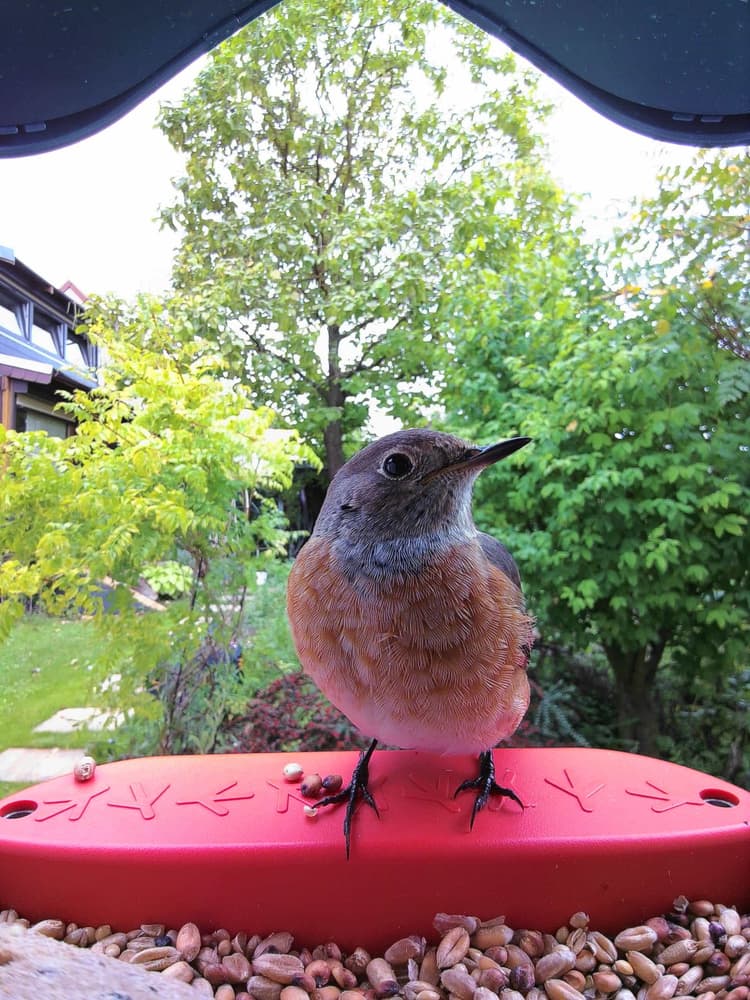
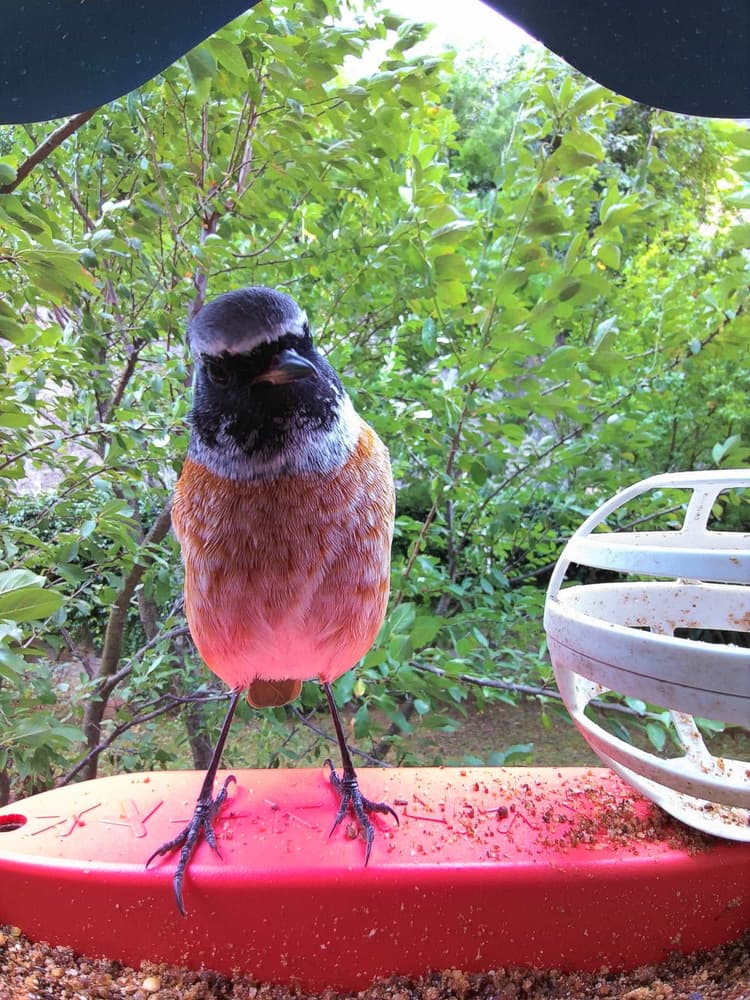
The common redstart (Phoenicurus phoenicurus) is a small bird adorned with distinct, vibrant coloring. It has an overall slate grey upper body, chestnut underparts, and a brilliant red tail that habitually quivers when perched. Its wings are black with white patches that help in identification during flight.
Male vs female
Males possess a distinct black face that extends down to the upper breast and encircles the white forehead. In contrast, females lack the slate grey and black coloring, featuring a light brown color above and dirty white below. Females also have a rusty-red tail, though not as vivid as the male's.
Juvenile
Juveniles largely mirror the appearance of the female but carry a more patchy and mottled aspect to their feathers. Flushed with earthy browns and faint hints of red, they gain their adult plumage after about six months post-fledging. Throughout autumn, they undergo a complete molt, adopting the familiar adult color scheme for their respective sexes.
Often mistaken for
Black Redstart vs Common Redstart
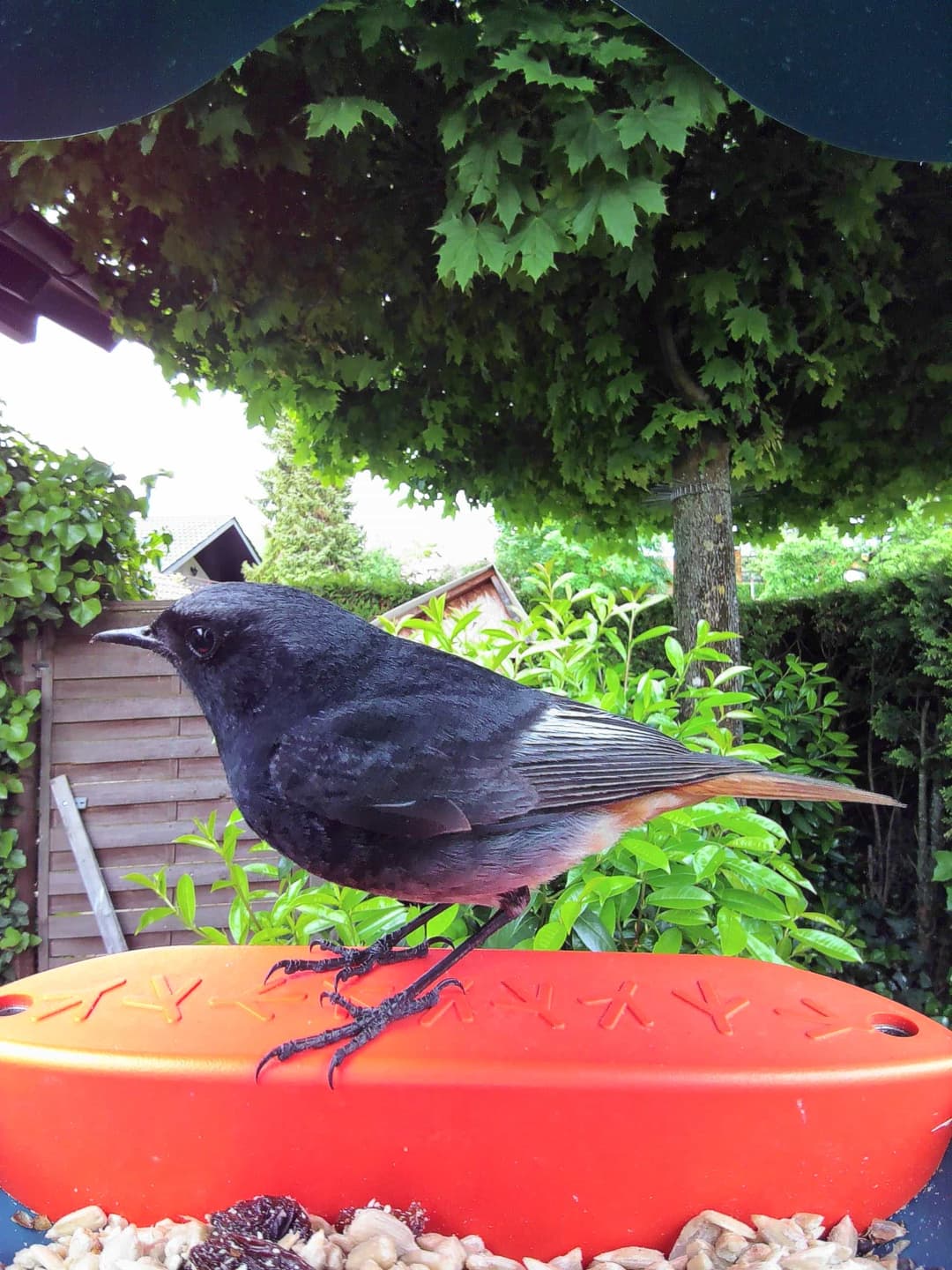
The Black Redstart resembles the Common Redstart but has a darker, smokier appearance. Males have dark gray to black upperparts, while females and juveniles have a more subdued brownish-gray coloration. The tail is orange-red, similar to the Common Redstart.
Daurian Redstart vs Common Redstart
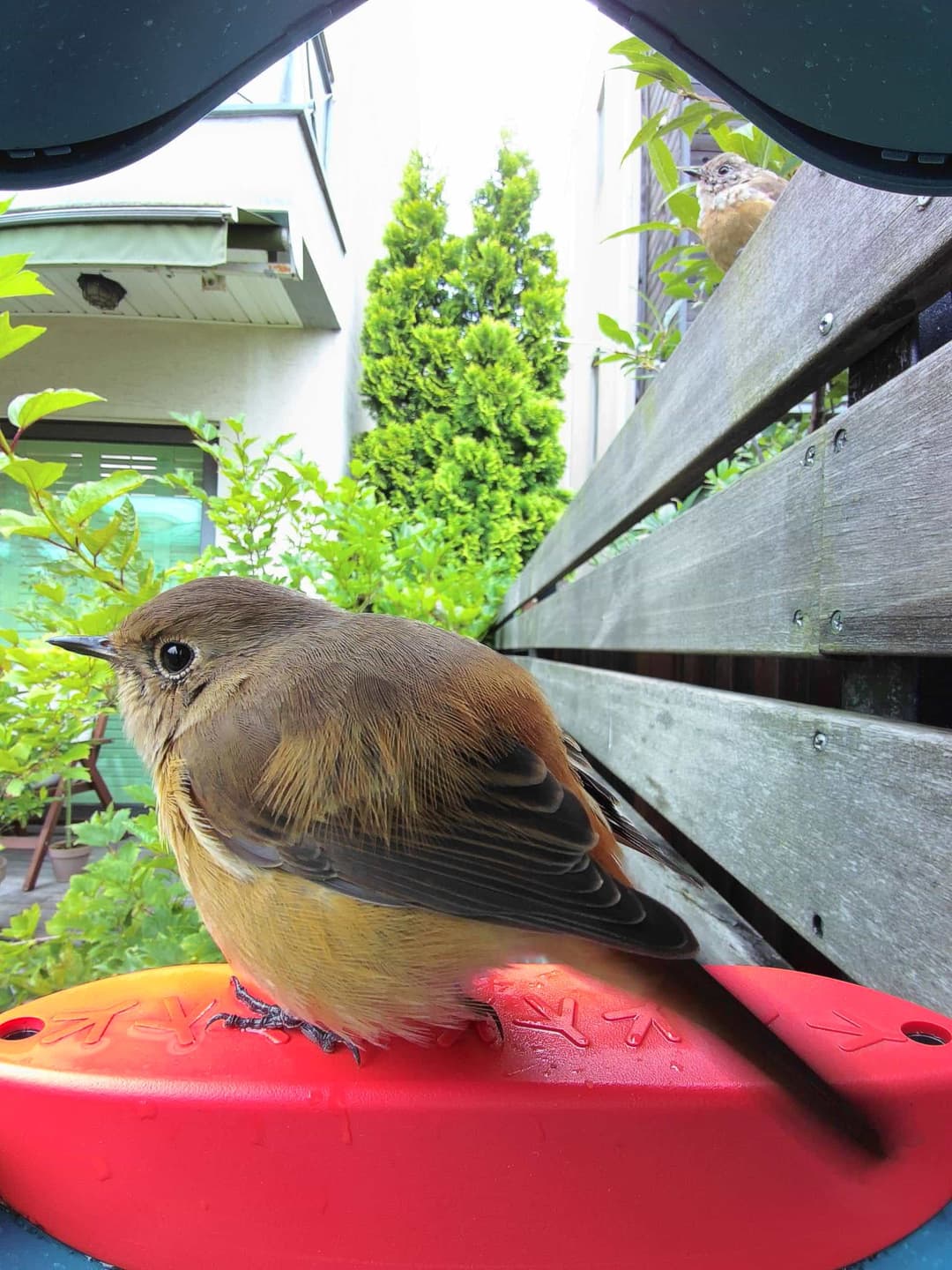
The Daurian Redstart shares size and shape with the Common Redstart but differs in coloration. Males typically have bright orange underparts and a white wing patch, while females are grayish with less intense orange.
Breeding and nesting habits of the common redstart
Mating behaviors
The common redstart engages in elaborate courtship displays, with males showcasing their vibrant plumage and singing to attract females. They perform fluttering flights and tail movements to display fitness.
Nesting details
Common redstarts prefer to nest in tree cavities or on ledges. They use grasses, moss, and feathers to build their nests. In gardens, providing nest boxes with a small entrance can encourage nesting. Ensuring a safe and quiet environment with dense foliage can attract these birds.
Eggs and chick-rearing
Females lay 4-6 eggs, incubating them for about two weeks. Both parents participate in feeding the chicks, which fledge approximately two weeks after hatching. Ensuring available food sources, like insects, and providing shallow water sources can support chick-rearing.
What does a common redstart like to eat?
Berries
Insects
Spiders
Natural diet
The common redstart primarily feeds on a variety of insects and other invertebrates, including caterpillars, beetles, and spiders. They also consume berries and fruits, such as elderberries and rowan berries, especially during the autumn months when insect availability is low. Their diet is highly dependent on the season and habitat, adapting to local food sources.
Bird feeders
While they are not frequent visitors to bird feeders, common redstarts may occasionally be attracted to them. They can be enticed with offerings such as mealworms, suet, and small pieces of fruit. However, their preference for natural foraging typically means they are less reliant on feeder food compared to other garden birds.
Attracting common redstarts to your yard
To tempt common redstarts, you need to create a welcoming environment in your yard. This species of bird prefers a naturally landscaped yard with ample cover in the form of trees and shrubs. If you have a water feature, even better, as these birds are fond of bathing and drinking fresh water. Creating a nesting habitat in nearby trees by leaving dead branches can also attract these birds.
Feeding the common redstarts
Though they eat a range of foods including fruit and insects, common redstarts are particularly fond of seeds. Bird Buddy seeds are a top choice, expertly selected for the season to offer the best results. These can be offered in a standard bird feeder which will attract the hungry redstarts to your yard.
Fun tricks to encourage visits
Common redstarts are known for their curiosity. One fun trick to make your yard more enticing is to place shiny objects around, like foil or glossily painted stones. Additionally, playing soft bird songs from your speakers can stir their interest and instigate a friendly 'sing-along'. Be patient and consistent, and soon enough you'll have these lovely birds livening up your yard.
Where can you find common redstarts?

Primary habitat
The common redstart typically inhabits open mature deciduous woodland, parks, and gardens.
Additional range
Its range extends across most parts of Europe and western Asia. It prefers temperate climates but can also thrive in the cold taiga biome.
Do they migrate?
The common redstart is a migratory bird. It breeds in Europe and parts of Asia and then migrates to sub-Saharan Africa for the winter. **Migration Route and Timing:** In late summer and early autumn, the common redstart begins its southward migration. The eastern populations tend to migrate via the Eastern Mediterranean and the Middle East, while western populations might travel through Western Europe and across the Iberian Peninsula. Many utilize a route crossing the Sahara Desert to reach their wintering grounds. **Key Locations:** During their migration, common redstarts can be found in a wide range of habitats, including woodlands, gardens, and scrublands. They often stop in North Africa and the Sahel region before continuing farther south. In Africa, they winter predominantly in countries such as Ghana, Nigeria, and Cameroon. In the spring, they make their return journey northwards to their European and Asian breeding grounds. The timing might vary slightly depending on the specific geographic origin and local climatic conditions.
What is the role of common redstarts in nature and how to protect them?
Conservation status
The common redstart is generally classified as "Least Concern" due to its wide distribution and large population. However, habitat loss and degradation, particularly in their breeding and wintering areas, pose threats. Conservation efforts focus on preserving woodlands, maintaining traditional orchard landscapes, and promoting agroforestry practices to provide suitable habitats. In some regions, nest box programs support breeding success. Efforts to mitigate climate change also help address broader environmental challenges impacting the species. Overall, while currently not vulnerable or endangered, ongoing monitoring and habitat conservation are vital to prevent future population declines.
Ecological role of common redstarts
Its role in the ecosystem
Common Redstarts (Phoenicurus phoenicurus) hold significant ecological importance due to their insectivorous dietary habits. They serve as a natural pest control, feeding on a variety of insects that some species consider pests, including beetles, flies, and spiders. This role helps to regulate the insect population, ensuring a natural balance in the ecosystem. Also, these birds disperse seeds, inadvertently aiding in plant propagation. Often, seeds from consumed fruits pass through their digestive system unharmed and are defecated in new locations, contributing to the growth and spread of certain plant species. Additionally, Redstarts themselves serve as prey for larger predators, thus playing a critical part in the food chain and supporting biodiversity within the ecosystem. Lastly, as migratory birds, they assist in linking different geographical areas ecologically, affecting not just local, but global biodiversity.
How to help protect common redstarts
Preservation tips
Habitat preservation strategies for common redstart
Protect and manage habitats where the common redstart breeds and winters. It typically prefers open woodlands and heathlands. Avoid any forms of habitat destruction such as clear-cutting and urbanisation. Implement controlled burning and periodic grazing to maintain habitat conditions. Establish protected areas and buffer zones around its habitats.
Community science initiatives for common redstart conservation
Encourage local communities to participate in common redstart monitoring programs to track their population trends and to report sightings. Public education about the importance of common redstart and their habitats should also be promoted. Citizens can also get involved in the restoration and preservation of habitats by participating in tree planting events and litter cleanups.