
Bullock’s Oriole
Bullock’s Oriole
Icterus bullockii


Quick Identification guide
Quick Identification guide
- •
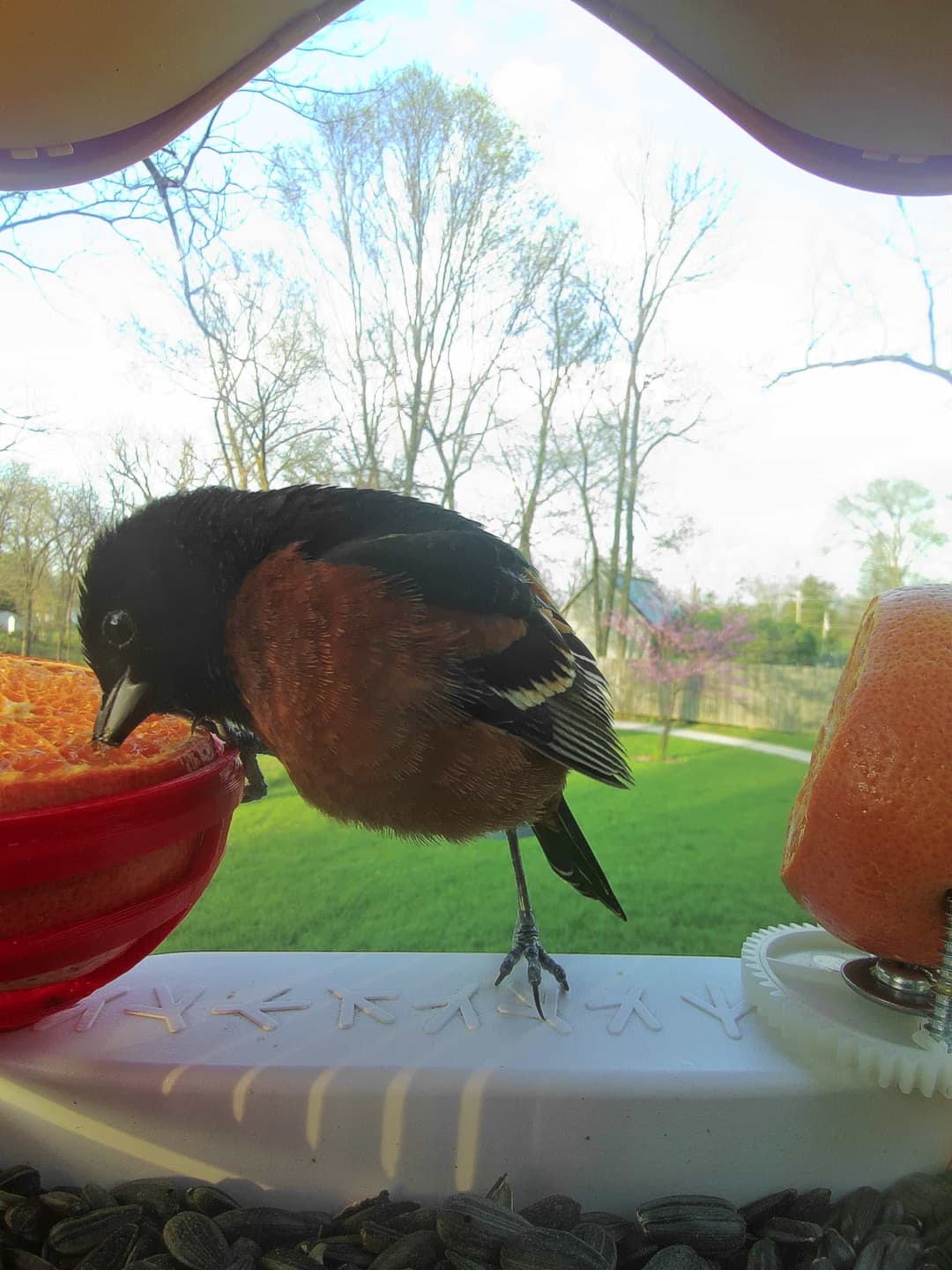
The male showcases a striking bright orange body contrasted by a bold black cap and throat
- •
Features white wing patches and black streaks on its wings, adding to its distinctive look
- •
Both sexes have a medium build with a thin, pointed beak ideal for foraging
What does a Bullock's oriole sound like?
The Bullock’s oriole has a distinct and varied repertoire of vocalizations. Its calls are often clear and resemble the flute-like whistle of single or double notes, usually in short and highly individual phrases. Alongside this, it also emits a rapid, falling chatter. The types of calls include chatter, chirp/chip, and whistle. They are known for their unique melody and variation, making their song notable.


Description
This bird used to, together with the Baltimore oriole, just be called the northern oriole between 1983 and 1995. It's actually not named after the actress Sandra Bullock but the English naturalist William Bullock! Their nests are frequently invaded by brown-headed cowbirds but they fight back when this happens. They puncture and throw the strange eggs out, sometimes even damaging their own in the process.
The Bullock's oriole can weigh between 29to43grams and be from17to19centimeters tall.
The lifespan of a Bullock's oriole typically ranges from 7 to 8 years. This is about average when compared to other related Oriole species. The related Baltimore Oriole, for example, has a similar lifespan, often living to be about 6 to 7 years old. However, many factors like predation and availability of resources affect their survival rate.
Did you know?
Most popular questions about Bullock's oriole
How to recognise a Bullock's oriole?
General appearance
Bullock's Oriole is a medium-sized songbird distinguished by its slender body and sharp, pointed bill. It typically displays vibrant colors with striking contrasts, making it easily recognizable in its natural habitat. Both genders possess a pointed beak, perfect for foraging insects and fruit.
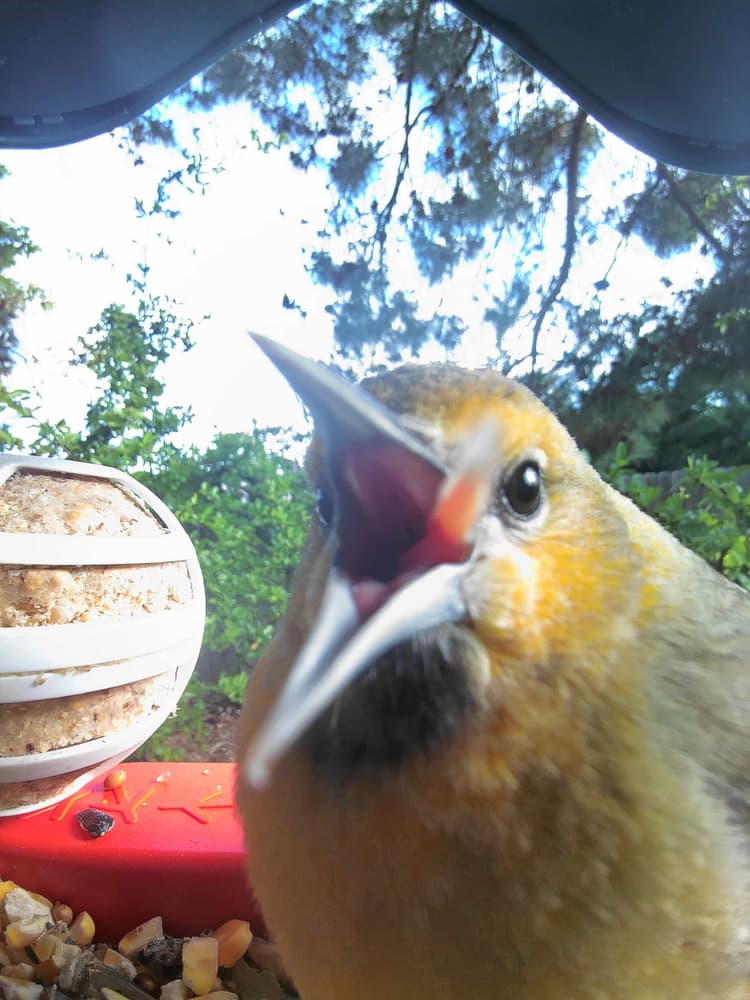
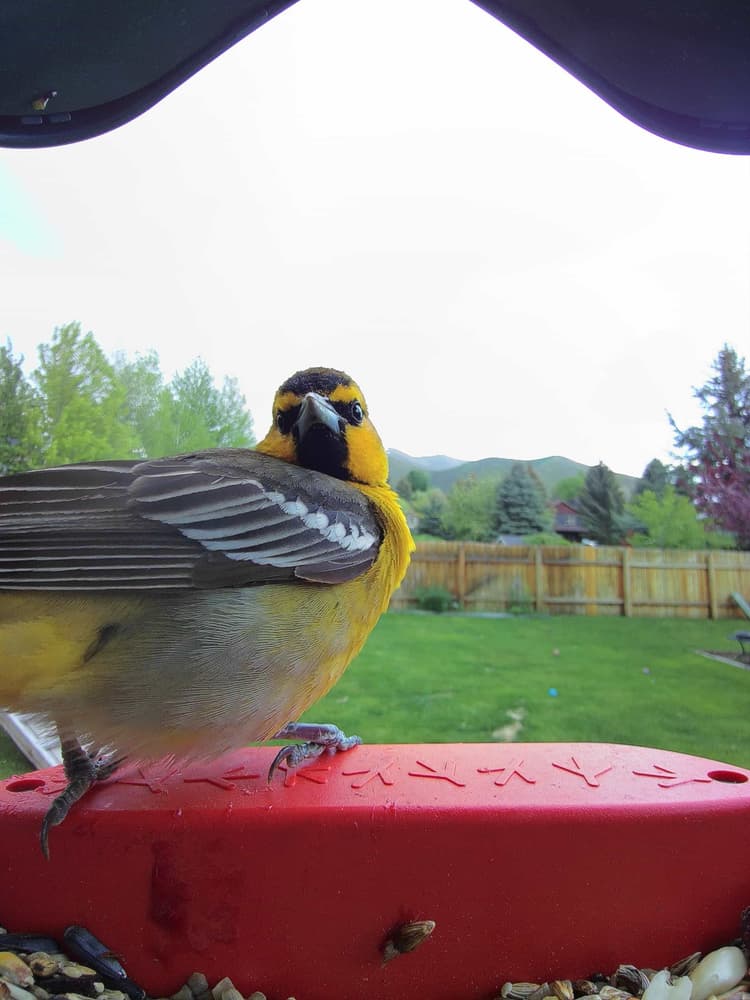
Male vs female
Males are brightly colored with a vibrant orange face and underparts, contrasted by a black cap, throat, and eye-line. They also have a distinctive white patch on the wing. Females are more subdued, showcasing grayish-buff tones with a hint of pale orange on the underparts and lacking the stark black markings seen in males. Their wings are more mottled, featuring less contrast.
Juvenile
Juvenile Bullock's Orioles resemble females but generally exhibit even duller and more muted colors. Young males may begin showing hints of the brighter orange plumage as they mature. Observers can identify juveniles by the mix of adult female-like body coloration and gradually emerging adult male plumage patterns.
Often mistaken for
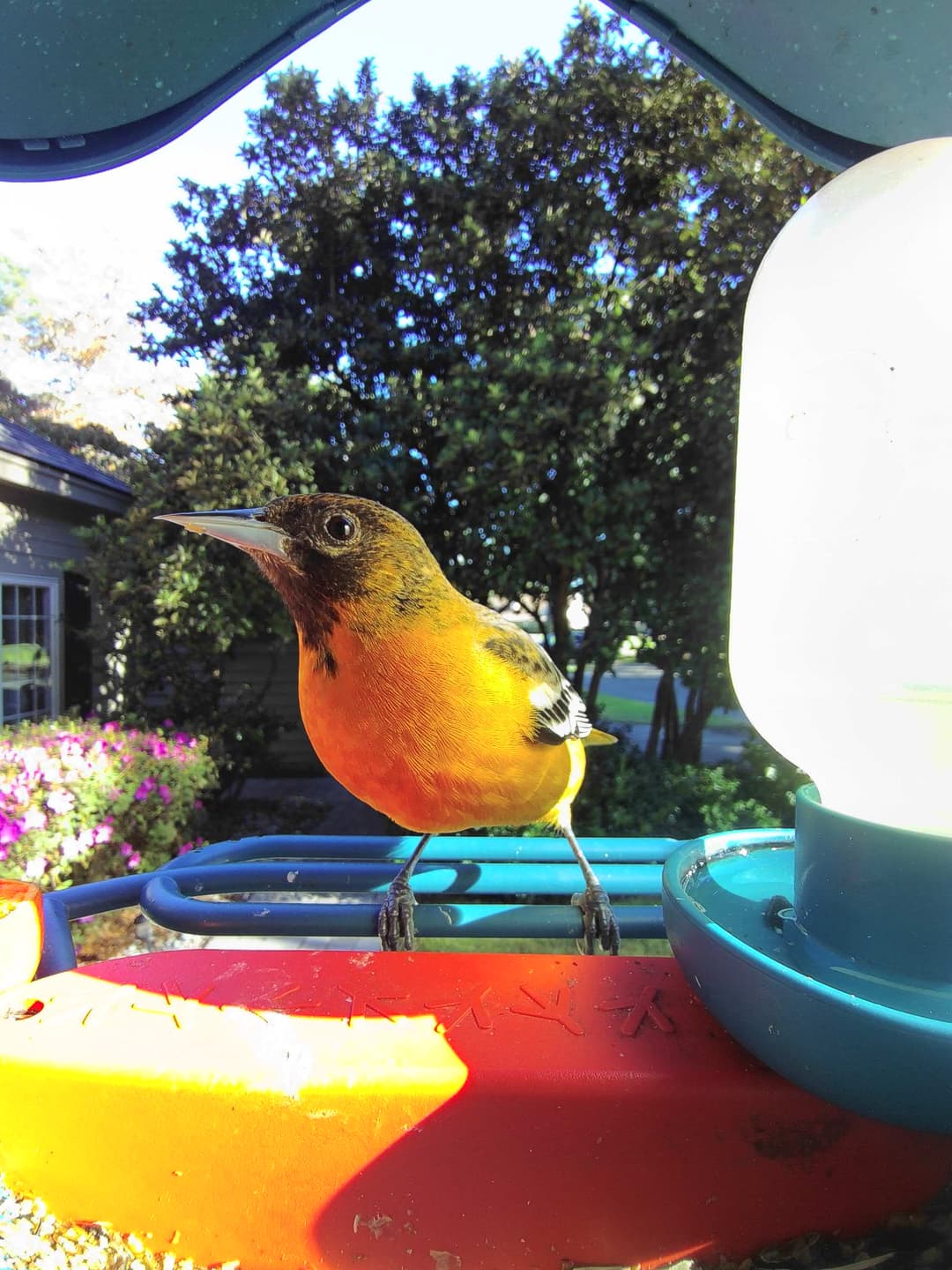
Baltimore Oriole vs Bullock’s Oriole
Bullock’s Oriole males have a distinctive bright orange body with a black line through the eye and a white wing patch, whereas Baltimore males are more uniformly black-headed with a solid black bib. Females differ too; Bullock’s are paler with a grayish back compared to the orange-buff shade of the Baltimore. Listen for Bullock's fast, chattering song, while Baltimore's is more melodious.
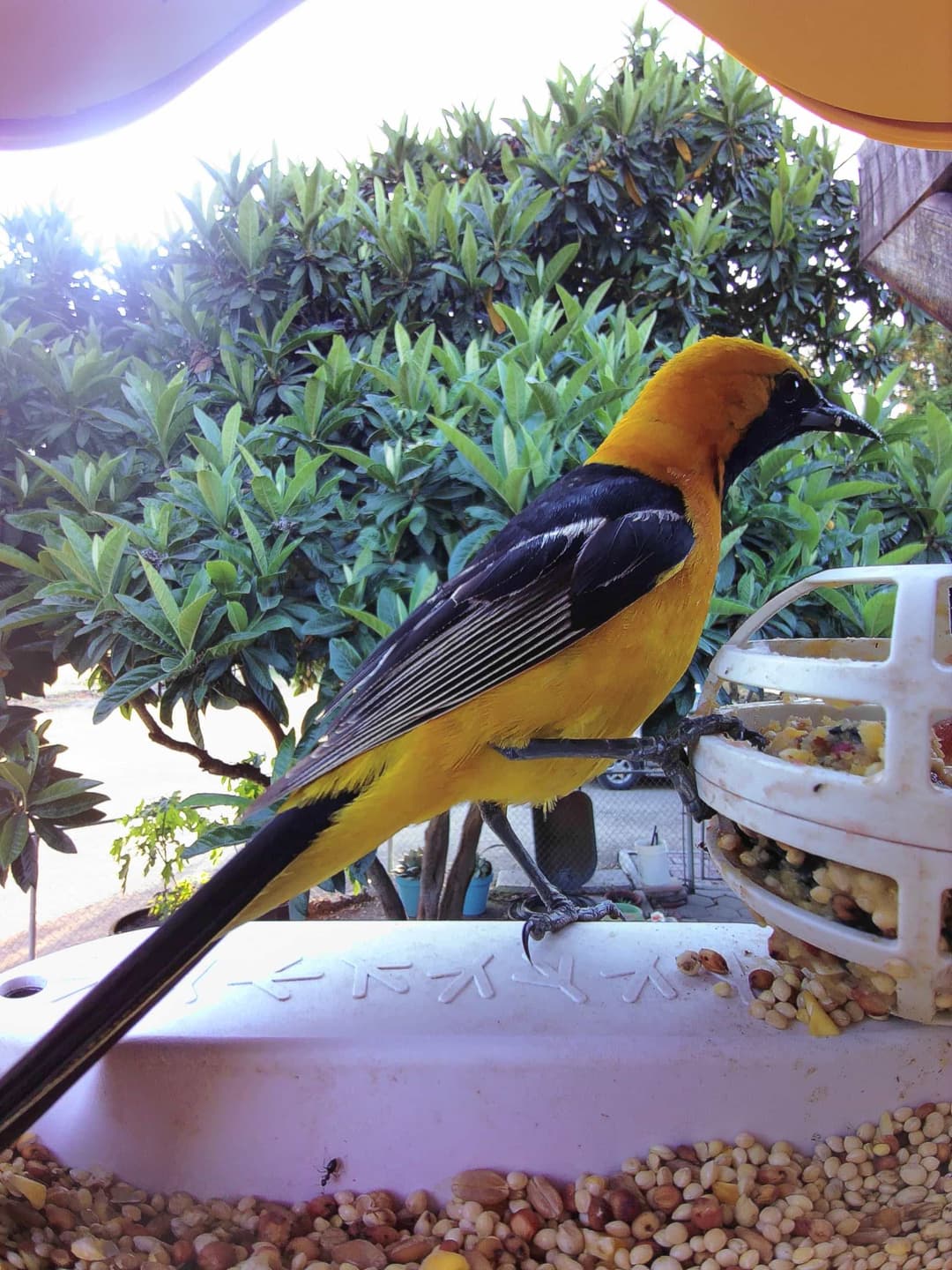
Hooded Oriole vs Bullock’s Oriole
The male Bullock’s Oriole is brighter orange than the Hooded, with a distinctive white wing patch and a black line through its eye, whereas the Hooded has an all-black throat extending to the upper chest. Females can also be confusing, but the Bullock’s tend to be more dull gray-yellow compared to the brighter yellow of the Hooded. They often frequent different habitats, with Bullock's preferring open woodlands.
Orchard Oriole vs Bullock’s Oriole
Bullock’s Oriole males are vibrant orange with a unique black eye line and white wing patches, while Orchard Oriole males are smaller, more reddish-chestnut with a full black head. Female Bullock’s are more orange, Orchard’s more greenish. Habitat helps too; Bullock’s are in open woodlands, whereas Orchards prefer more dense vegetation. Their songs differ, with Bullock’s lacking the richer, flute-like quality of the Orchard.
Breeding and nesting habits of the Bullock's oriole
Mating behaviors
During courtship, the male Bullock's oriole sings to defend nesting territory while facing the female. He stretches upright with tail spread and wings quivering and partly open.
Nesting details
The nest is a tightly woven hanging pouch, built primarily by the female, sometimes assisted by the male. It is located in tall deciduous trees, suspended from the tips of slender drooping branches, typically 10-25 feet above the ground, sometimes up to 50 feet. The nest uses materials such as plant fibers, bark strips, vine tendrils, grass, yarn, and string, with a lining of fine grass, plant down, and hair, and is wider and deeper than a Baltimore Oriole's nest.
Eggs and chick-rearing
The breeding practices include laying eggs and rearing chicks in the carefully constructed nest. For those looking to attract Bullock’s orioles to their garden, ensuring the presence of tall deciduous trees for nesting and scattered materials like yarn and string can encourage suitable habitat creation.
What does a Bullock's oriole like to eat?
Fruits
Insects
Nectar
Natural diet
In the summer, Bullock's o***** feeds primarily on insects, with a preference for caterpillars. Its insect diet also includes beetles, grasshoppers, crickets, wasps, and other bugs, as well as spiders. It supplements its insect consumption with berries and wild fruits and occasionally consumes cultivated fruits.
Bird feeders
At bird feeders, Bullock's o***** may be attracted to sugar-water solutions, similar to what is used for hummingbirds. They may also visit feeders offering fruits or berries.
Attracting bullock's orioles: the food factor
These beautiful birds are particularly fond of fruits like oranges, apples and bananas. Hang ripe pieces of these fruits in your yard or from the feeders. Bullock's Orioles also can't resist a good mix of jelly and nectar. For best results, use Bird Buddy seeds. They are chosen by experts for the season and guaranteed to tempt Bullock's Orioles into your yard.
Feeders and fun tricks for orioles
Bullock's Orioles enjoy perching rather than hanging, so consider a feeder with a perch. Tray feeders aligned horizontally work best. Place the feeder in a quiet, low-traffic spot near to some shrubs or trees. Orioles are making their nest in such areas, hence it creates a familiar and safe environment. A fun trick to get their attention is to add a shiny, colorful object near the feeder - they have a keen eye for such things.
Sing along with bullock's orioles
These birds are known for their lively and sweet melodies. One way to encourage a musical visit is to play recordings of Bullock's Oriole songs in your yard. This can intrigue them and inspire a visit and perhaps a sing-along. Remember, the goal is to make them feel welcome and comfortable in your yard. So, relax and enjoy the company of these beautiful birds!
Where can you find Bullock’s orioles?

Primary habitat
The Bullock’s Oriole primarily inhabits open woods, riverside groves, and edge forests. It particularly prefers to breed in deciduous trees like cottonwoods in fairly open spaces.
Additional range
The bird readily adapts to some suburban neighborhoods with sufficient trees. It winters predominantly in the tropics, dwelling around forest edges and semi-open regions.
Do they migrate?
The Bullock’s Oriole is a migratory bird. It primarily breeds in the western and central United States and parts of southwestern Canada. Migration for Bullock’s Orioles typically begins in the early fall, with many individuals leaving their northern breeding grounds by the end of July. They migrate in small flocks, often heading towards the southwestern United States and Central America for the winter. The route generally follows the Pacific Flyway or a path through the interior of North America, depending on their specific breeding locations. Key stopover and wintering areas include parts of Mexico, particularly in regions such as Baja California, as well as further south into Central America. During migration, they might also be spotted in states like Arizona, New Mexico, and Texas, often in wooded habitats and areas rich with fruits and insects, which are critical resources for these birds during their long journeys. The return migration to their northern breeding areas typically begins around March and continues into May. Timing can vary slightly based on environmental conditions and food availability.
What is the role of Bullock’s orioles in nature and how to protect them?
Conservation status
The Bullock’s oriole is considered common, with only slight declines observed in recent decades. It is not classified as vulnerable or endangered. Key conservation efforts focus on habitat preservation and monitoring population trends. Significant threats include habitat loss due to urban development and agricultural expansion. Maintaining and protecting suitable habitats, such as riparian zones and woodlands, are crucial for its continued stability. Public awareness and citizen science initiatives also aid in tracking and supporting its population.
Ecological role of Bullock’s orioles
Its role in the ecosystem
The Bullock’s oriole plays a crucial ecological role, particularly in the fields of pest control and seed dispersal. Thanks to its diet largely consisting of insects such as caterpillars, beetles, grasshoppers, crickets, wasps, bugs, spiders and others, it helps to naturally control pest populations, thereby preserving the balance within local ecosystems. Additionally, it considerably contributes to the pollination process, when it feeds on nectar. Secondly, with its consumption of various berries and wild fruits, the Bullock’s oriole participates in seed dispersal. As the bird feeds on fruits, it ingests seeds which are then dispersed across various locations when the bird defecates, aiding in the propagation of plant-life. This is especially important for the regrowth of plants in areas affected by deforestation or forest fires. By fulfilling these roles, the Bullock’s oriole is instrumental in maintaining biodiversity, ecological balance, and health of its ecosystem.
How to help protect Bullock’s orioles
Preservation tips
Habitat preservation strategies
Bullock’s orioles depend on riparian environments and open woodlands. Thus, conservation efforts should primarily focus on protection and restoration of such habitats. Reduce pesticide usage as it can harm not just these birds but their food sources like caterpillars and other insects. Install birdhouses with an entrance hole of 1.5-2 inches to offer them secure nesting locations. Leave dead trees standing since they often nest in tree cavities. Support local and national policies advocating for habitat conservation.
Community science initiatives
Encourage community members to participate in bird-watching and monitoring initiatives. Use platforms like eBird to record sightings. This data is invaluable for tracking population patterns and understanding migration routes. Fundraise for organizations involved in bird conservation, organize educational programs to increase public awareness about the Bullock’s oriole. Try to foster a community that appreciates and respects the natural world and the unique species within it, especially the Bullock’s oriole.