Whooping Crane or Sandhill Crane?
Here's how to tell the difference



Whooping Crane

Sandhill Crane
Whooping Crane
Grus americana
General appearance
Whooping Cranes are large birds characterized by their striking white plumage, black wingtips visible during flight, and a red crown on their head. They have long, slender necks and legs, with an impressive wingspan of up to 7.5 feet. Their bills are straight and pointed, ideal for foraging in wetland areas.
Male vs female
Males and females are similar in appearance, making them difficult to distinguish through mere visual observation. However, males are slightly larger than females in terms of body size and weight. Both sexes exhibit the same coloration and distinctive markings.
Juvenile
Juvenile Whooping Cranes have a more varied coloration compared to adults. They display a combination of white and cinnamon-brown feathers. As they mature, their brown feathers are gradually replaced by the pure white plumage seen in adults. Juveniles do not have the red crown that is characteristic of mature birds and develop it as they reach adulthood.
Size
47.2 - 63.0 in/211.6 - 264.6 oz
There's more to learn about Whooping Crane
View full detailsSandhill Crane
Grus canadensis
General appearance
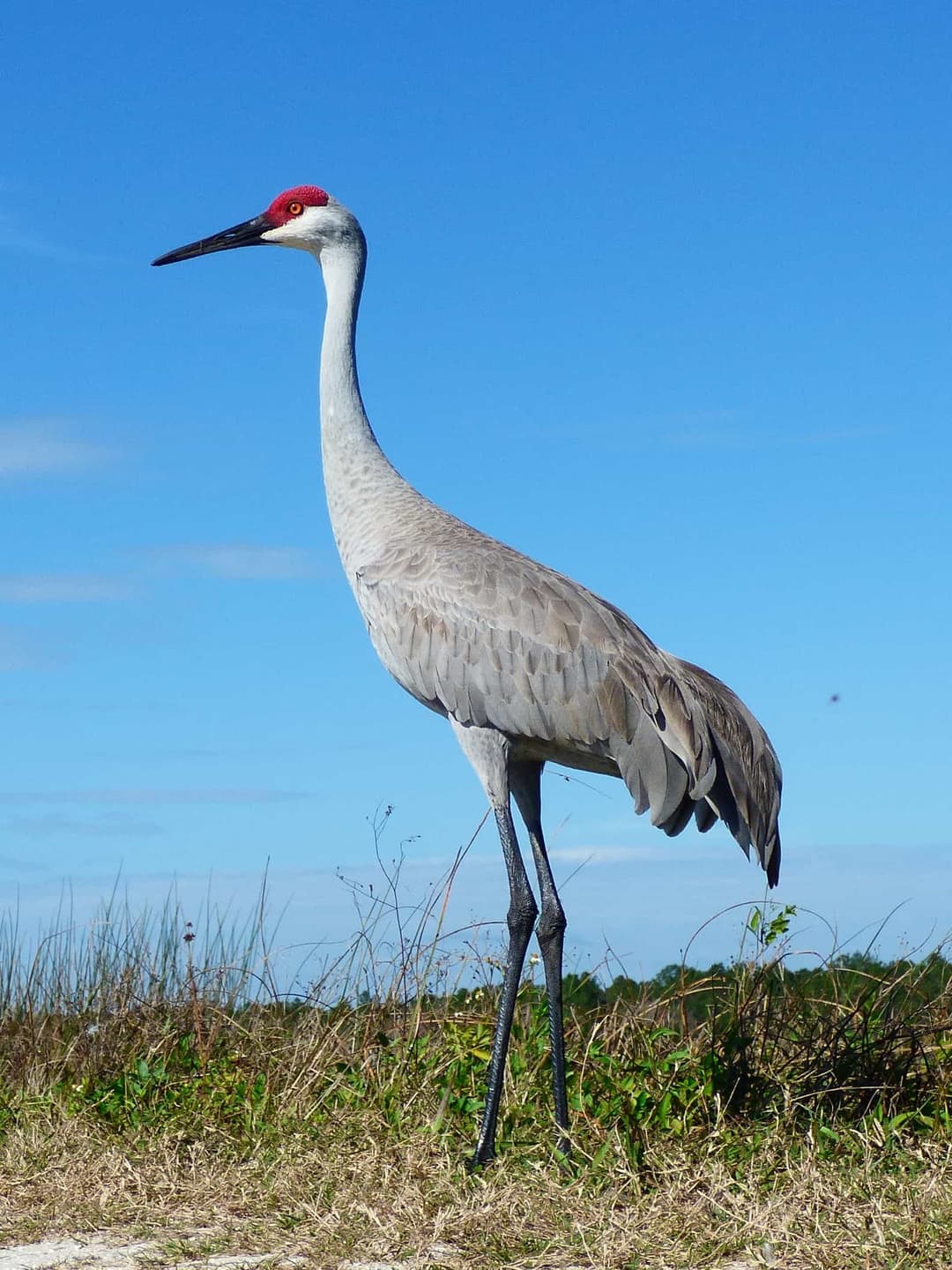
Sandhill cranes are tall, statuesque birds with grey bodies. Their wingspan ranges from 5-7 feet, boasting long legs and necks. They possess a bright red patch on their forehead, with white cheeks and a sharp pointed bill. Their plumage can sometimes be stained a rusty color from iron-rich muds.
Male vs female
Males and females look alike, making it challenging to distinguish between them based on physical characteristics alone. However, males are slightly larger than their female counterparts.
Juvenile
Juvenile Sandhill cranes bear a resemblance to adults, but their grey is mixed with some brown, and they lack the distinctive red forehead patch. Instead, juveniles possess a hair-like plumage on the top of their heads. This brownish color gradually lightens to gray as they mature.
Size
39.4 - 47.2 in/117.8 - 191.5 oz
There's more to learn about Sandhill Crane
View full detailsHow to tell the Whooping Crane from the Sandhill Crane
Visual differences
The Whooping Crane is larger, with a weight between 6000-7500g and a length of 120-160cm, compared to the Sandhill Crane's 3340-5428g and 100-120cm. Whooping Cranes have striking white plumage with black wingtips and a red crown, while Sandhill Cranes are generally grey with a red forehead patch and white cheeks, occasionally showing rusty stains. Juvenile Whooping Cranes have white and cinnamon-brown feathers, whereas juvenile Sandhill Cranes are grey with some brown and lack the red forehead patch. Both feature long necks and sharp, pointed bills.
Key differences and behavior
Whooping Cranes (Grus americana) and Sandhill Cranes (Grus canadensis) are both striking but distinctly different birds. Visually, Whooping Cranes are larger, with a 7.5-foot wingspan and white plumage accented by black wingtips and a red crown, while Sandhill Cranes are smaller, with a 5-7-foot wingspan and grey bodies, sometimes rust-stained, red forehead patches, and white cheeks. Behaviorally, Whooping Cranes have a loud bugle-like call, and perform elaborate dances for courtship and bonding. Sandhill Cranes also dance and are known for their powerful kicks. Both species inhabit wetlands, but Whooping Cranes predominantly winter along the Gulf Coast, whereas Sandhill Cranes are more widespread across North America. Both have omnivorous diets, but individual foraging habits differ seasonally and geographically.
Whooping Crane vs [Select a bird]


[Select a bird]
Pick a bird to compare
Sandhill Crane vs [Select a bird]
[Select a bird]
Pick a bird to compare