
Whooping Crane
Whooping Crane
Grus americana
Quick Identification guide
Quick Identification guide
- •
The imposing stature and entirely white body with black wingtips create a compelling visual impact
- •
Possesses a distinctive red crown that contrasts with its otherwise white plumage
- •
Features a long, pointed bill and slender black legs, contributing to its graceful appearance
Description
Did you hear that call? That's the Whooping Crane, famous for its loud, bugle-like call traveling for miles! These elegant dancers have an astonishing courtship routine involving leaping, bowing, and head-bobbing to impress their mates. Fun fact: Whooping Cranes have one of the longest migrations of any North American bird, flying over 2,500 miles from Canada to the Gulf Coast each year!
The whooping crane can weigh between 6000to7500grams and be from120to160centimeters tall.
Whooping Cranes typically live 22 to 30 years in the wild. They reach maturity between 3 to 5 years and have a lifespan that is longer than many other crane species. For comparison, Sandhill Cranes, a close relative, usually live around 20 years. The lifespan of cranes in captivity often extends, with some individuals living beyond 40 years due to controlled environments and veterinary care. Despite threats like predation and habitat loss, conservation efforts have stabilized and increased their wild populations, helping to maintain their natural longevity.
Did you know?
Most popular questions about whooping crane
How to recognise a whooping crane?
General appearance
Whooping Cranes are large birds characterized by their striking white plumage, black wingtips visible during flight, and a red crown on their head. They have long, slender necks and legs, with an impressive wingspan of up to 7.5 feet. Their bills are straight and pointed, ideal for foraging in wetland areas.
Male vs female
Males and females are similar in appearance, making them difficult to distinguish through mere visual observation. However, males are slightly larger than females in terms of body size and weight. Both sexes exhibit the same coloration and distinctive markings.
Juvenile
Juvenile Whooping Cranes have a more varied coloration compared to adults. They display a combination of white and cinnamon-brown feathers. As they mature, their brown feathers are gradually replaced by the pure white plumage seen in adults. Juveniles do not have the red crown that is characteristic of mature birds and develop it as they reach adulthood.
Often mistaken for
Sandhill Crane vs Whooping Crane
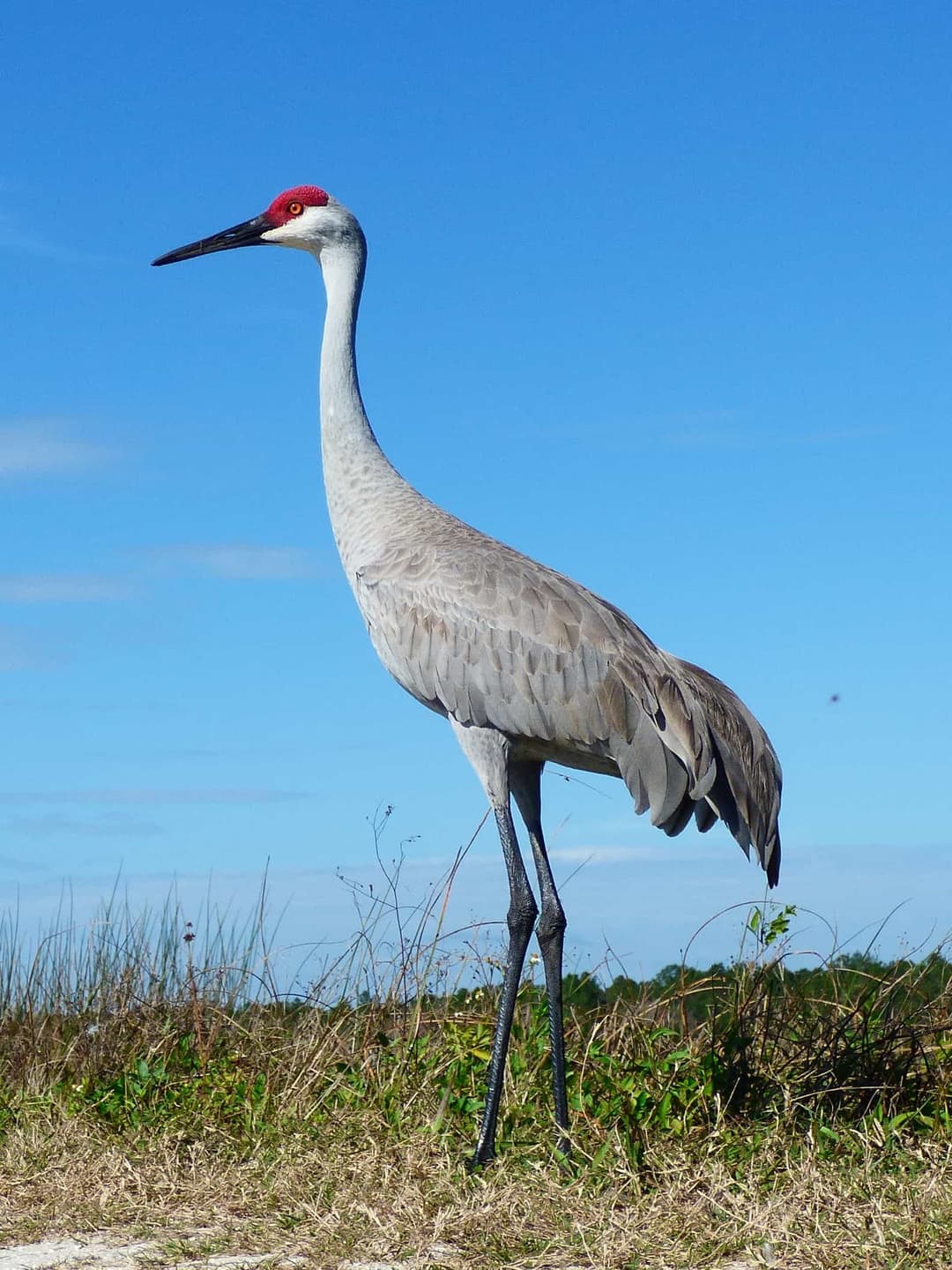
The Sandhill Crane is often mistaken for the Whooping Crane due to their similar size and build. However, Sandhill Cranes have a gray plumage compared to the Whooping Crane's distinct white plumage with black wingtips. Additionally, Sandhill Cranes have a red crown on their heads.
Breeding and nesting habits of the whooping crane
Mating behaviors
Whooping Cranes perform elaborate dances involving leaping, wing spreading, and vocalizations to strengthen pair bonds and attract mates.
Nesting details
Nests are built on the ground in wetlands, often on small grassy islands or marshes. The nests are large mounds made of bulrushes, grasses, and cattails, providing stability and protection from flooding.
Eggs and chick-rearing
Typically, two eggs are laid, but usually, only one chick survives. Both parents incubate eggs and share responsibilities for rearing, feeding chicks with insects, plants, and small animals.
What does a whooping crane like to eat?
Natural diet
Whooping Cranes have an omnivorous diet consisting mainly of aquatic and terrestrial plants, small mammals, fish, insects, crustaceans, and amphibians. They forage in shallow waters and open fields, utilizing their long bills to probe mud and vegetation.
Bird feeders
Whooping Cranes typically do not visit bird feeders, as their diet relies on natural foraging habitats. However, they may consume grains or seeds if available in agricultural areas, but this is rare in domestic settings.
Offer their favorite snacks
Whooping Cranes have a diverse diet that includes insects, crustaceans, and small vertebrates. To encourage their visit, you can also provide corn or grains. Adding a water feature or a shallow pond may attract them, as they are often found near wetlands.
Choose the right feeder type
While cranes typically do not use traditional bird feeders, creating a natural feeding station on the ground may entice them. Keep the area spacious and free from obstacles, allowing the cranes to safely forage and explore.
Try fun tricks to entice them
Set up a dedicated area with enticing visual cues, like shiny objects or flags that mimic wetland grasses. Cranes are curious and may investigate interesting features in your yard. Play crane vocalizations quietly in the background to make them feel at home and possibly join in a sing-along.
Use expert-selected bird buddy seeds
Bird Buddy seeds are specially chosen by experts to appeal to a variety of birds across seasons. Scatter them in your garden to invite not only the Whooping Crane but also a diverse array of birdlife to your yard.
Where can you find whooping cranes?

Primary habitat
The Whooping Crane primarily inhabits wetlands, marshes, and coastal estuaries. It prefers areas with shallow water for feeding and nesting, relying on environments rich in aquatic vegetation and invertebrates.
Additional range
Its current range includes regions from northern Canada to the southern United States, with some wintering in coastal marshes of Texas. Unexpectedly, they may occupy agricultural fields during migration.
Do they migrate?
The Whooping Crane (Grus americana) is a migratory bird. It primarily follows a north-south migratory route in North America. The main population, known as the Wood Buffalo-Aransas flock, travels between their summer breeding grounds in Wood Buffalo National Park in the Northwest Territories and Alberta, Canada, and their wintering habitat in the Aransas National Wildlife Refuge in Texas, USA. Migration typically begins in September, with Whooping Cranes embarking on a journey that can span up to 2,500 miles. They usually complete their migration by late October to early November. On their spring migration back north, they leave Texas around late March to mid-April, reaching Canada by late April to early May. Key stopover sites during migration include areas in the Central Flyway, such as the Platte River in Nebraska, Cheyenne Bottoms in Kansas, and Quivira National Wildlife Refuge also in Kansas. These sites provide essential rest and feeding opportunities. Juvenile cranes learn the migration route from older cranes, ensuring the continuity of these traditional pathways. Conservation efforts focus on protecting these critical stopover sites to support the species' recovery.
What is the role of whooping cranes in nature and how to protect them?
Conservation status
The Whooping Crane is classified as endangered. Major threats include habitat loss, human disturbance, and predation. Key conservation efforts focus on habitat protection, captive breeding, and reintroduction programs. The establishment of protected areas and the management of migration routes are critical. Conservation organizations have collaborated to increase populations through captive breeding, with birds released into the wild to bolster numbers. Education and awareness campaigns aim to reduce human disturbances in critical habitats. Despite these efforts, the species remains at risk, requiring ongoing protection to prevent extinction.
Ecological role of whooping cranes
Its role in the ecosystem
The Whooping Crane plays a vital role in maintaining ecological balance within its habitat. As an apex predator, it helps regulate the populations of small animals, such as insects, amphibians, and crustaceans, thus contributing to pest control. By preying on these species, the crane prevents overpopulation, which could otherwise disrupt plant communities and agricultural areas. Additionally, the Whooping Crane aids in seed dispersal. As it forages, it consumes various fruits and plant materials, later excreting the seeds at different locations, facilitating plant diversity and growth in their ecosystems. This behavior supports habitat heterogeneity, enhancing the resilience of ecosystems against environmental changes. The presence of Whooping Cranes also indicates a healthy, functioning wetland ecosystem, as they require wetlands for nesting and feeding. Their conservation helps protect these crucial habitats, promoting biodiversity and the overall health of the environment. Through their ecological roles, Whooping Cranes contribute significantly to the maintenance and stability of their ecosystems.
How to help protect whooping cranes
Preservation tips
Habitat preservation
Ensure protection of wetlands, marshes, and coastal areas crucial for Whooping Crane nesting and feeding. Promote sustainable land management practices, limit development in sensitive areas, and support the acquisition of key habitats by conservation organizations.
Community science initiatives
Engage in crane monitoring programs and report sightings through platforms like eBird. Participate in citizen science projects that track migration patterns and behavior. Involve local communities through educational workshops and events to raise awareness about their ecological importance.