Common Blackbird or Ring Ouzel?
Here's how to tell the difference




Common Blackbird

Ring Ouzel
Common Blackbird
Turdus merula
Also known as: Eurasian Blackbird
General appearance
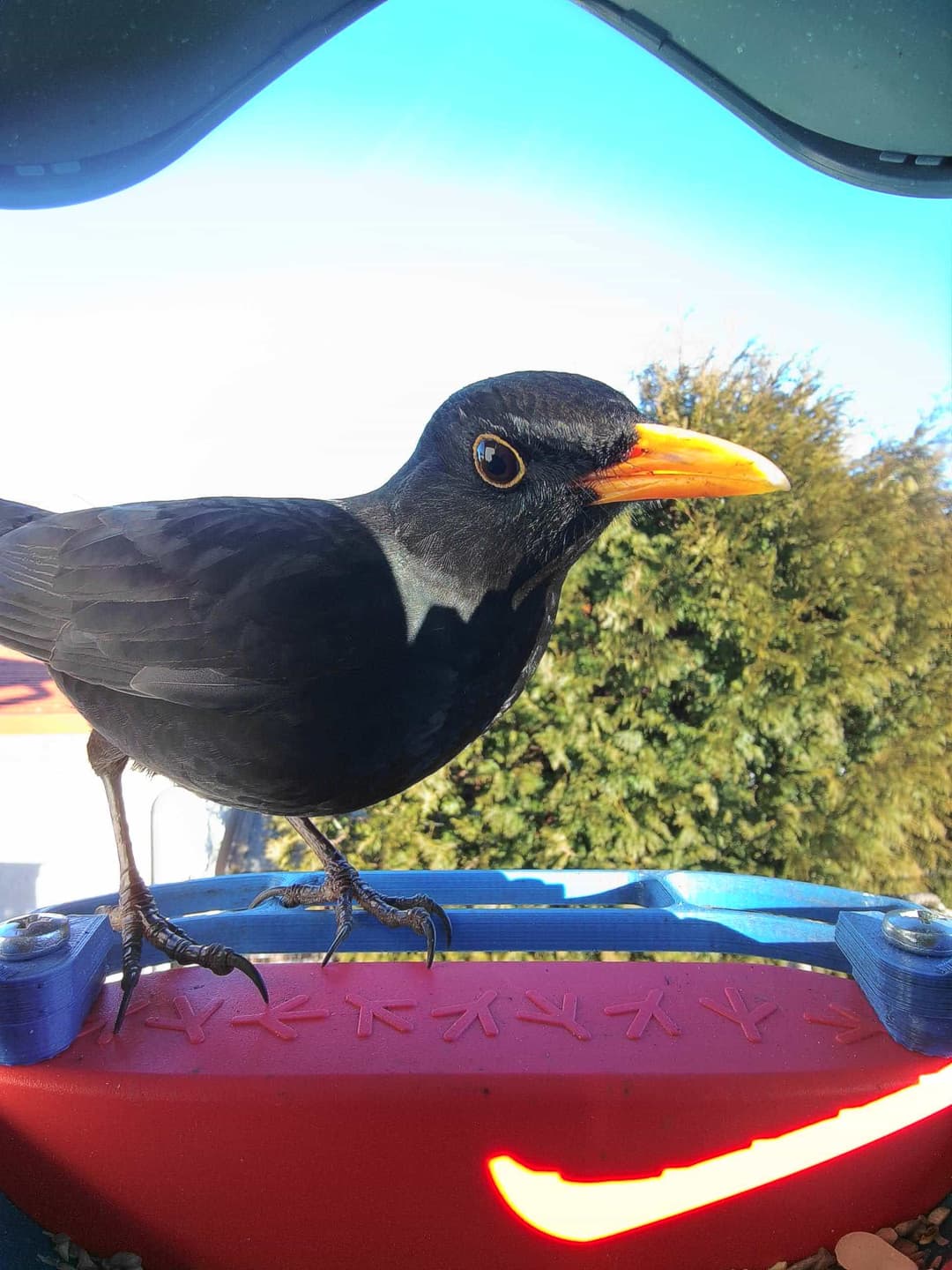
The common blackbird is medium-sized, measuring approximately 23-29 cm in length. They have slender bodies, long tails, and are known for their distinctive melodious songs. Their eyes are highlighted with a bright yellow ring, and they possess a sharp, pointed beak.
Male vs female
Males are predominantly jet black with a vivid orange-yellow beak, contributing to their striking appearance. Females, however, are brown with streaky plumage and a duller beak, serving as a form of camouflage during nesting. Both exhibit the characteristic yellow eye-ring, though it's more prominent in males.
Juvenile
Juvenile blackbirds have brownish plumage, often with speckled or mottled patterns, aiding in their camouflage. Unlike adults, they lack a yellow eye-ring and their beak is darker. As they mature, they'll gradually attain adult coloration. Observing them in woodlands or gardens, particularly in spring and summer, is easier when they are most active.
Size
9.3 - 11.4 in/3.0 - 4.8 oz
There's more to learn about Common Blackbird
View full detailsRing Ouzel
Turdus torquatus
General appearance
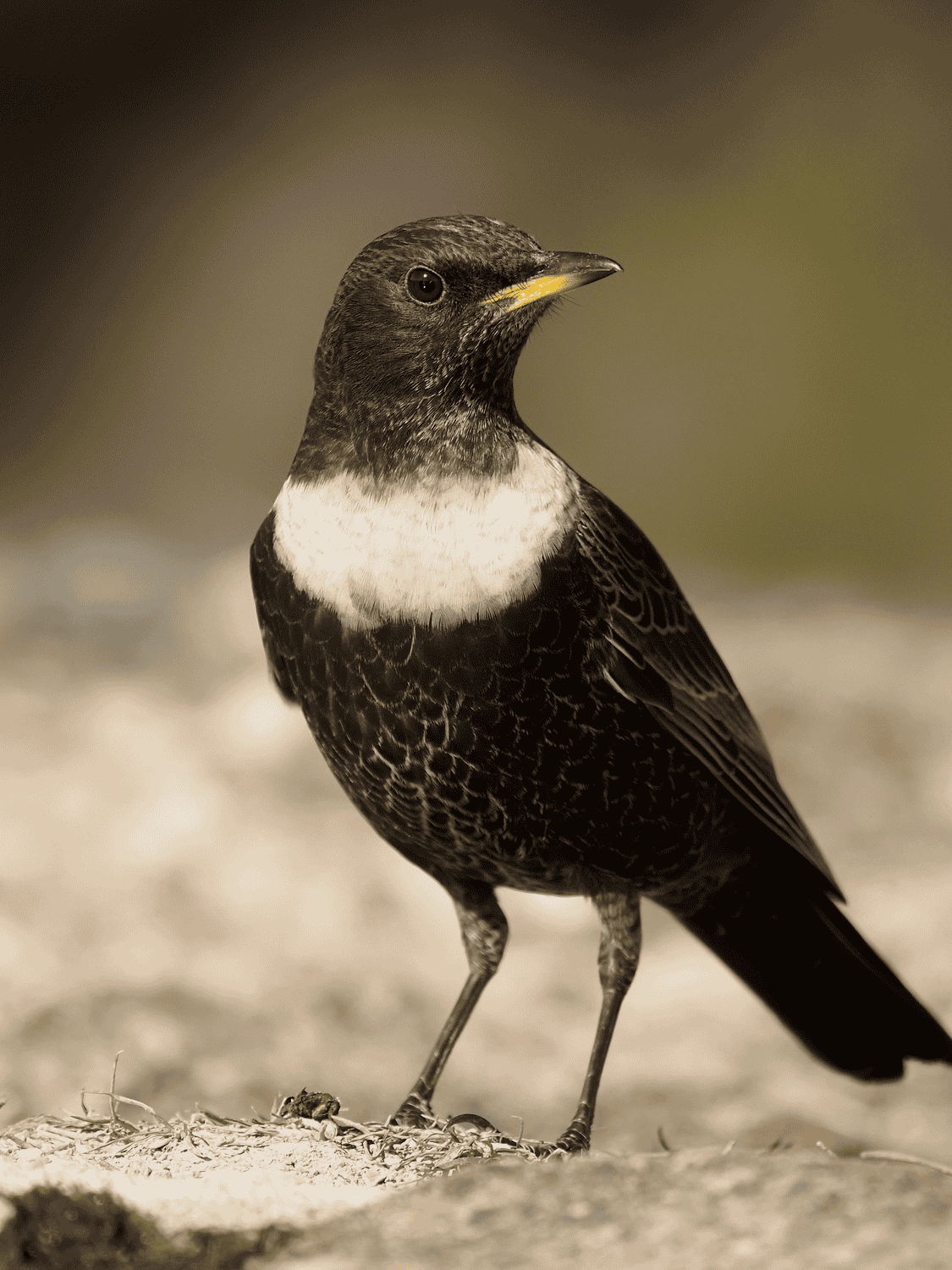
The Ring Ouzel is a small bird relative to the blackbird family, with a length of about 24-26 cm. It has a short tail and long wings, useful for its migration habits. Its plumage is predominantly black or dark grey, with a distinctive white breast-band, giving it its 'ring' moniker.
Male vs female
There is slight sexual dimorphism within the Ring Ouzel's appearance. Males possess a starkly black plumage that adopts a blue sheen in direct sunlight, and their white breast-band is typically broad and clearly defined. Females, however, present a browner coloration with a thinner, sometimes indistinct, white band.
Juvenile
Juvenile Ring Ouzels bear a resemblance to adults but are more spotted in appearance. Their breast-band is blurry and less defined, and their plumage often contains buff-coloured edges. They adopt adult-like appearances after their first winter, yet young males may still exhibit spotted plumage on their underparts.
Size
9.1 - 9.4 in/3.2 - 4.9 oz
There's more to learn about Ring Ouzel
View full detailsHow to tell the Common Blackbird from the Ring Ouzel
Visual differences
The Common Blackbird (9-11.5 inches) is slightly larger than the Ring Ouzel (9-10 inches). Male blackbirds are jet black with a vivid orange-yellow beak and a prominent yellow eye-ring, while Ring Ouzel males are black with a distinctive white breast-band and a blue sheen in sunlight. Female blackbirds are brown and streaked, unlike the browner Ring Ouzel females with a thinner white band. Juvenile blackbirds have speckled brown plumage without the yellow eye-ring; juvenile Ring Ouzels are more spotted with blurry white bands and buff-colored edges.
Key differences and behavior
The Common Blackbird and Ring Ouzel exhibit distinct behaviors. Blackbirds are resident, adaptable to urban spaces, while migratory Ring Ouzels prefer upland moors. Blackbirds are known for post-rain songs, contrasting with the dawn and dusk singing of Ring Ouzels. Both have similar diets, foraging for earthworms and fruits, but Blackbirds are frequent garden visitors and may feed at bird tables, unlike the shy Ring Ouzels. Blackbirds mate for life, construct nests in gardens and parks, and engage in mutual preening during courtship. In contrast, Ring Ouzels prefer nesting on steep hillsides and exhibit territorial singing. Both species participate in feeding chicks, with Ring Ouzels favoring alpine and northern habitats in winter.
Common Blackbird vs [Select a bird]

[Select a bird]
Pick a bird to compare
Ring Ouzel vs [Select a bird]
[Select a bird]
Pick a bird to compare