Blyth's Reed Warbler or Marsh Warbler?
Here's how to tell the difference
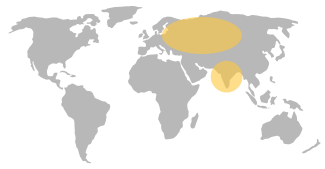
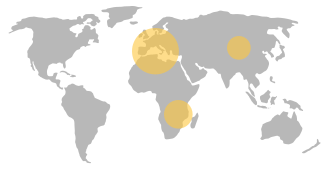

Blyth's Reed Warbler

Marsh Warbler
Blyth's Reed Warbler
Acrocephalus dumetorum
Blyth's Reed Warbler Characteristics
General appearance: Blyth's Reed Warbler is a small, dull-colored songbird. Its plumage is predominantly grey-brown above with a paler, creamy-buff underside, which can appear slightly warmer in some lights. Its upperparts are characterized by a distinct olive tinge, while the wings have light, delicate feather edges that provide a slightly scalloped appearance. The bird boasts a pale supercilium, set against the slightly darker areas around the eyes. The bill is sharp and slender, perfectly adapted for its insectivorous diet. Male vs female: In Blyth's Reed Warbler, males and females exhibit minimal dimorphism, with both sexes sporting similar plumage and size. This resemblance can make gender identification challenging in the field without close observation or during specific behavioral displays during breeding. Juvenile: Juvenile Blyth's Reed Warblers are similar to adults but often possess a fresher and slightly more vibrant appearance due to the newness of their plumage. Their undersides might display a subtle, buff hue, and they lack the slight wear and tear that might be evident in adult feathers. Identifying juveniles is more straightforward during the late summer months when their pristine feathers contrast with those of worn adults.
Size
4.3 - 5.5 in/0.3 - 0.7 oz
There's more to learn about Blyth's Reed Warbler
View full detailsMarsh Warbler
Acrocephalus palustris
Characteristic Description of Marsh Warbler
Marsh Warblers are small, plain-looking birds with a body length of approximately 13 cm and a wingspan between 18cm and 21cm. Their overall coloration is a dull greenish-brown on the upperparts and off-white to pale yellow on the underparts. Their rounded wings and pointed tails give them an unremarkable, though functional appearance in flight. The differences between male and female Marsh Warblers are limited, as both sexes display similar color patterns. They share the same tones of brown and cream across their plumage, making them challenging to differentiate in the field without closer inspection. During the breeding season, however, males might exhibit slightly brighter hues due to hormonal changes. Juvenile Marsh Warblers can be distinguished from adults by their somewhat darker and duller plumage. Their feathers tend to look more ruffled and worn compared to the sleeker appearance of adults. Juveniles generally lack the subtle sheen that indicates maturity and may also exhibit more prominent light streaking on their throats which fades with age.
Size
5.1 - 5.9 in/0.4 - 0.5 oz
There's more to learn about Marsh Warbler
View full detailsHow to tell the Blyth's Reed Warbler from the Marsh Warbler
Visual differences
Blyth's Reed Warbler and Marsh Warbler have subtle visual differences. The Blyth's Reed Warbler is generally smaller, measuring 4.3-5.5 inches in length and weighing 0.28-0.71 ounces, whereas the Marsh Warbler is slightly larger, 5.1-5.9 inches long and 0.35-0.53 ounces. The Blyth's Reed Warbler has plainer, browner plumage, while the Marsh Warbler displays a more olive-toned appearance. Both have similar beak shapes, but the Marsh Warbler's might appear slightly more robust. Identifying specifics can be challenging due to their similar size and color.
Key differences and behavior
Blyth's Reed Warbler and Marsh Warbler exhibit distinct behavioral traits aiding field identification. Blyth’s Reed Warbler prefers temperate forests and dense shrubs, often seen singing complex, imitative tunes from trees. In contrast, Marsh Warblers inhabit wetlands and engage in impressive mimicry during lively courtship, incorporating up to 75 bird songs. Both species are monogamous during breeding, but Blyth's Reed Warblers sing elaborate melodies early in spring to attract mates, nesting in dense bushes. They share parental duties over 4-6 eggs. Marsh Warblers frequently relocate breeding grounds annually, nesting in reeds near water, caring for 4-5 eggs over 14 days. Dietarily similar, both primarily consume insects, shifting slightly to berries during migration. Blyth's may sporadically visit feeders with dried insects, while Marsh prefer softer foods and fruits. Providing native shrubs boosts natural insect populations to attract both species.
Still not sure? Here are more lookalikes!
Blyth's Reed Warbler vs Eurasian Reed Warbler


Blyth's Reed Warbler vs Great Reed Warbler


Blyth's Reed Warbler vs [Select a bird]

[Select a bird]
Pick a bird to compare
Marsh Warbler vs [Select a bird]
[Select a bird]
Pick a bird to compare