Blyth's Reed Warbler or Eurasian Reed Warbler?
Here's how to tell the difference
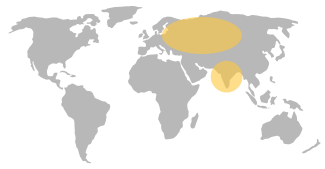


Blyth's Reed Warbler

Eurasian Reed Warbler
Blyth's Reed Warbler
Acrocephalus dumetorum
Blyth's Reed Warbler Characteristics
General appearance: Blyth's Reed Warbler is a small, dull-colored songbird. Its plumage is predominantly grey-brown above with a paler, creamy-buff underside, which can appear slightly warmer in some lights. Its upperparts are characterized by a distinct olive tinge, while the wings have light, delicate feather edges that provide a slightly scalloped appearance. The bird boasts a pale supercilium, set against the slightly darker areas around the eyes. The bill is sharp and slender, perfectly adapted for its insectivorous diet. Male vs female: In Blyth's Reed Warbler, males and females exhibit minimal dimorphism, with both sexes sporting similar plumage and size. This resemblance can make gender identification challenging in the field without close observation or during specific behavioral displays during breeding. Juvenile: Juvenile Blyth's Reed Warblers are similar to adults but often possess a fresher and slightly more vibrant appearance due to the newness of their plumage. Their undersides might display a subtle, buff hue, and they lack the slight wear and tear that might be evident in adult feathers. Identifying juveniles is more straightforward during the late summer months when their pristine feathers contrast with those of worn adults.
Size
4.3 - 5.5 in/0.3 - 0.7 oz
There's more to learn about Blyth's Reed Warbler
View full detailsEurasian Reed Warbler
Acrocephalus scirpaceus
Also known as: Reed Warbler
General appearance
The Eurasian Reed Warbler is a small, agile bird primarily characterized by its reddish-brown upperparts and creamy underparts. The head has a subtle grey-brown hue with a slightly paler throat and chest. Its wings are broad and rounded, aiding in its skilled maneuvering through dense reed beds where it typically resides. The tail is relatively long and slightly notched, displaying a similar reddish-brown coloring. The bird's bill is slender and pointed, a typical feature of insectivore birds, allowing it to adeptly catch insects amidst foliage.
Male vs female
Male and female Eurasian Reed Warblers appear remarkably similar, with little distinction in plumage coloration between the sexes. Both possess the characteristic brownish tones and creamy underparts, making gender differentiation mainly reliant on behavior during the breeding season rather than distinct visual traits. Occasionally, males may exhibit slightly brighter plumage, but this is not significantly pronounced.
Juvenile
Juvenile Eurasian Reed Warblers display similar coloration to adults but with slightly duller and less defined plumage. Their underparts tend to show a buffish tint rather than the creamy white of adults. Additionally, juveniles may have more prominent streaking on their upperparts, providing some degree of camouflage during their initial stages of life. As they mature, these streaks fade, and the overall plumage becomes more pronounced, adopting the characteristic adult coloring.
Size
4.9 - 5.3 in/0.3 - 0.7 oz
There's more to learn about Eurasian Reed Warbler
View full detailsHow to tell the Blyth's Reed Warbler from the Eurasian Reed Warbler
Visual differences
Blyth's Reed Warbler typically measures 4.3-5.5 inches in length, while the Eurasian Reed Warbler is slightly smaller at about 4.9-5.3 inches. Visually, Blyth's has browner plumage with less contrast between upperparts and underparts, while the Eurasian displays reddish-brown upperparts and creamy underparts. Blyth's has a more rounded bill, whereas the Eurasian's is slender and pointed. Additionally, Blyth's lacks the distinctly broad and rounded wings seen in the Eurasian, making the latter better suited for weaving through reed beds.
Key differences and behavior
Blyth's Reed Warbler and Eurasian Reed Warbler exhibit distinct behavioral differences. Blyth's Reed Warbler frequents trees and bushes to sing, often incorporating other birds' songs, demonstrating adaptability across temperate forests and urban areas, especially during migration. In contrast, the Eurasian Reed Warbler's presence is nearly exclusive to reed beds, identifiable by its melodious song, with singing aids in defending territory. For breeding, both species construct cup-shaped nests, but Blyth's often hides them in shrubs, while Eurasian Reed Warblers prefer reeds near water. Both are monogamous, with similar incubation periods and fledging timelines. Dietarily, both warblers consume insects, but Blyth's Reed Warbler also forages for berries during migrations, seldom visiting feeders. In comparison, Eurasian Reed Warblers might visit feeders with insect-based offerings when natural food is scarce, relying more heavily on insects year-round.
Still not sure? Here are more lookalikes!
Blyth's Reed Warbler vs Great Reed Warbler


Blyth's Reed Warbler vs [Select a bird]

[Select a bird]
Pick a bird to compare
Eurasian Reed Warbler vs [Select a bird]

[Select a bird]
Pick a bird to compare