
Northern Mockingbird
Northern Mockingbird
Mimus polyglottos


Quick Identification guide
Quick Identification guide
- •
Medium-sized with a slender build and a long tail featuring white outer tail feathers
- •
Has a distinctive grayish upper part, with paler gray to white underparts
- •
Features a slim, straight black beak and white wing patches that are visible in flight
What does a northern mockingbird sound like?
The Northern Mockingbird has a complex call pattern that includes rising, falling, flat, and undulating sounds, with each musical phrase repeated at least three times. Its vocalizations often mimic other birds, and it regularly sings at night. Typical calls include a harsh "chack", chatter, chirp or chip-like noises, odd cries, screams, and whistles. These sounds are repetitive and can be grating, but are also characterized by their unique musicality.


Description
Is that ten different birds you hear? No, just one. Mockingbirds are excellent mimics and love to learn; they keep adding new sounds to their repertoire and a single male can learn up to 200 songs in their lifetime. They are tireless, singing all day and sometimes all night; especially when there's a full moon! They sing in spring and autumn and have two different set lists fit for the seasons.
The northern mockingbird can weigh between 40to58grams and be from20.5to26centimeters tall.
The Northern Mockingbird typically lives up to 8 years, though under optimal conditions may survive to 20 years old. This is longer than related species like the Catbird and the Brown Thrasher. Despite facing threats like predation and harsh winters, the mockingbird’s longevity can be attributed to its adaptability to different environments, varied diet and aggressive defensive tactics.
Did you know?
Most popular questions about northern mockingbird
How to recognise a northern mockingbird?
General appearance
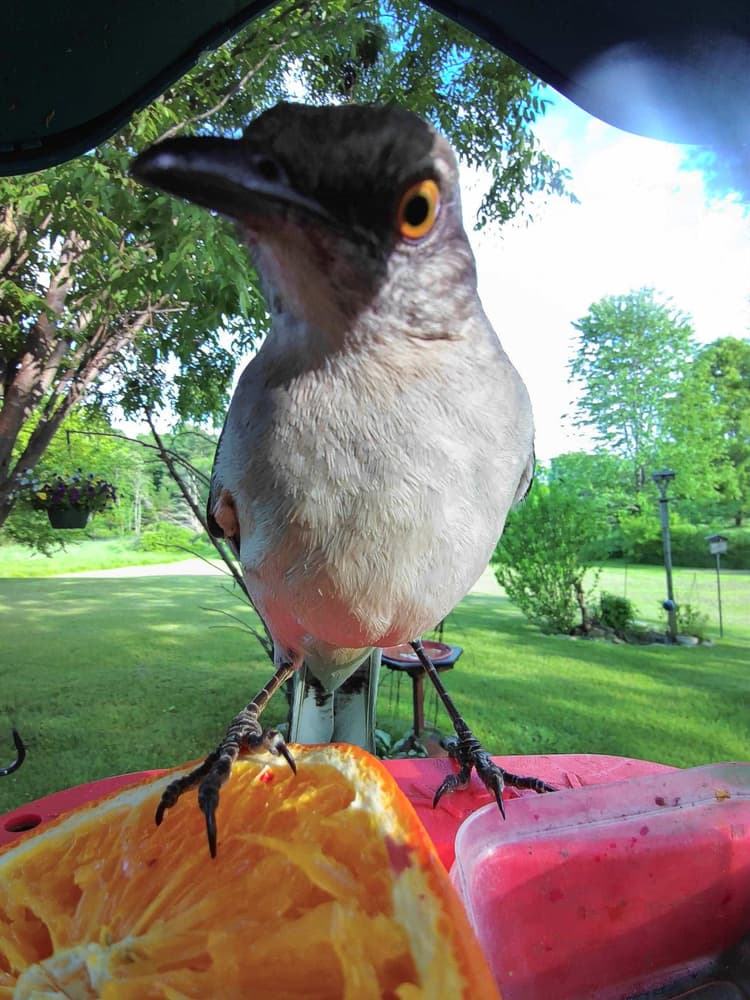
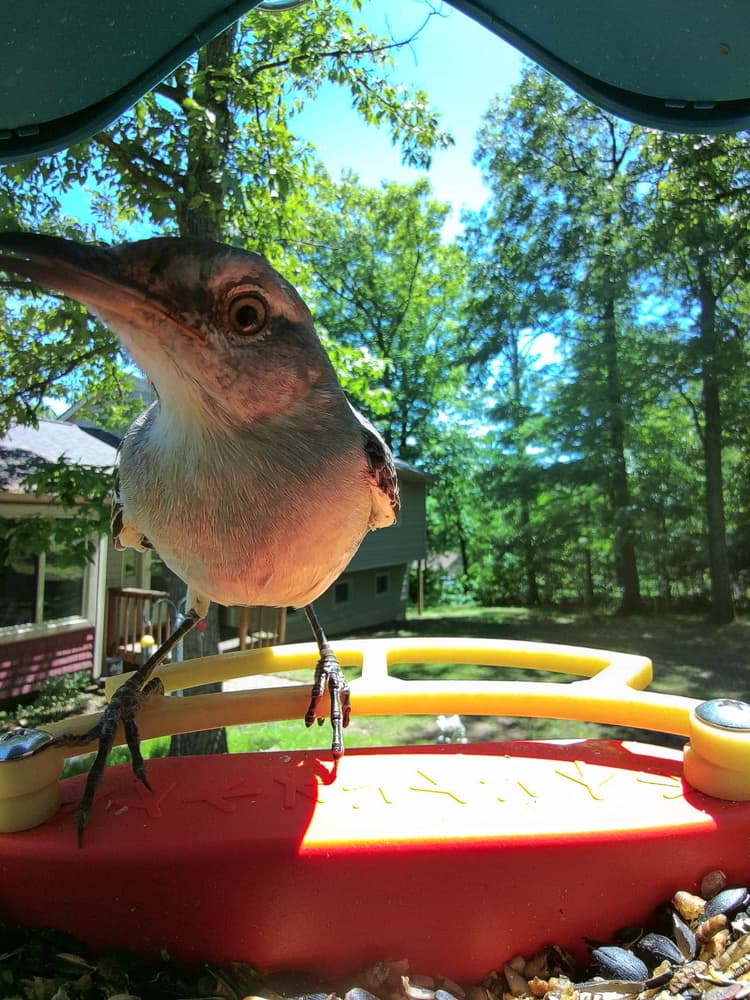
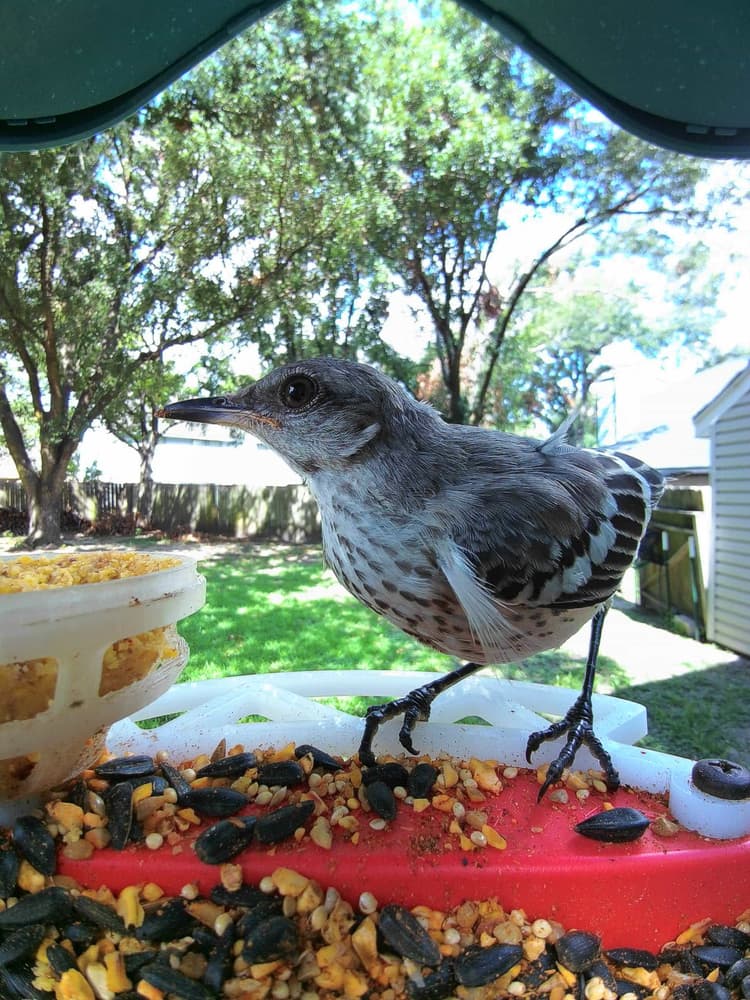
The northern mockingbird is a slim, long-tailed bird standing at a size of about 9-11 inches (23-28 cm), comparable to a robin. It showcases a pale grey coloration, with prominent white wing patches that are especially discernable when in flight. Furthermore, the bird has white outer tail feathers that contribute to its distinctive sleek appearance. The tail shape can be variously described as long, rounded, or wedge-shaped.
Male vs female
Both male and female northern mockingbirds bear similar characteristics in terms of size, color, and other physical traits. They both have slim bodies, white wing patches, and long tail feathers. Therefore, distinguishing between males and females solely based on physical traits may be challenging.
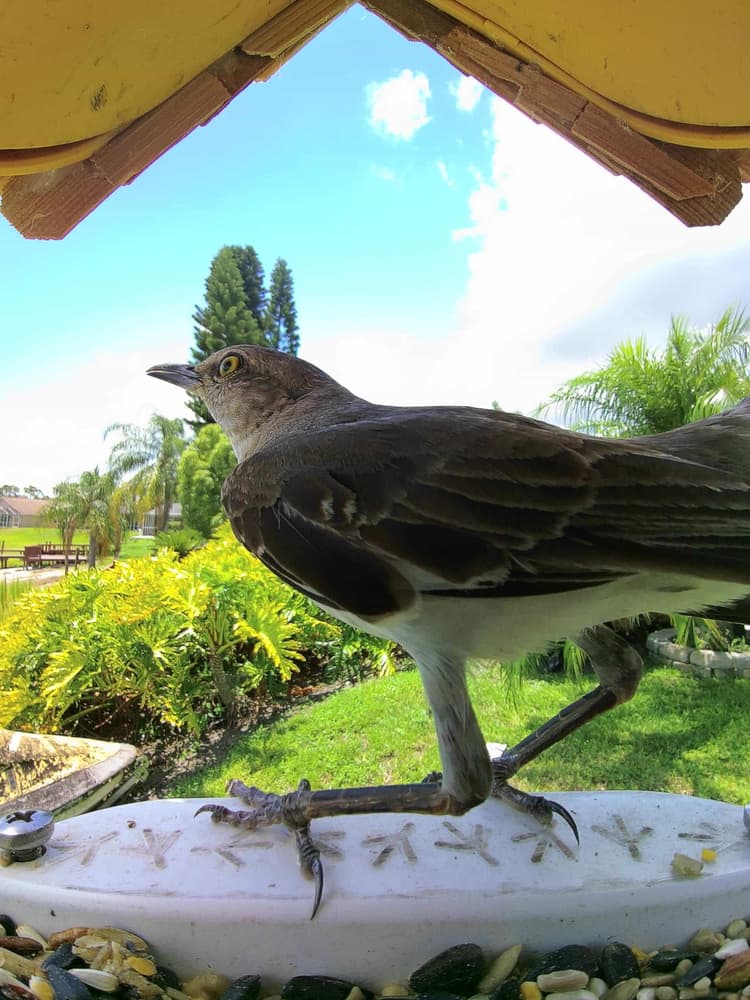
Male Northern Mockingbird
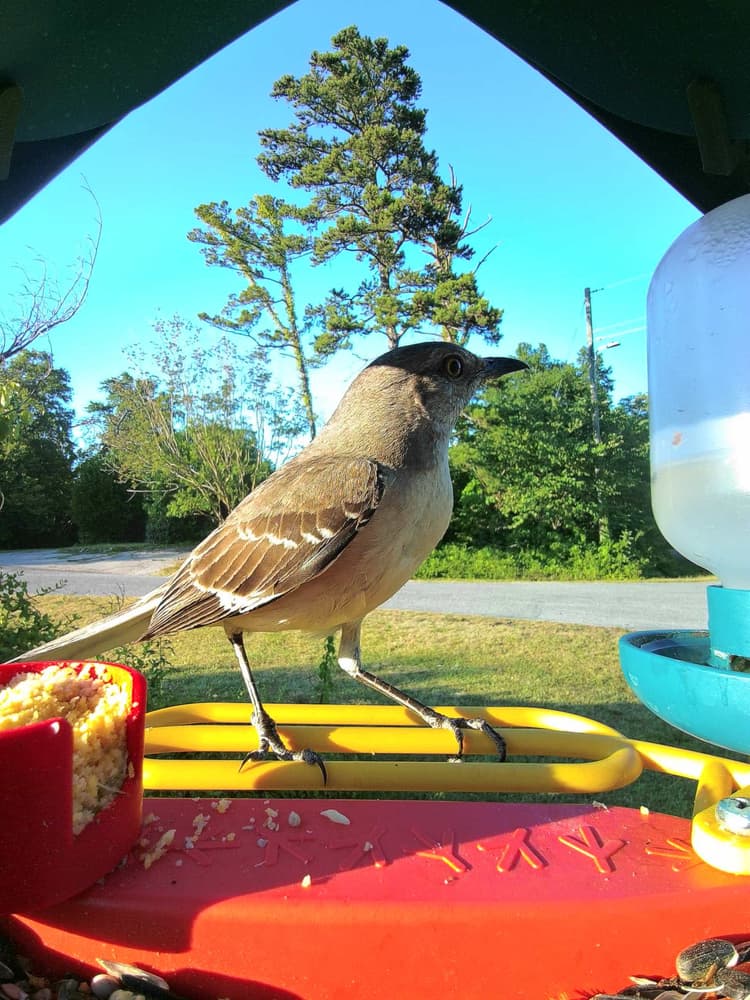
Female Northern Mockingbird
Juvenile
Young northern mockingbirds, or juveniles, share the same basic coloration and size as adults. However, they can be distinguished due to unique traits found prominently during their early stages. A juvenile mockingbird has darker streaks on their chest and somewhat darker eyes compared to adult birds. Moreover, their wing patches may not be as pronounced.
Often mistaken for
Gray Catbird vs Northern Mockingbird
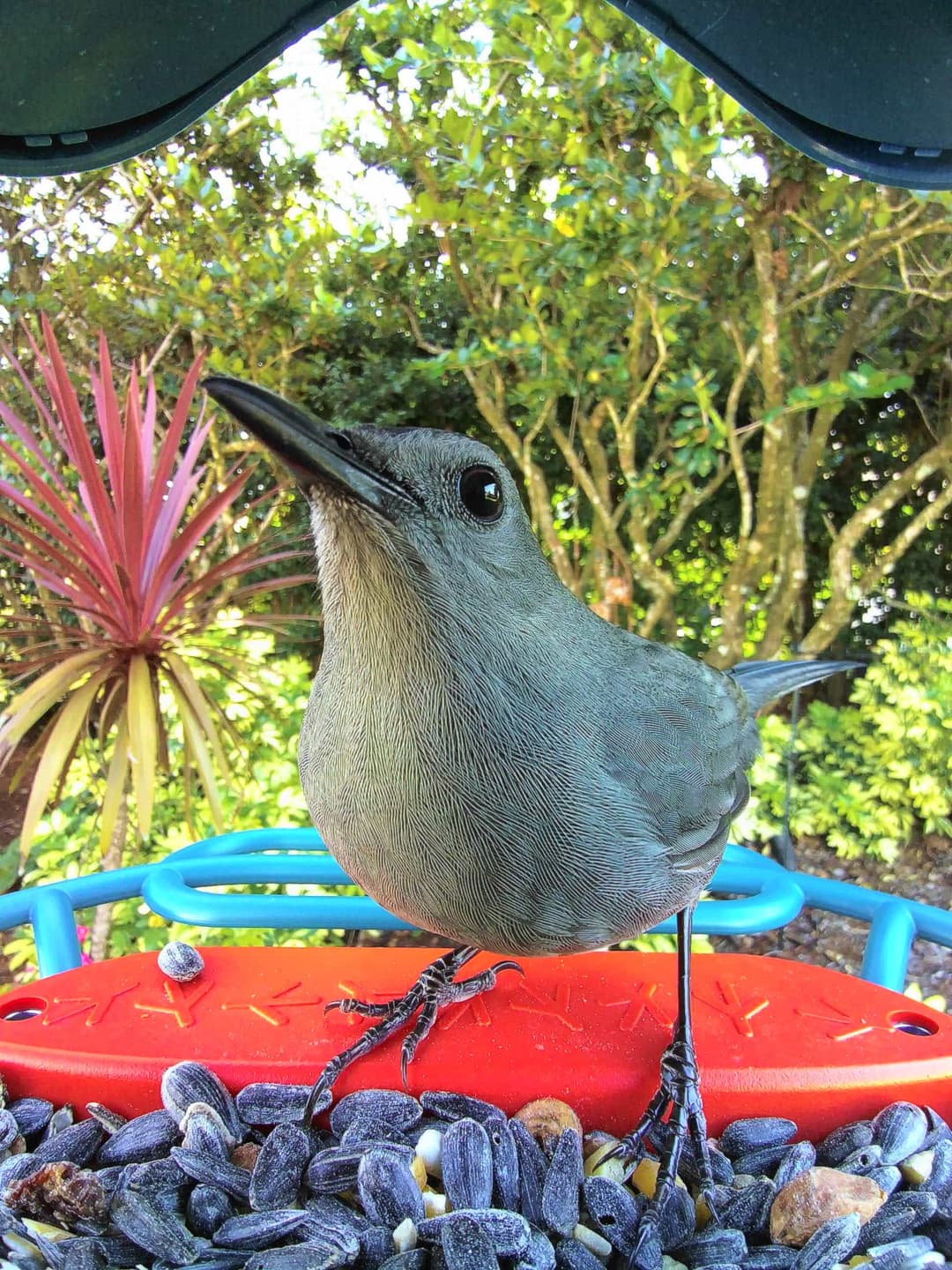
The Northern Mockingbird is overall lighter with white wing bars that are prominent when in flight. In contrast, the Gray Catbird is uniformly dark gray with a distinctive black cap. The Mockingbird has a longer tail with white outer feathers, while the Catbird's tail is plain. Mockingbirds have a varied, mimicking song, whereas Catbirds often end their songs with a cat-like mew.
Blue-Gray Gnatcatcher vs Northern Mockingbird
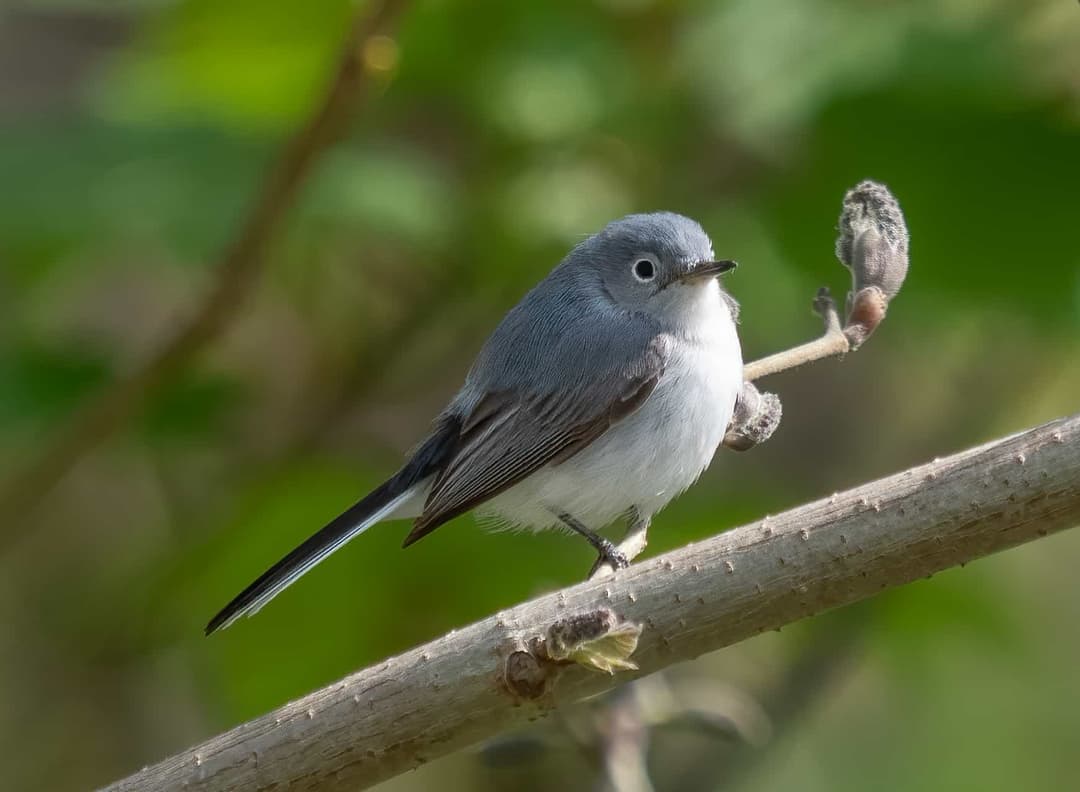
The Northern Mockingbird is significantly larger than the Blue-Gray Gnatcatcher. Mockingbirds have a gray upper body and white underparts with visible white wing patches. In comparison, the Gnatcatcher is smaller, with a more slender build and lacks the Mockingbird's notable white wing patches. Gnatcatchers have a narrow, faint eye ring and a more bluish-gray tone.
Breeding and nesting habits of the northern mockingbird
Mating behaviors
Nesting begins early in late winter in southern areas. Males sing to defend their territory and attract a mate, often leaping a few feet into the air and flapping their wings while singing. The early stage of courtship involves both male and female rapidly chasing each other around their territory.
Nesting details
Nests are typically placed in dense shrubs or trees, usually 3-10 feet above the ground, though rarely as high as 60 feet. The nest features a bulky foundation of twigs supporting an open cup of weeds, grass, and leaves, lined with fine materials such as rootlets, moss, animal hair, and plant down. The male builds most of the foundation, while the female adds most of the lining. To create a suitable habitat in gardens, plant dense shrubs or small trees to provide potential nesting sites.
Eggs and chick-rearing
Once nesting is established, the female lays eggs which she incubates until hatching. Both parents participate in feeding and rearing the chicks, ensuring they have the necessary nutrition and protection to develop and fledge successfully.
What does a northern mockingbird like to eat?
Berries
Fruits
Insects
Sap
Scraps
Seeds
Natural diet
The northern mockingbird's diet primarily includes insects and berries. Annually, about half of its diet consists of insects and other arthropods, and the other half comprises berries and fruits. During late spring and summer, it feeds heavily on insects such as beetles, grasshoppers, caterpillars, ants, and wasps, along with spiders, snails, sowbugs, and earthworms. In rare instances, it may consume crayfish and small lizards. During fall and winter, the bird's diet shifts towards berries and wild fruits, occasionally including some cultivated fruits.
Bird feeders
The northern mockingbird can be attracted to bird feeders with offerings of fruits, such as raisins and apples. It may also consume suet and is infrequently drawn to peanut butter mixtures. Its preference leans more towards natural sources, so attractants that mimic these will be more successful in enticing them to feeders.
Favorite snacks for northern mockingbirds
Northern Mockingbirds are omnivores. They have an eclectic taste and enjoy a variety of foods like insects, berries, and fruits. They are particularly fond of mealworms, which you can provide in your bird feeder. They might also enjoy apples, grapes, and raisins. Bird Buddy seeds have given great results because they offer seasonally appropriate seed mixes chosen by experts.
Feeder types for northern mockingbirds
Northern Mockingbirds prefer flat feeders with some sort of cover nearby that they can escape to if threatened. A platform, tray, or hopper style bird feeder would be a good option. Ensure that the feeder is safe from predators, especially cats, and not too close to windows to prevent colliding accidents.
Fun tricks to encourage northern mockingbirds
Northern Mockingbirds are known for their unique capacity to mimic. To get them to stay for a sing-along, play bird songs on a device near your yard. Just be sure not to play the same song often as they may interpret it as a territorial threat. Another fun trick is to place some shiny objects around your yard. Mockingbirds are attracted to shiny things and this will likely make your yard an interesting place for them to visit.
Where can you find northern mockingbirds?
Based on Birdbuddy sighting data. The heatmap shows where Birdbuddy users have spotted this species.
Embed this map
This map shows the full native range based on scientific range data.
Wild suburbs and always sunny countrysides
Frolicking in suburban gardens and open farmland, the northern mockingbird is a thrill-seeker under the sunny skies of Southern U.S. states and Mexico.
Urban jungles and aquatic surprises
Don't let their love for open fields fool you! These birds can call busy urban jungles home, and with a surprising penchant for swimming pools, their knack for unexpected locales is unmatched.
Do they migrate?
The northern mockingbird (Mimus polyglottos) is primarily a non-migratory bird, meaning it generally stays in one place throughout the year. It is commonly found in the United States, Mexico, and parts of Canada. While most populations do not migrate, there can be some local movement or short-distance migration, especially among northern populations. In the northernmost parts of their range, such as the extreme northern United States and southern Canada, some individuals may move southward during severe winters to avoid harsh weather. These movements are not well-documented as long-distance migrations and tend to be irregular and not specific to particular routes or key locations. Overall, the northern mockingbird is well-adapted to a variety of habitats, including urban and suburban areas, which allows it to remain year-round in most of its range. This adaptability, coupled with its ability to find food such as insects and fruits in different environments, supports its non-migratory lifestyle.
What is the role of northern mockingbirds in nature and how to protect them?
Conservation status
The northern mockingbird, once scarce due to the pet trade, has rebounded and is now common across much of its range. After the cessation of the cagebird trade, its population recovered significantly. In recent decades, it has expanded northwards, aided by the widespread planting of multiflora rose, which provides berries and nesting sites. Currently, the species faces no major threats and does not require special conservation efforts, indicating it is not vulnerable or endangered. The planting of multiflora rose remains a beneficial factor in its successful population spread in the northeast.
Ecological role of northern mockingbirds
Its role in the ecosystem
The Northern Mockingbird holds great ecological significance. Firstly, it controls pests by feeding heavily on insects such as beetles, grasshoppers, caterpillars, ants, wasps and others. This limits the population of these insects, sustaining a balanced ecosystem and possibly reducing damage to crops or vegetation in human settings. Secondly, the Mockingbird contributes to seed dispersal. Its diet leans heavily towards berries and wild fruits during the fall and winter. By consuming these and excreting the undigested seeds, the Mockingbird aids in the propagation of these plants, helping to maintain plant biodiversity. Thirdly, its nesting behavior and territoriality may directly impact the structure of local avian communities by influencing where certain bird species can establish nests. Therefore, the Northern Mockingbird actively contributes to an ecosystem's functional dynamics.
How to help protect northern mockingbirds
Preservation tips
Habitat preservation strategies
Conserving the northern mockingbird involves protecting and restoring their natural habitats, which include urban and suburban areas, along with farmland and forest edges. Avoiding the use of pesticides can preserve their insect food sources. Plant native shrubs, trees, and vines that provide food and nesting sites. Leaving leaf litter on the ground can attract insects which are integral to their diet.
Community science initiatives
Engaging in community science projects can help monitor and conserve the northern mockingbird population. Participate in citizen-science projects like the Audubon's Christmas Bird Count or the Great Backyard Bird Count. Record and share your sightings on platforms like eBird. Educate your community by organizing workshops about the importance of bird conservation.