Black-Winged Red Bishop or Yellow-Crowned Bishop?
Here's how to tell the difference


Black-Winged Red Bishop

Yellow-Crowned Bishop
Black-Winged Red Bishop
Euplectes hordeaceus
Also known as: Fire-Crowned Bishop, Black-Winged Bishop
General appearance
The Black-Winged Red Bishop is a strikingly colorful bird known for its vibrant plumage. Exhibiting a brilliant red-orange hue on the head, neck, and chest, the bird's back and wings are starkly contrasting, exhibiting a shiny black sheen. It has a compact body with a short tail and a thick, conical bill that is well-suited for seed feeding. These colors are most vivid during the breeding season, making it an eye-catching presence in its habitat.
Male vs female
In this species, males and females display notable sexual dimorphism. Males are resplendent with their bright red-orange plumage, especially prominent during the breeding season, which serves to attract mates. In contrast, females are more inconspicuous, with a muted brown coloration that provides camouflage and protection from predators. While male bishops change their plumage with the seasons, females retain relatively consistent coloration year-round.
Juvenile
Juvenile Black-Winged Red Bishops are initially clad in a dull brown plumage that lacks the vivid coloration of adult males. This drab appearance is similar to that of adult females and serves as an essential adaptation for survival, helping them remain camouflaged in their natural environment. As they mature, young males will gradually molt into their characteristic red and black plumage, marking their transition into adulthood.
Size
4.5 - 4.9 in/0.6 - 1.0 oz
There's more to learn about Black-Winged Red Bishop
View full detailsYellow-Crowned Bishop
Euplectes afer
Also known as: Golden Bishop, Napoleon Weaver, Black-Winged Golden Bishop, Napoelon Bishop
General appearance
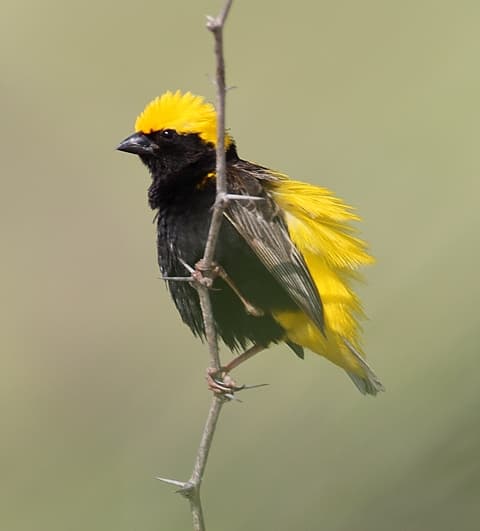
The yellow-crowned bishop (Euplectes afer) is a vivacious small bird, measuring around 10 centimeters in length. They have short, conical beaks suited for seed eating and are best known for their stunning yellow and black plumage.
Male vs female
Male bishops exhibit a vibrant yellow crown, back, and underparts, juxtaposed with pitch-black wings, tail, and belly during breeding seasons. Outside this period, males don similar, more subdued hues as females. Females are generally smaller and have entirely brown-feathered bodies, making them hard to distinguish from other female weavers.
Juvenile
Juvenile yellow-crowned bishops resemble the females, with a dusky-brown appearance. However, the coloration starts to change to either vibrant (in males) or a bit intense brown (in females) as they hit adolescence. Seasonal molting introduces more of the striking yellow and black colors in the males.
Size
3.9 - 4.3 in/0.4 - 0.7 oz
There's more to learn about Yellow-Crowned Bishop
View full detailsHow to tell the Black-Winged Red Bishop from the Yellow-Crowned Bishop
Visual differences
The Black-Winged Red Bishop (4.5-4.9 inches, 0.6-1 ounce) features vibrant red-orange heads, necks, and chests with shiny black backs and wings. In contrast, the Yellow-Crowned Bishop (3.9-4.3 inches, 0.4-0.7 ounce) boasts a yellow crown, back, and underparts with black wings and bellies. Both species have short, conical beaks, but the yellow-crowned bishop is smaller. Male Bishops exhibit their bright colors during breeding, while females of both are brown and less conspicuous year-round.
Key differences and behavior
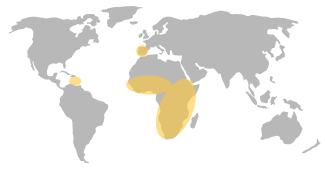
The Black-Winged Red Bishop and Yellow-Crowned Bishop, both social birds, differ notably in behavior and habitat. The Black-Winged Red Bishop thrives in wetland regions, savannas, and adaptable areas near water across sub-Saharan Africa, whereas the Yellow-Crowned Bishop also inhabits tropical zones in California and Hawaii. Both perform vibrant courtship displays, but the Black-Winged engages in elaborate flight activities, maintaining territories with polygyny, whereas the Yellow-Crowned builds multiple nests to attract females. In diet, both favor grass seeds but diversify into insects during breeding. The Black-Winged Red Bishop also consumes nectar occasionally. In breeding, the Black-Winged male is vigorously involved in nest building, while the Yellow-Crowned defers mostly to females. Overall, these bishops share social and dietary traits but are distinguished by their nesting and courtship behaviors, along with differing habitats.
Still not sure? Here are more lookalikes!
Black-Winged Red Bishop vs Southern Red Bishop



Black-Winged Red Bishop vs [Select a bird]

[Select a bird]
Pick a bird to compare
Yellow-Crowned Bishop vs [Select a bird]
[Select a bird]
Pick a bird to compare