Black-Winged Red Bishop or Southern Red Bishop?
Here's how to tell the difference

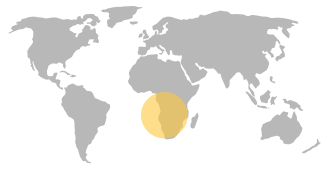

Black-Winged Red Bishop

Southern Red Bishop
Black-Winged Red Bishop
Euplectes hordeaceus
Also known as: Fire-Crowned Bishop, Black-Winged Bishop
General appearance
The Black-Winged Red Bishop is a strikingly colorful bird known for its vibrant plumage. Exhibiting a brilliant red-orange hue on the head, neck, and chest, the bird's back and wings are starkly contrasting, exhibiting a shiny black sheen. It has a compact body with a short tail and a thick, conical bill that is well-suited for seed feeding. These colors are most vivid during the breeding season, making it an eye-catching presence in its habitat.
Male vs female
In this species, males and females display notable sexual dimorphism. Males are resplendent with their bright red-orange plumage, especially prominent during the breeding season, which serves to attract mates. In contrast, females are more inconspicuous, with a muted brown coloration that provides camouflage and protection from predators. While male bishops change their plumage with the seasons, females retain relatively consistent coloration year-round.
Juvenile
Juvenile Black-Winged Red Bishops are initially clad in a dull brown plumage that lacks the vivid coloration of adult males. This drab appearance is similar to that of adult females and serves as an essential adaptation for survival, helping them remain camouflaged in their natural environment. As they mature, young males will gradually molt into their characteristic red and black plumage, marking their transition into adulthood.
Size
4.5 - 4.9 in/0.6 - 1.0 oz
There's more to learn about Black-Winged Red Bishop
View full detailsSouthern Red Bishop
Euplectes orix
Also known as: Red Bishop
General Appearance
The Southern Red Bishop is a small yet vivid bird that showcases spectacular plumage during the breeding season. The male is best known for its bright red or orange-red coloration that covers much of the body, particularly the head, back, and breast. It is contrasted by glossy black wings and a black face mask. Its stout bill is perfectly suited for seed consumption. Non-breeding males and females display more subdued colors, primarily brownish with streaky patterns that aid in camouflage.
Male vs Female
During the breeding season, male Southern Red Bishops are easily distinguishable from females, thanks to their flamboyant red-orange attire and dark black masked face. Females, on the other hand, are more discreet, donning earthy tones of brown with speckled patterns for an overall duller and more camouflaged appearance. Outside the breeding season, males lose much of their bright coloration, blending in more with female plumage.
Juvenile
Juvenile Southern Red Bishops bear strong resemblance to adult females, sporting similar brown streaks and lacking the striking coloration of breeding males. This subdued appearance helps in remaining unnoticed by predators. Eventually, as they mature, males begin to acquire the intense red hues characteristic of the breeding season, distinguishing them from their female counterparts.
Size
3.9 - 5.9 in/0.9 - 1.0 oz
There's more to learn about Southern Red Bishop
View full detailsHow to tell the Black-Winged Red Bishop from the Southern Red Bishop
Visual differences
The Black-Winged Red Bishop has a vivid red-orange head, neck, and chest with black back and wings, a compact body, and a thick, conical bill. In contrast, the Southern Red Bishop displays intense red plumage primarily on the body, with less contrast between head and body colors. Southern Red Bishops are slightly larger overall, reaching up to 5.9 inches in length and weighing 0.88 to 0.95 ounces, compared to the Black-Winged Red Bishop's 4.5-4.9 inches and 0.6-1.0 ounces. Both have short tails, but the Black-Winged Red Bishop is more compact and brightly contrasted.
Key differences and behavior
The Black-Winged Red Bishop and Southern Red Bishop exhibit distinct behavioral and ecological preferences. Both species demonstrate polygynous mating behavior, but differ in habitat adaptation. The Black-Winged Red Bishop thrives in wetland, savanna, and occasional urban areas, while the Southern Red Bishop favors open grasslands and wetlands. Both species showcase elaborate male courtship displays and build nests in dense vegetation near water, yet Southern Red Bishops excel in reed beds. Dietary preferences are similar, focusing on seeds and insects, though Southern Red Bishops show a higher affinity for grains. Social behavior in Black-Winged Red Bishops is notable, often forming flocks, whereas Southern Red Bishops perform displays in smaller groups. Both species are adaptable to bird feeders, but Southern Red Bishops have a notable preference for grain-based mixes.
Still not sure? Here are more lookalikes!
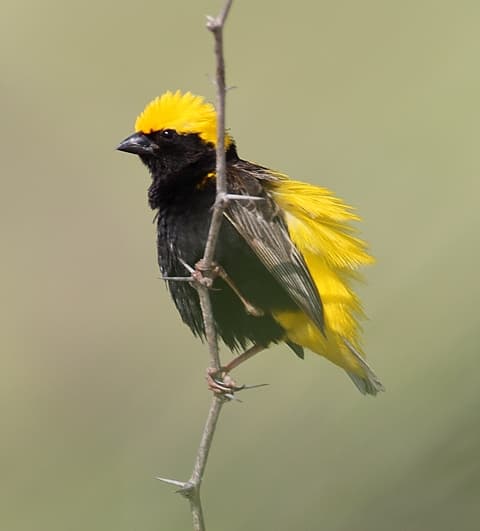
Black-Winged Red Bishop vs Yellow-Crowned Bishop

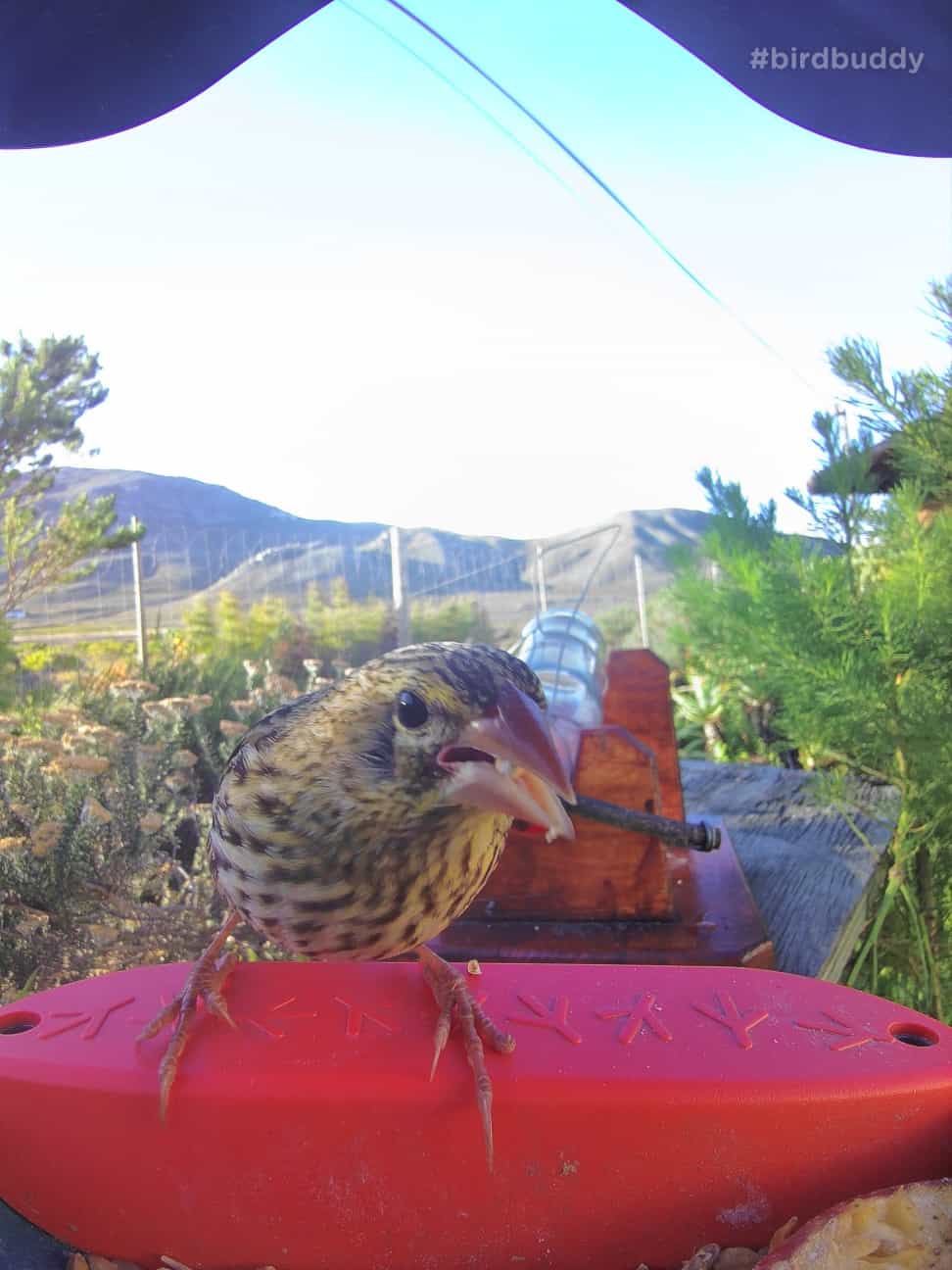
Southern Red Bishop vs Yellow-Crowned Bishop

Black-Winged Red Bishop vs [Select a bird]

[Select a bird]
Pick a bird to compare
Southern Red Bishop vs [Select a bird]
[Select a bird]
Pick a bird to compare