
Yellow-Throated Warbler
Yellow-Throated Warbler
Setophaga dominica


Quick Identification guide
Quick Identification guide
- •
Features a bright yellow throat and white underparts that contrast sharply with its body
- •
Displays black streaks on the sides of its chest and a long, slender body
- •
Exhibits a bluish-gray back and a distinctive dark line through the eye, adding to its unique appearance
What does a yellow-throated warbler sound like?
The Yellow-throated Warbler's vocalizations are distinct, with clear ringing notes that descend in pitch and increase in speed, concluding with an abrupt rise. It primarily uses a 'teeew-teeew-teeew-teeew-tew-tew-twi' call pattern, which can be characterized as falling, flat, then undulating. The warbler's standard calls and songs can be classified under chirp/chip and whistle types.


Description
Is that a creeper? Nope, just a yellow-throated warbler. These birds hop up and down branches much like a creeper would! Hear it singing? It might just be telling you to get lost, because males use their song to establish their territory. In non-breeding season, they are much friendlier and like to forage for food with buddies of all kinds of species.
The yellow-throated warbler can weigh between 9to11grams and be from13to14centimeters tall.
The yellow-throated warbler has an average lifespan of 6-7 years, though some have been recorded to live as long as 9 years. Compared to neighbouring passerine species such as the black-capped chickadee, with a lifespan of 7-12 years, or the Northern cardinal, living up to 15 years, the yellow-throated warbler's lifespan is relatively shorter. However, it's longer-lived than the American redstart, which has a life expectancy of only 5 years.
Did you know?
Most popular questions about yellow-throated warbler
How to recognise a yellow-throated warbler?
General appearance
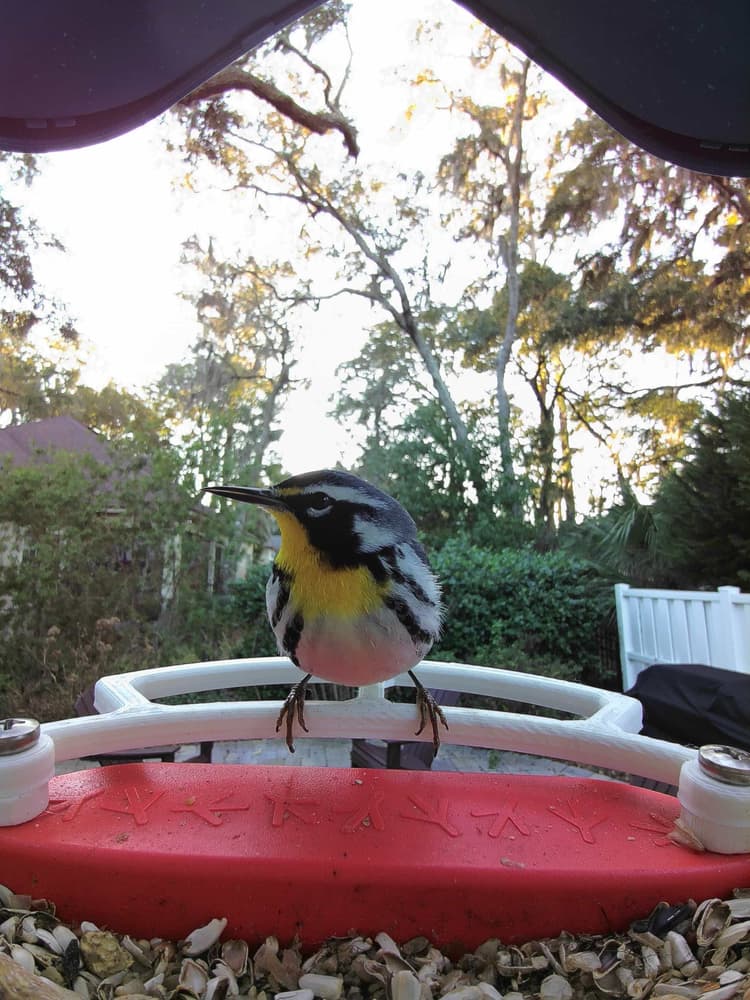
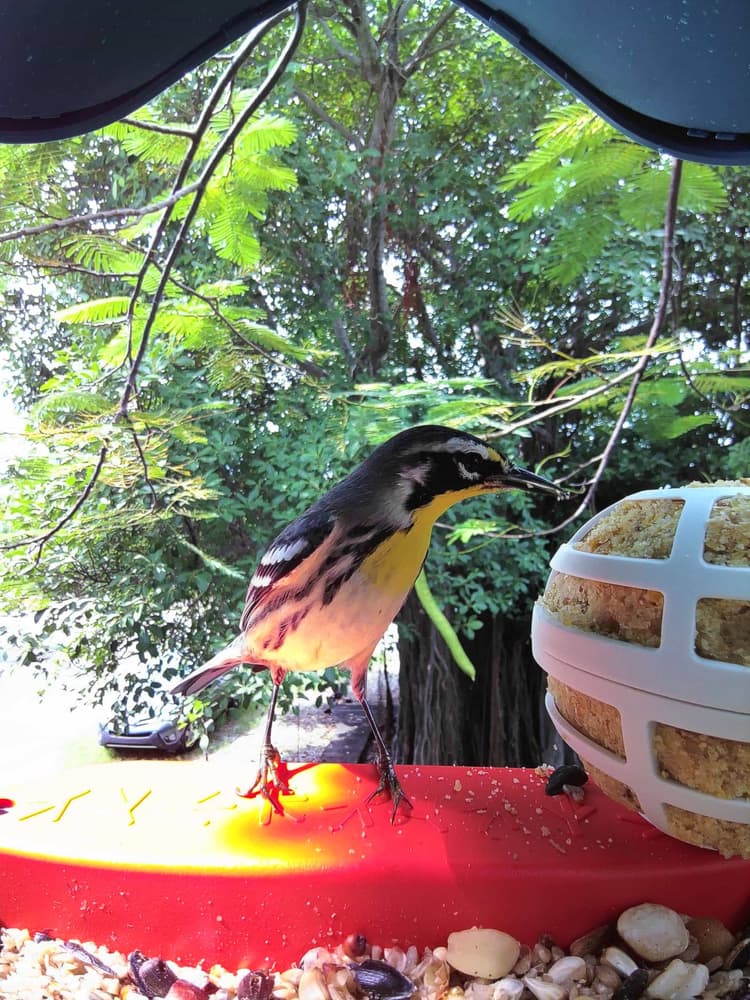
The yellow-throated warbler (Setophaga dominica) is a slender songbird known for its striking coloration. It features a bright yellow throat, black streaks along the sides, and a white belly. The upper parts are generally gray with two white wing bars. The face is distinctly marked with a bold, black triangle extending back from each eye.
Male vs female
There is little sexual dimorphism in yellow-throated warblers, with both sexes exhibiting similar plumage. However, males may display slightly more vibrant throat and face markings during the breeding season. Females are generally similar in appearance but might be slightly duller overall.
Juvenile
Juvenile yellow-throated warblers resemble adults but have more subdued coloration. Their yellow throat is paler, and their black markings are less pronounced. Juveniles possess a less defined face pattern, providing them with a more muted overall appearance.
Often mistaken for
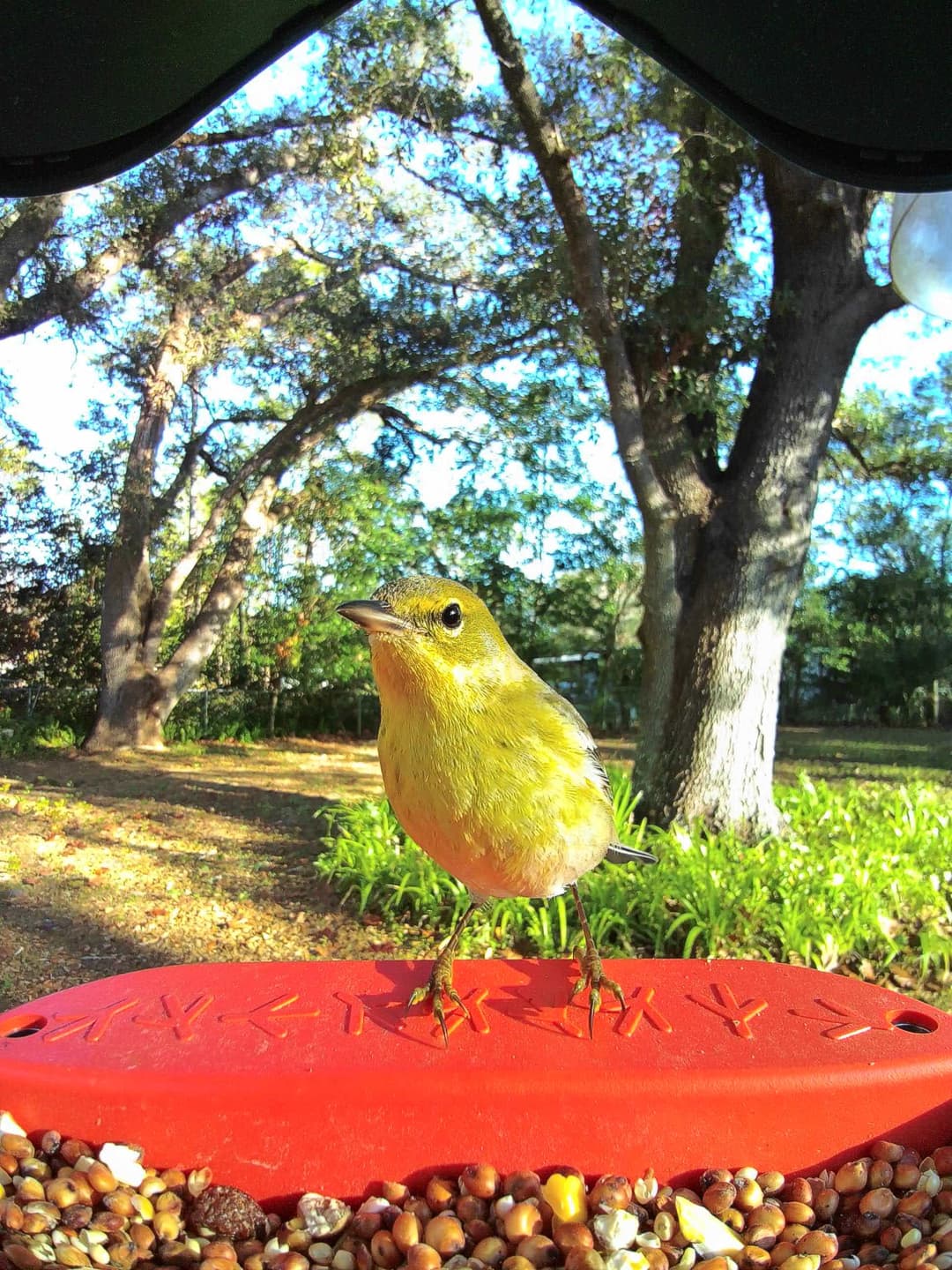
Pine Warbler vs Yellow-Throated Warbler
The Yellow-Throated Warbler features a bold yellow throat, contrasting with its white belly and striking black streaks down the sides, whereas the Pine Warbler has a more muted yellow chest and lacks the sharp black markings. Pine Warblers have a more consistent olive-green or gray back, while Yellow-Throated Warblers show a blue-gray back with white wing bars. Look for the Yellow-Throated Warbler's distinctive white eyebrow stripe and black eye line for a clear identification.
Breeding and nesting habits of the yellow-throated warbler
Mating behaviors
Male yellow-throated warblers arrive early on breeding grounds in the spring and defend their nesting territories by singing. Courtship displays may include song and flight patterns to attract a mate.
Nesting details
Nests are open cups made of grass, moss, bark strips, weeds, and lined with plant down and feathers. Typically placed in Spanish moss at branch ends; where Spanish moss is absent, nests are on high branches of pine, sycamore, or cypress, from 30 to 60 feet up, sometimes from 4 to 120 feet.
Eggs and chick-rearing
Eggs are incubated primarily by the female, who also leads in the nest construction. Both parents participate in feeding and caring for the chicks until they fledge. The cooperative efforts ensure that chicks are nurtured and protected in their early stages of growth.
What does a yellow-throated warbler like to eat?
Insects
Spiders
Natural diet
The yellow-throated warbler primarily feeds on insects. Its diet includes a wide variety of insects such as beetles, moths, caterpillars, grasshoppers, crickets, flies, mosquitoes, ants, scale insects, and aphids. It also consumes spiders as part of its natural food sources.
Bird feeders
At bird feeders, yellow-throated warblers may occasionally consume offerings such as suet or small bits of fruit, though they are primarily insectivorous and do not heavily rely on feeders.
Yellow-throated warbler: favorite snacks
Yellow-throated Warblers are primarily insectivorous, munching on beetles, caterpillars, spiders, and other small creatures. To attract them to your yard, try Bird Buddy seeds. Selected by bird feeding experts depending on the season, these seeds are sure to appeal to our feathered friends.
Choosing the right feeder
These birds typically prefer trees and high branches, hence a hanging tube feeder would be a perfect choice to attract them. Ensure feeders are stable and safe from predators, placed at a height and near cover, if possible. Yellow-throated Warblers are known to be unafraid of heights, so don't hesitate to hang your feeder high.
Encouraging your feathered friends
Certain plants can attract insects that Yellow-throated Warblers love, so consider adding native flowering plants or a shrub in your landscape. When the weather begins to cool, offer suet in your feeders, which provides fats birds need to keep warm. And, of course, pot a variety of Bird Buddy seeds for best results!
Joining the chorus
Yellow-throated Warblers are music lovers, and your backyard chorus could attract them. Consider placing a bird bath or a shallow water feature; the splashing sounds can lure them. Safe and gentle soundtrack of bird songs, played softly, can also mimic a welcoming environment for these songbirds.
Where can you find yellow-throated warblers?
Primary habitat
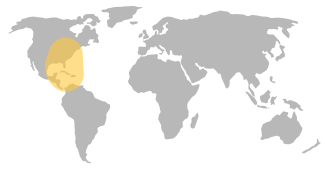
The yellow-throated warbler breeds in southern forests or open woodlands, particularly those containing live oaks, pines, sycamores, or which are covered in Spanish moss. Cypress swamps and pine forests are also frequented.
Additional range
It is prevalent on the southern Atlantic coastal plain. Notably, it's also found along streams in the Mississippi Valley's bottomland woods. In winter, it often forages in palm groves.
Do they migrate?
The yellow-throated warbler is a migratory bird. It primarily migrates nocturnally, which helps reduce the risk of predation and allows it to take advantage of cooler temperatures and more stable air conditions for long flights. This species is an early migrant in the spring, with individuals reaching many areas of their breeding range by March. The breeding range includes parts of the southeastern United States, such as the coastal plains and the southeastern forests. In autumn, the yellow-throated warbler is among the earlier migratory departures. It begins moving south in August, where it generally winters in parts of the southern United States, Mexico, Central America, and the Caribbean. Key wintering locations include Florida, the Bahamas, coastal areas of Central America, and occasionally further into South America. The migration path of the yellow-throated warbler involves flying south from southeastern U.S. breeding grounds towards tropical and subtropical regions. This migration ensures that the birds can access food resources, such as insects, that are scarce in their breeding grounds during the winter months. Their early departure and return coincide with the availability of these resources, allowing them to thrive in both their summer and winter habitats.
What is the role of yellow-throated warblers in nature and how to protect them?
Conservation status
The yellow-throated warbler has disappeared from certain areas due to loss of breeding habitat, indicating a potential past decline. However, current populations are considered stable, suggesting it is not immediately vulnerable or endangered. While it is not classified as endangered, its reliance on specific habitats underscores the importance of conservation efforts focused on habitat preservation. Key conservation efforts should address maintaining and restoring suitable breeding environments to prevent future declines. Habitat loss remains the most significant threat to this species.
Ecological role of yellow-throated warblers
Its role in the ecosystem
The Yellow-throated Warbler plays a crucial role in maintaining the ecological balance in its habitat. As an insectivorous bird, it significantly contributes to pest control by feeding on a wide variety of insects like beetles, moth, caterpillars, grasshoppers, crickets, flies, mosquitos, ants, aphids, etc., and spiders as well. This predation on pests is particularly beneficial for forests and agricultural fields, reducing the need for human intervention with harmful pesticides and insecticides. Furthermore, its nest-building activities, typically on high branches of pines, sycamores, or cypresses, and in Spanish moss, aids in the distribution and proliferation of these plants, playing a small but meaningful role in seed dispersal. The presence of this bird species is also an indication of a healthy ecosystem due to its preference for foraging in rich, insect-laden territories. This makes the Yellow-throated Warbler an important part of biodiversity and ecosystem health monitoring.
How to help protect yellow-throated warblers
Preservation tips
Habitat preservation strategies
Preserving the Yellow-throated Warbler's habitat is crucial. This includes mature pine and hardwood forests near streams. Encourage responsible logging practices and forest conservation efforts. Focus on maintaining and restoring older forests and occurrence of snags, which are important nesting sites. Support initiatives against deforestation and promote the conservation of their wintering grounds in Central America.
Community science initiatives
Engage in community science projects like the Audubon's Christmas Bird Count and the Great Backyard Bird Count to track the yellow-throated warbler population. Contribute to bird databases including eBird. Promote avian biodiversity education in schools and communities to increase awareness. Advocate for regulations protecting migratory birds and encourage local participation in bird-friendly practices such as keeping cats indoors and reducing window collisions.