
Spotted Towhee
Spotted Towhee
Also known as: Pipilo
Pipilo maculatus


Quick Identification guide
Quick Identification guide
- •
Features bold black head, back, and tail contrasting with rusty-orange sides
- •
Exhibits white spots on the wings and white edges on the tail
- •
Carries a sturdy, conical beak ideal for seed and insect eating
What does a spotted towhee sound like?
The spotted towhee's vocalizations are distinctive, offering a variety of sounds. Its song comes across as a long, buzzy "cheweeeee". Additionally, it has a particular call that sounds questioningly curious, akin to a "meewww?". When mapping the call's pattern, it appears to be flat and then gradually rising. The types of calls produced by the spotted towhee typically fall into categories such as chirp or chip, trill, and whistle.


Description
These little guys search for food by hopping along the ground and scratching at leaves, then pouncing on their find. They also wash themselves with morning dew from leafy vegetation. If two get into a fight, the loser has been known to pick up a twig, leaf or piece of bark and carry it around to indicate submission.
The spotted towhee can weigh between 33to49grams and be from17to21centimeters tall.
Spotted Towhees typically live up to 11 years. Relative to other emberizids, or sparrows and buntings, like the Savannah Sparrow whose lifespan is 13 years, the Spotted Towhee's lifespan is slightly shorter. Compared to closely related species like the Eastern Towhee, which has a similar lifespan of up to 12 years, they live about equally long.
Did you know?
Most popular questions about spotted towhee
How to recognise a spotted towhee?
General appearance
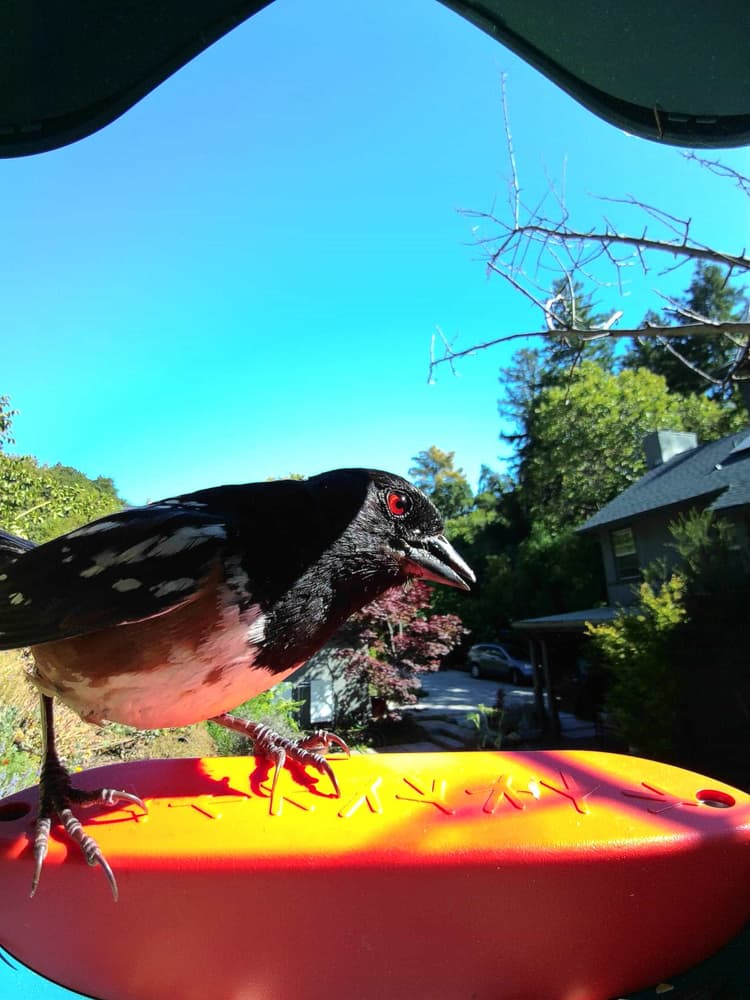
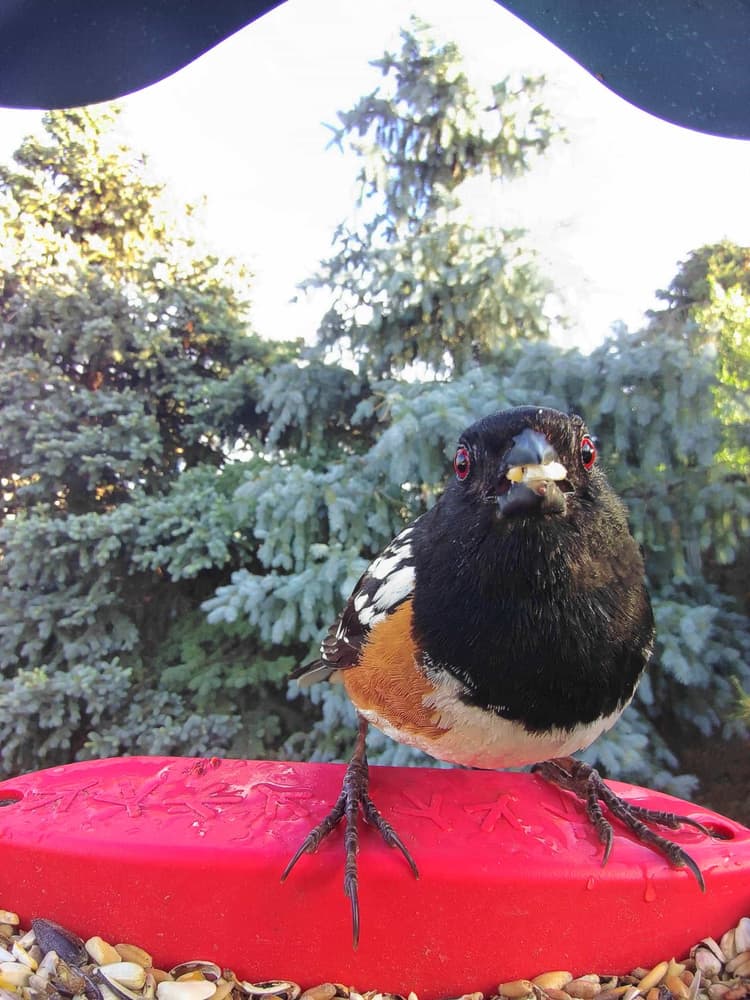
The spotted towhee is a striking, medium-sized sparrow with bold coloration. It has a prominent black hood, back, and wings, complemented by distinctive white spots on the wings and back. Its sides and flanks are a rich rufous hue, while the belly remains white. A red eye adds to its distinctive look, and it has a robust, rounded body with a long, fan-shaped tail often held aloft.
Male vs female
Males are more vividly colored, displaying deep black on their hoods and backs. Females, in contrast, have a more subdued, dark brown tone replacing the black, providing some camouflage. Both sexes have similar white spots, rufous flanks, and red eyes, which remain consistent throughout their lives.
Juvenile
Juvenile spotted towhees lack the sharp contrasting coloration of adults. They exhibit a more mottled and streaky brown appearance with less vibrant rufous on the flanks. The characteristic white spots on the wings are muted, and the eyes are brown, gradually turning red as they mature.
Often mistaken for
Eastern Towhee vs Spotted Towhee
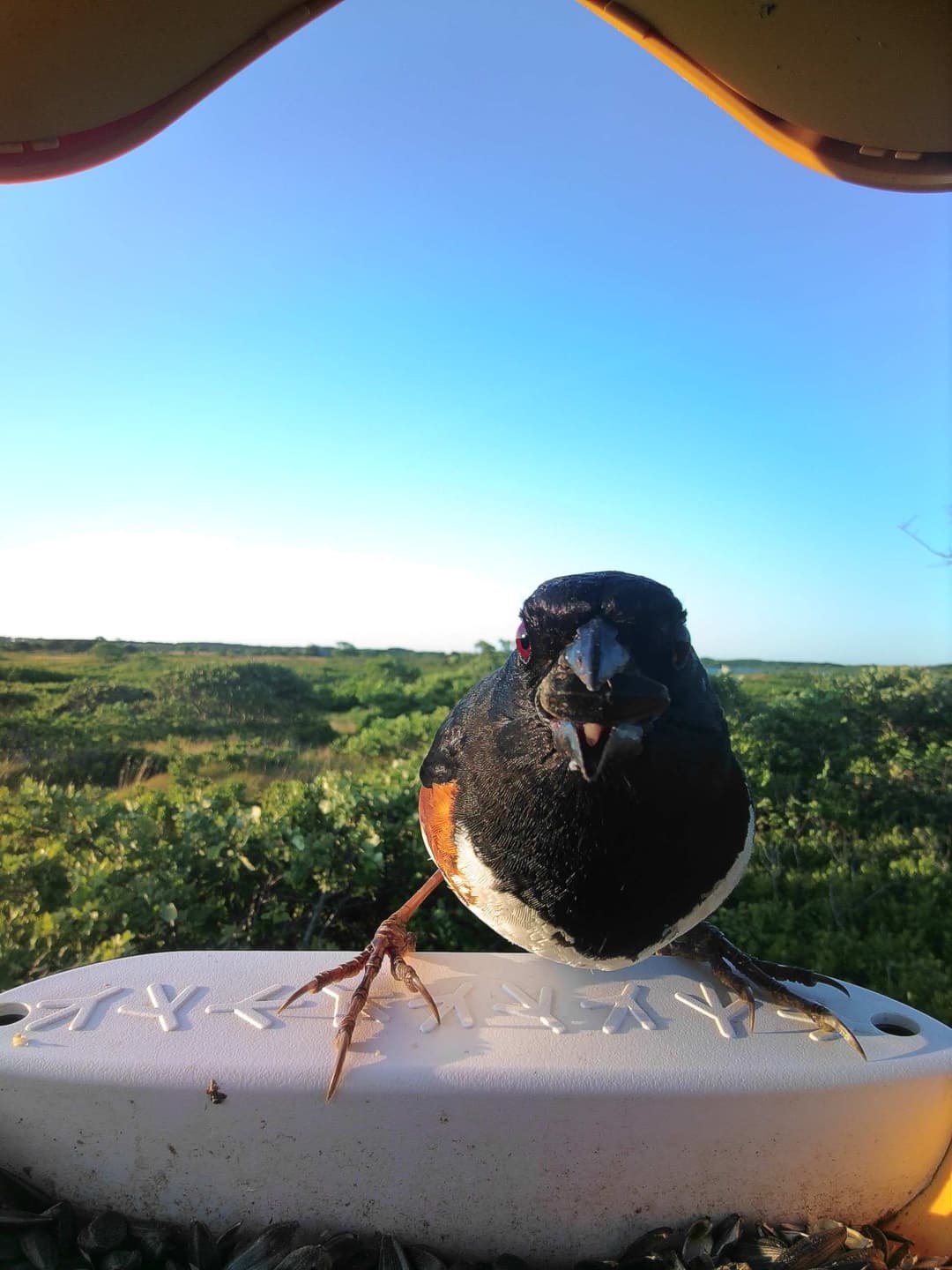
The Spotted Towhee and Eastern Towhee are similar but can be distinguished by their markings. Spotted Towhees have white spots on their wings and back, while Eastern Towhees lack these spots. Instead, Eastern Towhees have a clean, white belly distinct from the rufous sides. In terms of song, the Spotted Towhee's call includes a sharp 'chewink' sound, whereas the Eastern Towhee's call is more of a 'drink-your-tea' melody. Habitat preference can also assist in identification; Spotted Towhees are more common in western North America, while Eastern Towhees are found in the eastern parts.
Breeding and nesting habits of the spotted towhee
Mating behaviors
Spotted towhees engage in courtship through song and displays, with males often singing from elevated perches to attract females. Displays may include spreading wings and tail feathers to showcase their distinct markings. Males may also perform a hopping display to court females.
Nesting details
The spotted towhee's nests are usually built on the ground or in low shrubs. Nests are cup-shaped, made from grass, bark strips, and twigs, often lined with finer materials like hair. To attract towhees to gardens, provide dense, native shrubs and a layer of leaf litter for concealment.
Eggs and chick-rearing
Females lay 3–5 eggs per clutch, which are incubated for about 12–13 days. Chicks are altricial, requiring parental care for two weeks in the nest before fledging. Both parents feed the chicks, with diets including insects and seeds. Create a foraging habitat by maintaining a natural ground layer for food access.
What does a spotted towhee like to eat?
Berries
Flowers
Fruits
Insects
Nuts
Seeds
Spiders
Natural diet
The spotted towhee's diet is diverse and varies with the season. In summer, it primarily consumes insects, including beetles, caterpillars, moths, true bugs, spiders, snails, and millipedes. During other times of the year, it eats many seeds, acorns, berries, and small fruits.
Bird feeders
At bird feeders, the spotted towhee commonly consumes seeds such as sunflower seeds and may also enjoy suet or mixed grain varieties.
Setting up a suitable environment
Spotted towhees love dense shrubbery and low vegetation. Treat them with a natural habitat by planting native bushes, trees or creating brush piles in your yard. They also love a yard with leaf litters, which they rummage through to find insects and seeds.
Feeder types and feeding habits
Spotted towhees aren't predominantly feeder birds, but they will visit ground feeders or broad platform feeders if available. They generally prefer to feed off the ground, thus a flat platform feeder placed near dense shrubs can attract them. Plus, it's safer from potential predators.
Choose the right snacks
Their diet commonly consists of insects, seeds, and berries. Bird Buddy seeds are especially tempting for spotted towhees as they are expertly chosen for different seasons, to ensure they offer the most appealing and nutritious option to these birds. You can also tempt them with mealworms, sunflower seeds, millet etc.
Long-term bonding tips
Maintain a consistent feeding routine to encourage spotted towhees to frequent your yard. It makes them feel a sense of reliability. Also, ensure your pets (if any) don’t intrude in these birds' space. Over time, you might just be lucky enough to enjoy a melodic sing-along with the spotted towhees!
Where can you find spotted towhees?

Primary habitat
The spotted towhee prefers open woods, undergrowth, and brushy edges. It significantly inhabits chaparral, scrub oaks, and mountain manzanita thickets.
Additional range
Apart from typical wooded terrain, the towhee also lives in unexpected environments like pinyon-juniper woods with dense understory, common in the varied terrain of the West.
Do they migrate?
The spotted towhee exhibits varying migratory behavior depending on the population. Southern populations of the spotted towhee are generally permanent residents, meaning they stay in one place throughout the year. In contrast, northern interior populations of the spotted towhee are migratory. During the colder months, these populations migrate eastward onto the Great Plains, which serve as their wintering grounds. While the primary migratory route leads these birds to the Great Plains, some individuals, referred to as "occasional strays," may continue their migration journey all the way to the Atlantic Coast. This suggests that their migration is primarily eastward from their northern interior breeding territories. The timing of the migration typically coincides with changes in weather and resource availability, usually occurring in the fall as they move to winter grounds and returning north in the spring to their breeding areas. Key locations involved in the spotted towhee's migration include northern interior regions, the Great Plains, and, less commonly, areas along the Atlantic Coast. These movements help them to exploit different ecological niches and resources throughout the year.
What is the role of spotted towhees in nature and how to protect them?
Conservation status
The spotted towhee is very common and widespread, with stable numbers, indicating it is not currently vulnerable or endangered. This suggests that its conservation status is secure and does not require urgent conservation efforts. While there may be general threats like habitat loss due to urban development, the species has not shown significant declines. Maintaining healthy habitats remains crucial to prevent future vulnerabilities. Overall, the spotted towhee thrives across its range without facing immediate conservation concerns.
Ecological role of spotted towhees
Its role in the ecosystem
The Spotted Towhee plays a significant role in ecosystem regulation. Its diet compositional changes across seasons, consuming a large number of insects such as beetles, caterpillars, moths, true bugs, spiders, snails, and millipedes, particularly in summer. This makes it a natural pest controller, reducing the population of insects that may be harmful to plant life. Moreover, it contributes to the biological control by preying on snails, reducing their impact on plant biodiversity. The Towhee also assists in seed dispersal. It forages seeds, acorns, berries, and small fruits from the ground and shrubs. When feeding, the seeds that are not digested are excreted, aiding in the propagation of certain plant species across the landscape. Additionally, it occasionally turns the leaf-litter for feeding, enhancing the decomposition of organic material and contributing to nutrient cycling. Thus, the Spotted Towhee's feeding and nesting habits offer vital ecological benefits, including pest control, seed distribution, and nutrient recycling.
How to help protect spotted towhees
Preservation tips
Habitat preservation strategies
To support conservation of the spotted towhee, focus on preserving its natural habitat, which includes shrubby areas, thickets, and woodland edges. Avoid land development and deforestation in these areas. If you manage a piece of land, consider creating suitable habitats by planting native shrubs and hardwood trees. Avoid pesticide usage as spotted towhee feeds largely on insects and seeds.
Community science initiatives
Engage local communities in science initiatives. Organize ‘bird watching’ events, where citizens can contribute to data collection about spotted towhee’s population, their nesting habits, and feeding patterns. Educate the public about the importance of this bird species for ecosystem balance and encourage them to participate in bird-friendly practices, like creating bird feeders in gardens, in their daily lives. Use collected data for ongoing conservation efforts.