
Eastern Towhee
Eastern Towhee
Pipilo erythrophthalmus


Quick Identification guide
Quick Identification guide
- •
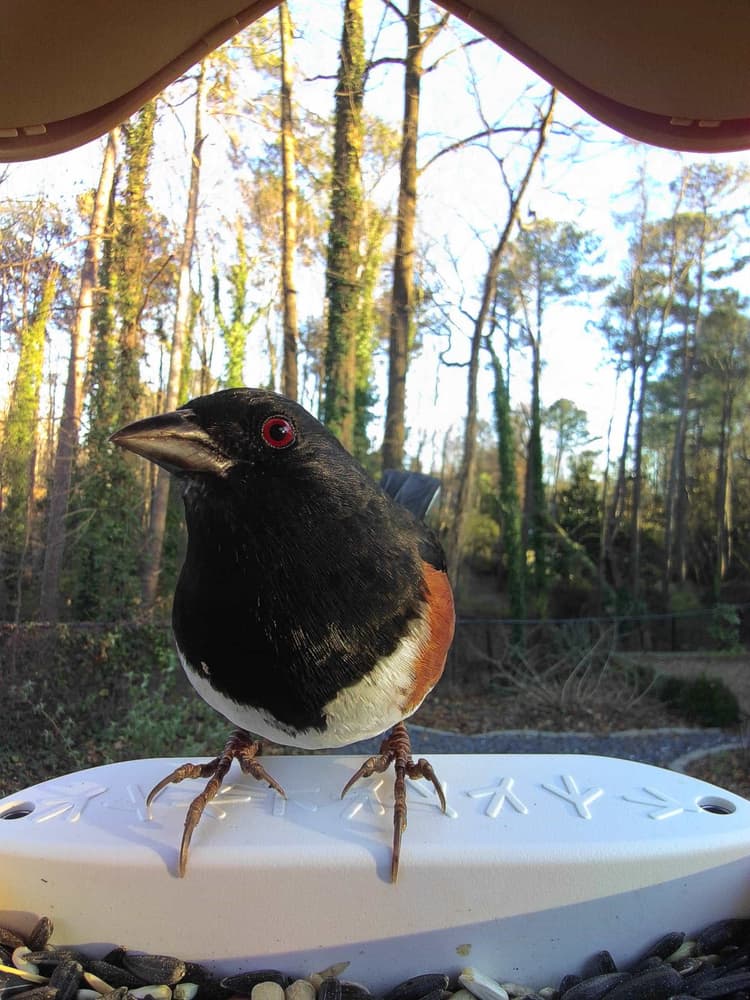
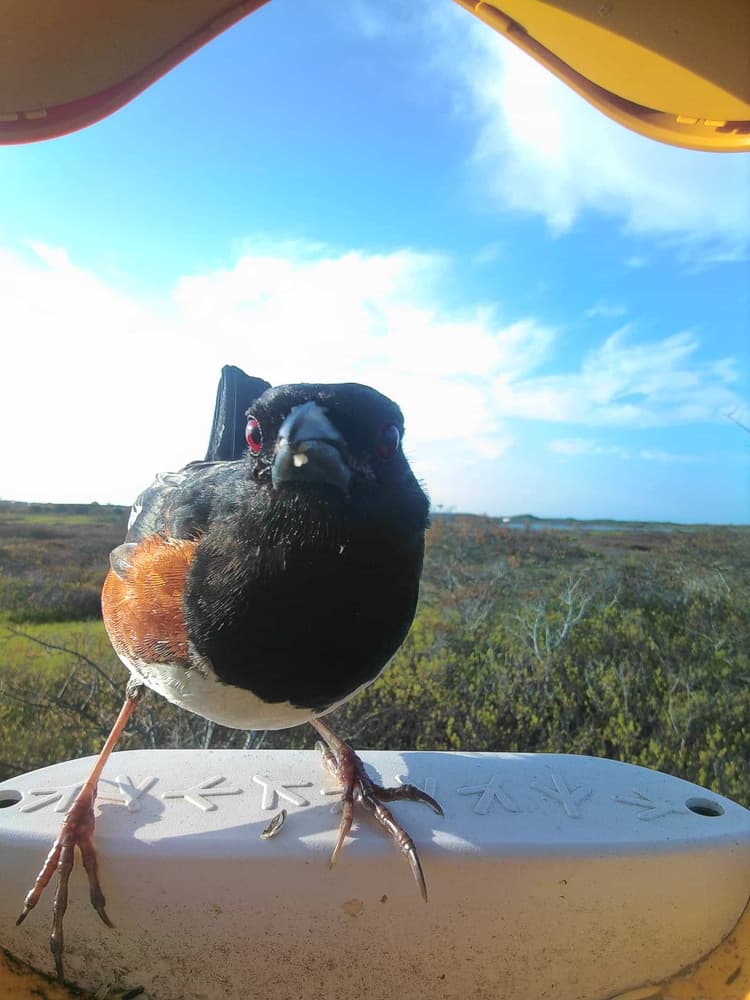
The Eastern Towhee has a distinctive black (male) or brown (female) head, back, and wings, contrasting sharply with its white underbelly
- •
Its red eyes and sturdy, conical beak are eye-catching features perfect for seed consumption
- •
Both genders possess rusty flanks and a long, rounded tail edged with white spots
What does an eastern towhee sound like?
The eastern towhee typically vocalizes with a varying song that often starts with a few introductory notes and ends with a long trill, sounding like "drink-your-teeeaaa" or "to-wheeee". Its call, a questioning "meewww?" is inquisitive in nature. The call patterns can be flat, rising, or undulating across different tones. Its call types are diverse, including chirps or chips, trills, and whistles.


Description
Eastern towhees wash themselves with morning dew from leafy vegetation. You could say they sure dew love their morning shower! If two get into a fight, the loser will pick up a twig, leaf or piece of bark and carry it around.
The eastern towhee can weigh between 32to52grams and be from17.3to21centimeters tall.
The eastern towhee typically lives up to 12 years. Compared to related species like dark-eyed juncos or song sparrows who live up to 13 and 11.3 years respectively, their lifespan is comparative. Factors impacting lifespan include availability of food, predation, and disease.
Did you know?
Most popular questions about eastern towhee
How to recognise an eastern towhee?
General appearance
The Eastern Towhee is a bird measuring 7-8 1/2 inches, approximately the size of a Robin. Its main physical characteristic is a dark hood and rusty sides, separated by a white stripe down the center of the belly. Sporting primarily black upperparts, its tail showcases significant white corners. A peculiar white-eyed form exists in Florida.
Male vs female
While both males and females display a similar body structure and pattern, there is a notable difference in their coloration. Males are adorned with mostly black upperparts, contrasting the females that show off a chocolate-brown hue. Both genders however possess red eyes.
Juvenile
The description does not provide specific details about the appearances of juvenile Eastern Towhees. Further research would be necessary to make distinctions between adults and juveniles.
Often mistaken for
Spotted Towhee vs Eastern Towhee
The Eastern Towhee and Spotted Towhee are similar in size and shape. However, the Spotted Towhee has white spots on its wings and back, while the Eastern Towhee has solid black upperparts. The Eastern Towhee's call is a sharp 'drink-your-tea', whereas the Spotted Towhee's is a more raspy 'chewink'.

American Robin vs Eastern Towhee
While the Eastern Towhee and American Robin both have rusty-orange underparts, the Robin is larger with a gray back and head, lacking the Towhee's black and white patterning. The Robin also has a distinctive white eye ring and yellowish bill, whereas the Towhee's eye is red and the bill is dark.

Breeding and nesting habits of the eastern towhee
Mating behaviors
The male defends its nesting territory by singing, often from a high perch. During courtship, the male may sing a soft 'whispered' version of its song. It may also chase the female or rapidly spread its tail to display white spots.
Nesting details
Nesting sites are located on the ground under a shrub or in low bushes, typically less than 5 feet above the ground. The nest, built by the female, is an open cup made of grass, twigs, weeds, rootlets, and bark strips, lined with finer materials such as animal hair.
Eggs and chick-rearing
Female eastern towhees lay eggs in the constructed nest. After hatching, chicks are reared by the parents in the protected low-lying nests. These locations offer concealment from predators, aiding in the successful growth of the young birds.
What does an eastern towhee like to eat?
Berries
Flowers
Fruits
Insects
Plants
Seeds
Snails
Spiders
Natural diet
The eastern towhee's diet comprises mostly of insects, seeds, and berries, which vary by season and region. In the summer, it consumes a variety of insects such as beetles, caterpillars, moths, true bugs, ants, spiders, snails, and millipedes. Occasionally, it might eat small vertebrates like salamanders, lizards, or snakes. In addition to animal matter, the eastern towhee eats a wide range of plant material including seeds, acorns, berries, and small fruits.
Bird feeders
At bird feeders, eastern towhees are mainly attracted to seeds. They may consume sunflower seeds, millet, cracked corn, and other seed offerings commonly available in bird feeders.
Provide their favorite food
Eastern Towhees love to eat insects, berries, and seeds. Make sure to use Bird Buddy seeds, which are expertly chosen for the season and known to attract Eastern Towhees. They are especially fond of sunflower seeds, corn, and millets. These birds are also known to appreciate fruits including apples, blueberries, and raspberries.
Suitable feeder types
Eastern Towhees prefer to feed on the ground or in low bushes or trees. So, use a tray or platform feeder and place it close to the ground, ideally in a quiet, secluded spot. If you have cats or fear other predators, you might want to use hanging feeders instead but keep them not too high off the ground.
Maintain a bird-friendly environment
Eastern Towhees love areas with dense shrubs, so try to include these in your yard. Provide ample cover by planting native shrubs and trees in your yard. They also like water, so a bird bath or a water dish can be a welcome addition.
Fun tricks
These birds are a little shy, so give them some space when they are visiting. However, they are also known for their beautiful singing, so you might get a sing-along if you’re lucky! If you have a friendly yard dog, their movement can help to stir up the insects that Eastern Towhees love to eat.
Where can you find eastern towhees?

Primary habitat
The eastern towhee usually inhabits open woods and understory, particularly in the Northeast. This bird loves brushy areas.
Additional range
Additionally, it can be found in regions where undergrowth and brushy edges are prevalent. The habitat preferences largely vary depending on the region.
Do they migrate?
The eastern towhee exhibits both migratory and resident behaviors, depending on its geographic location. In northern parts of its range, such as the northeastern United States and parts of the Midwest, the eastern towhee is primarily migratory. These birds generally migrate southward for the winter, traveling to regions such as the southeastern United States, including Florida and the Gulf Coast states. The migratory route of the eastern towhee typically follows a southward path through the eastern United States. Migration usually begins in September and October, and the birds return to their breeding grounds by March or April. Key locations for these migratory birds during winter include the coastal plains and hardwood forests of the southeastern U.S., where temperatures remain more temperate. In contrast, populations of eastern towhees residing in the southern parts of their range, including the southeastern United States, are often permanent residents and do not migrate. These birds enjoy milder winters and lack the necessity to move south. Overall, whether an eastern towhee migrates or remains in the same place year-round depends largely on its specific location within its range.
What is the role of eastern towhees in nature and how to protect them?
Conservation status
The eastern towhee is generally considered stable elsewhere but has experienced significant population declines in the northeast, making it vulnerable in that region. Key threats include habitat loss due to urbanization and changes in land use. Conservation efforts focus on preserving and restoring shrubby habitats, which are essential for their feeding and nesting. Initiatives to manage early successional forests and limit urban sprawl are critical to supporting their populations, particularly in the northeast, where declines are most pronounced. Overall, the species remains common in other parts of its range.
Ecological role of eastern towhees
Its role in the ecosystem
The eastern towhee plays an important role in pest control in its ecosystem. Its diet primarily consists of insects such as beetles, caterpillars, moths, true bugs, ants, and others, as well as spiders, snails, and millipedes, thus controlling their populations and keeping a check on these potentially harmful species. Besides, it may occasionally consume small salamanders, lizards, or snakes. The eastern towhee also contributes to seed dispersal. It feeds on many seeds, acorns, berries, and small fruits. As it moves around foraging, it excretes these seeds in different areas, aiding in their dispersion and consequently in the proliferation of these plants. Often having two to three broods per year, it also contributes to the local avian biodiversity. Thus, the eastern towhee plays a significant role in maintaining the health and balance of its native ecosystems.
How to help protect eastern towhees
Preservation tips
Habitat preservation strategies
To support the conservation of the Eastern Towhee, actions should be taken to preserve and manage their natural habitats. This includes maintaining early successional habitats, such as young forests and shrublands, through controlled burns, selective logging and preventing complete forestation. The creation and conservation of these habitats help in increasing the survival rate of Eastern Towhees by providing nesting sites and feeding grounds.
Community science initiatives
Citizens can participate in bird monitoring programs such as the Christmas Bird Count (CBC) and the Great Backyard Bird Count (GBBC) to help track Eastern Towhee populations. Also, reporting sightings to eBird, an online database from the Cornell Lab of Ornithology and National Audubon Society can contribute valuable information for scientists studying these birds. By planting native shrubs and inspiring others to do the same, everyone can make a difference in conserving the Eastern Towhee.