
Rivoli's Hummingbird
Rivoli's Hummingbird
Eugenes fulgens
Quick Identification guide
Quick Identification guide
- •
Possesses a dark green body with shimmering gorget that can appear violet depending on the light
- •
Features a straight, slender bill which is ideal for reaching deep into blossoms
- •
Males display a distinct violet crown atop their head that contrasts with the dark body
Description
Isn't it enchanting to catch sight of a hummingbird adorned with a dazzling purple crown and an emerald throat? Fun fact: that used to be the former name for Rivoli’s Hummingbird! These charming birds call the mountainous pine-oak forests and shady canyons spanning from Nicaragua to the far southwestern United States their home. Despite their larger size, they're surprisingly gentle souls, opting not to boss other hummingbirds around at flowers or feeders. Instead, they have this adorable habit called "traplining." They follow a consistent route between widely spaced flower patches, using their extra-long bills to delicately sip nectar along the way.
The Rivoli's hummingbird can weigh between 6to10grams and be from11to14centimeters tall.
The Rivoli's hummingbird typically lives 4-5 years. This is comparatively shorter than some related species such as the Ruby-throated Hummingbird, which can live up to 9 years. However, it's similar to lifespan of other species like the Anna's Hummingbird that also lives up to 5 years.
Did you know?
Most popular questions about Rivoli's hummingbird
How to recognise a Rivoli's hummingbird?
General appearance
Rivoli's hummingbird is a large hummingbird with a straight, medium-length bill and vibrant plumage. Its deep green upperparts, combined with the iridescent emerald-purple crown, make it distinctive. The throat can appear black in dim light, which contrasts sharply with the rest of its vibrant plumage. When in flight, their wings beat rapidly, producing a unique humming sound.
Male vs female
Males are vividly colored with an emerald-green crown and throat, while their underparts are often darker. Females, on the other hand, have more muted colorations, lacking the vibrant green on the crown and throat; instead, they display a more subdued grayish-green. Both sexes have white spots behind the eyes. During the breeding season, males can be seen performing aerial displays to attract females.
Juvenile
Juvenile Rivoli's hummingbirds closely resemble females in coloration, typically displaying more subdued tones and less iridescence. They lack the striking crown feathers of the adult males. As they mature, the plumage becomes more vibrant. Juveniles might show gradual development of iridescent feathers typically as they transition into adulthood, especially noticeable during their first molting period.
Often mistaken for
Blue-Throated Mountain-Gem vs Rivoli's Hummingbird
Rivoli's Hummingbird males feature an iridescent green crown and throat, while the Blue-Throated Mountain-Gem males have a distinctive blue throat and slightly larger size. Females of both species have muted colors, but Rivoli's are less gray on the underside. Look for Rivoli's distinctive white spot behind the eye.
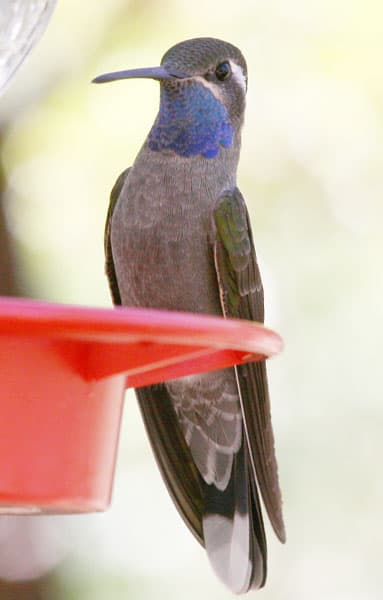
Black-Chinned Hummingbird vs Rivoli's Hummingbird
While Rivoli's Hummingbird males flaunt a vibrant green crown and deep purple throat, Black-Chinned males exhibit a black face and less colorful dark throat band. The latter are smaller in size with a longer, straighter bill. Note the Rivoli's unique postocular white spot for identification.
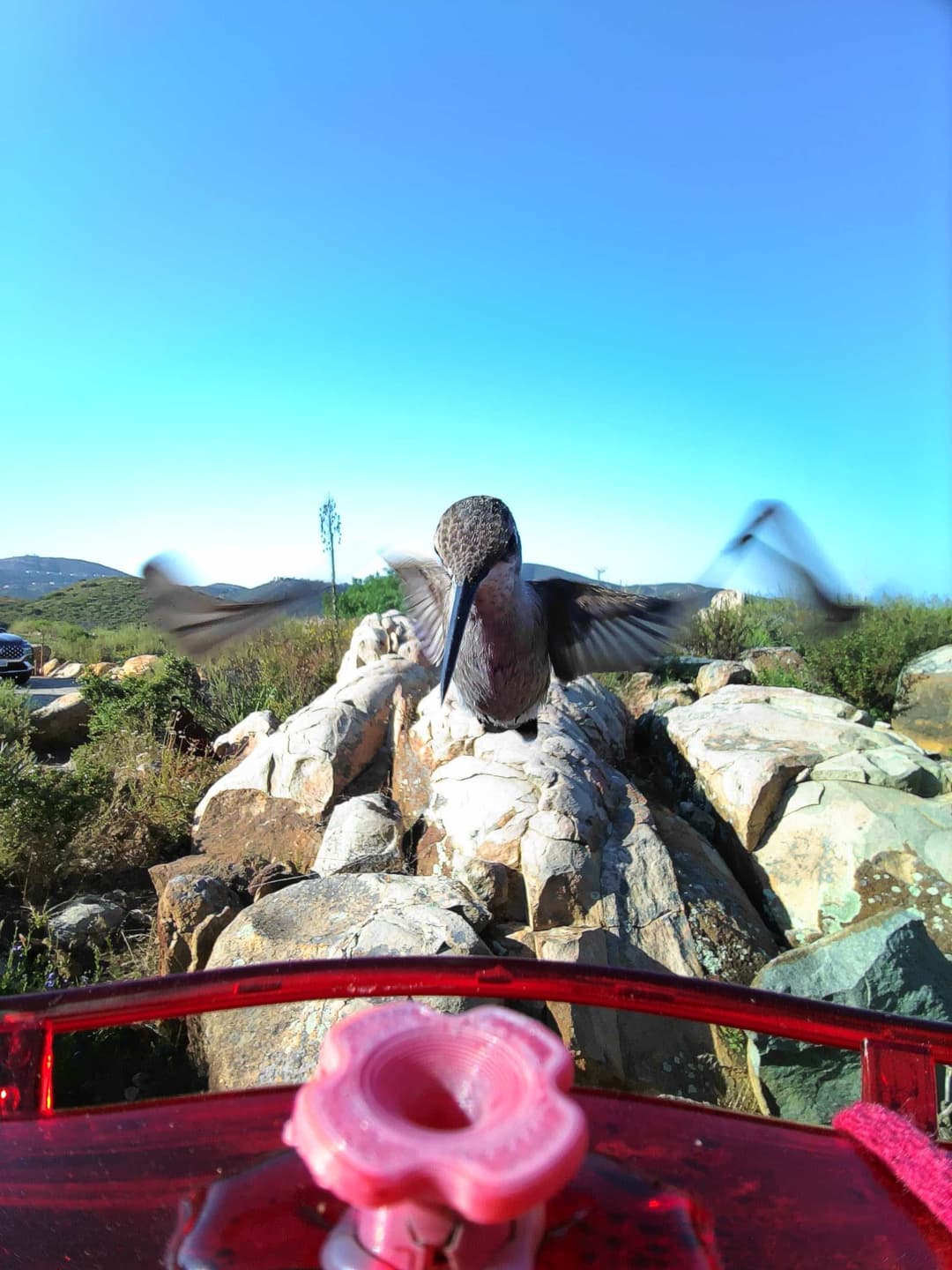
Breeding and nesting habits of the Rivoli's hummingbird
Mating behaviors
Rivoli's hummingbirds exhibit courtship behavior characterized by the male singing a squeaky, scratchy song from a preferred perch. After singing, the male may engage in chasing away rival males.
Nesting details
Nesting sites are located 10-60 feet above the ground, often in trees like pine or maple. The female builds the nest on a horizontal branch, utilizing materials such as moss, plant fibers, and spider webs. The compact cup nest is lined with plant down and sometimes feathers, and camouflaged with lichen.
Eggs and chick-rearing
While specific details on egg number and chick-rearing are not well documented, it is customary for female hummingbirds to take primary responsibility for incubating the eggs and feeding the chicks once hatched.
What does a Rivoli's hummingbird like to eat?
Nectar
Natural diet
Rivoli's hummingbird primarily consumes nectar from flowers as a main component of its diet. Additionally, it actively forages for insects, supplementing its nectar intake. The bird is known to perch in wooded areas, where it watches for insects and subsequently flies out to capture them mid-air. This behavior demonstrates its reliance on both nectar and insects as natural food sources.
Bird feeders
Rivoli's hummingbird is known to frequent bird feeders, particularly those offering sugar-water mixtures. These feeders are often designed to mimic the nectar they naturally consume from flowers, providing an easily accessible food source that they regularly utilize in addition to their natural dietary habits.
Attracting rivoli's hummingbird with the right food
The Rivoli's hummingbird is a fan of sweet things, especially nectar. You can prepare a homemade solution of 1-part sugar to 4-parts water to replicate their favorite food. Alternatively, you can buy a specialized hummingbird nectar. Remember to clean and refill the feeders regularly to avoid fermentation or mold. Bird Buddy seeds also have garnered the best results for attracting these lovely birds. These seeds are expert-approved and season-appropriate.
Choosing the ideal hummingbird feeder
The feeder you choose can hugely impact your success in attracting the Rivoli's hummingbird. A feeder with bright colors, particularly red, will attract these birds as it imitates the flowers they feed from. Opt for a feeder with perching space as it provides them with resting space. But, the feeder's cleaning ease should be a main factor. Don’t forget to place the feeder in a quiet and safe space away from the usual feisty yard activities.
Adding extras to your yard to retain your feathered friends
Apart from food, adding hummingbird-friendly plants to your yard can make it more appealing. Flowers like trumpet vine, bee balm, or salvia are excellent choices. A birdbath with a mister will keep them cool and help with their preening. A hummingbird swing is an amusing addition, as these birds are known to be territorial and would enjoy a perch with a good view of the feeder. They also enjoy a good 'sing-along.' So, putting on some soft bird sounds can encourage them to stay around and maybe even sing back!
Where can you find Rivoli's hummingbirds?

Primary habitat
Rivoli's hummingbird favours mountain glades and pine-oak woods, primarily at elevations of 5,000-9,000 feet. It typically occupies shaded canyons with sycamore and maple trees, or open hillsides within pine-oak woodlands.
Additional range
Additionally, this hummingbird can be found in the coniferous forest of higher mountains in the southwestern U.S. Unlike the Blue-throated Hummingbird, it is less restricted to streamsides, indicating a wider habitat range.
Do they migrate?
The Rivoli's hummingbird, a summer resident in the southwestern United States, exhibits migratory behavior. During the cooler months, it likely undertakes short-distance migrations moving southward into Mexico for the winter. In particular, while some individuals remain in the southwest, where they occasionally winter at feeders in places like Arizona, the majority move into warmer climates just over the U.S.-Mexico border. Key locations along this migratory route include parts of Arizona and New Mexico, where these birds spend the summer, frequently found in montane forests and canyons. As autumn approaches, Rivoli’s hummingbirds head south into northern Mexico, where they find suitable conditions to spend the winter. This migration facilitates access to abundant floral resources and more temperate climates, aiding their survival during the off-breeding season. While the specifics of timing can vary, migration generally begins in late summer or early fall, aligning with diminishing food sources and cooling temperatures. The return north usually occurs in spring, as conditions in the southwestern U.S. become more favorable, and food sources like flowering plants and insects become plentiful once again.
What is the role of Rivoli's hummingbirds in nature and how to protect them?
Conservation status
The Rivoli's hummingbird is common within its limited U.S. range. However, it may be vulnerable to habitat loss in Mexico and Central America, which poses a significant threat to its conservation status. The bird's survival depends on preserving its natural habitats, highlighting the importance of conservation efforts focused on protecting these areas. Key threats include deforestation and land development, which could reduce the available habitat necessary for the species' survival in its southern ranges. Conservation strategies should prioritize habitat preservation and restoration to mitigate these risks.
Ecological role of Rivoli's hummingbirds
Its role in the ecosystem
The Rivoli's hummingbird plays a significant role in the ecosystem. Its diet mainly consists of nectar from flowers and insects, making it an essential pollinator, as it moves pollen from flower to flower while feeding. This process helps in the reproduction of flowering plants, contributing to plant diversity and the production of fruit and seeds, which are important food sources for other wildlife. Also, by supplementing its diet with small insects, it aids in pest control, reducing the population of potentially harmful insects. Although not explicitly mentioned, their role in seed dispersal cannot be overlooked as their movement from plant to plant can inadvertently contribute to the spread of seeds. Their nests, made from moss, plant fibers and spider webs, can also stimulate nutrient cycling and support tiny organisms in the tree canopy, enriching the local biodiversity.
How to help protect Rivoli's hummingbirds
Preservation tips
Habitat preservation strategies
Focus on protecting and restoring high-altitude forested areas and riparian habitats, the prime living zones for the Rivoli's hummingbird. This will involve reducing deforestation, responsibly managing water resources, controlling invasive species, and using sustainable farming and logging practices. Work with local landowners to establish conservation easements to protect critical habitat areas.
Community science initiatives
Encourage local communities to participate in citizen science initiatives such as bird monitoring programs and hummingbird counts. Schools and community groups can create hummingbird-friendly gardens with native plants that provide natural food and nesting spaces. Meanwhile, globally, citizen scientists can donate to conservation groups, engage in advocacy, and contribute data to online platforms tracking the health and distribution of the Rivoli's hummingbird.