Plain Chachalaca or Wild Turkey?
Here's how to tell the difference
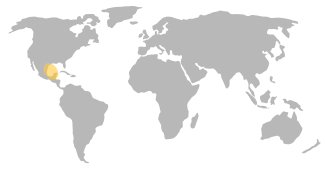


Plain Chachalaca


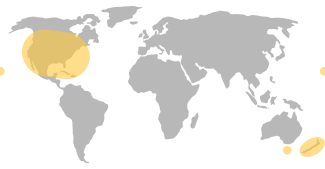
Wild Turkey
Plain Chachalaca
Ortalis vetula
General appearance
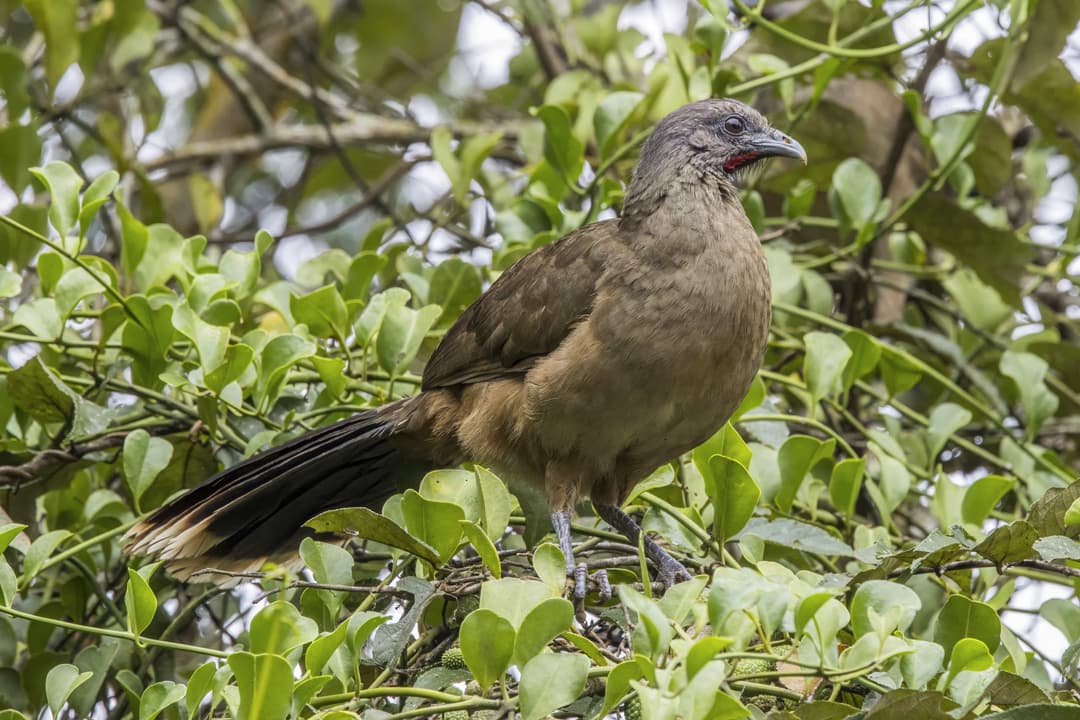
The Plain Chachalaca bears a size resembling a Crow or a Mallard. It has a massive structure, having a length of 18-21 inches and a wingspan of approximately 26 inches. Characterized by a small head and large, long tail feathers, the bird predominantly carries an olive-brown hue which progressively becomes grayer on the head and buff on the belly. The tail feathers are black, contrasting with white tips. It also may display hints of red on the throat area.
Male vs female
Generally, male and female Plain Chachalacas appear quite similar, making it challenging to distinguish between the sexes based on physical traits. However, males sometimes may carry a slightly more vibrant red coloration on the throat area compared to females, especially during the mating season. Detailed scrutiny or behavioral observation may be required for accurate sex determination.
Juvenile
Juvenile Chachalacas bear a resemblance to the adults, though they may be slightly smaller in size. Their coloration may seem less vibrant as they generally exhibit a duller plumage. The characteristic red on the throat area may also be underdeveloped or absent during early stages of growth.
Size
18.9 - 22.8 in/11.2 - 24.2 oz
There's more to learn about Plain Chachalaca
View full detailsWild Turkey
Meleagris gallopavo
General appearance
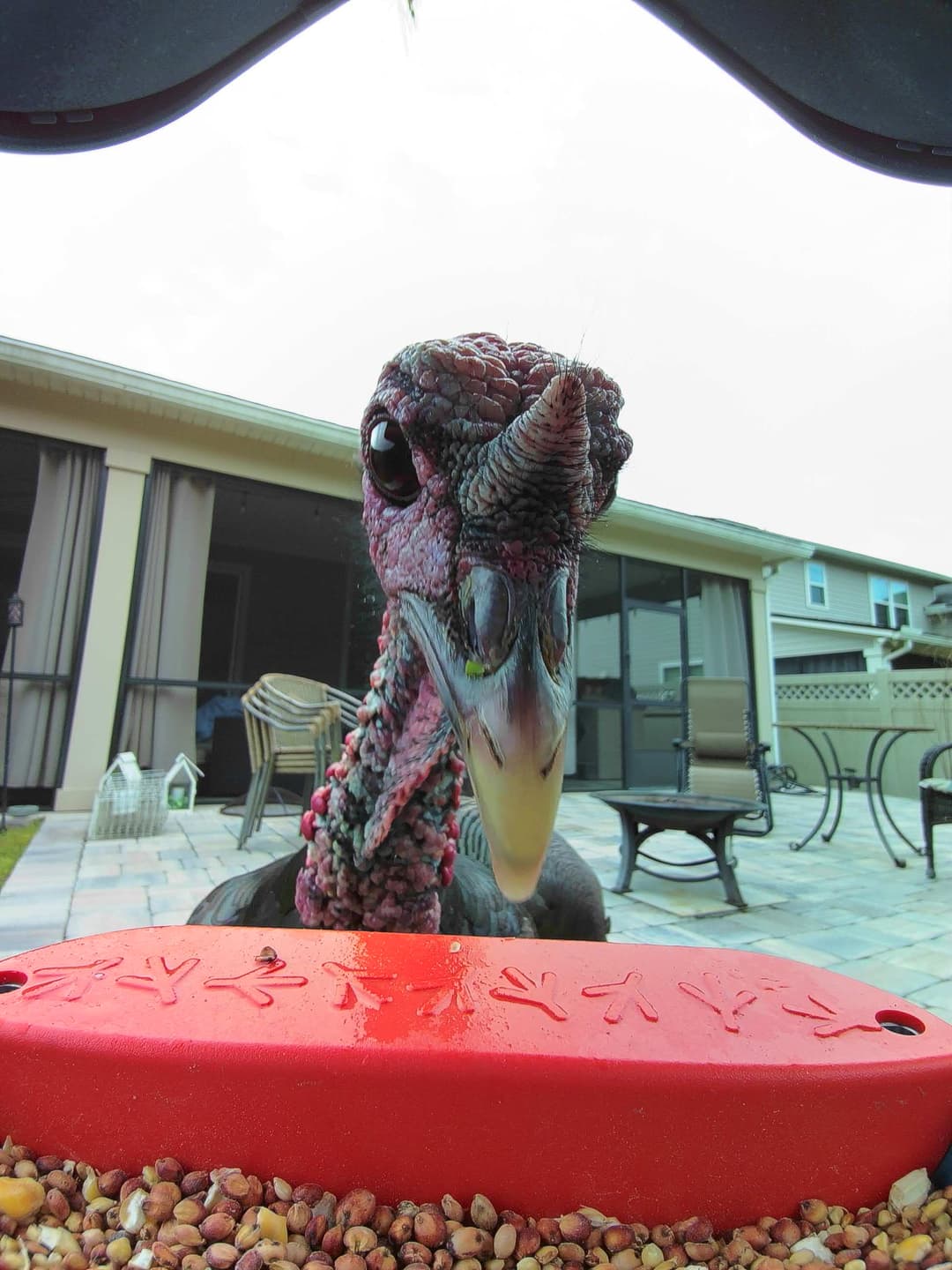
Wild turkeys are large birds, equivalent in size to a heron, with distinct coloration patterns of black, brown, green, red, and white. Their bodies portray a robust depiction, including big heads and long, wide tails. An identifying characteristic is their tendency to have bare heads, irrespective of gender. Another distinguishing feature is their broad, fingered, rounded, short wings and long, rounded, square-tipped tails.
Male vs female
When it comes to gender differences, male wild turkeys, also known as 'gobblers', are larger in size, standing at around 1.2 meters and flaunt more striking coloration patterns than females. In contrast, female wild turkeys, known as 'hens', are smaller - approximately 91 cm tall and exhibit more subdued coloring, making them less noticeable. Males are generally more robust and announce a trimmer and stronger build than females.
Juvenile
Young wild turkeys, also known as 'poults', are comparatively smaller and duller in coloration compared to adult male turkeys. Much like the females, juvenile males do not exhibit the vibrant colors of their mature counterparts. Yet over time, as they grow, their colors become pronounced, displaying the adult color patterns.
Size
29.5 - 47.2 in/127.0 - 335.1 oz
There's more to learn about Wild Turkey
View full detailsHow to tell the Plain Chachalaca from the Wild Turkey
Visual differences
Plain Chachalacas are crow-sized with olive-brown plumage, grayer heads, buff bellies, and a distinguishing long tail with black and white-tipped feathers. They have a small head and may show a hint of red on the throat. Wild Turkeys are much larger, heron-sized, exhibiting a blend of black, brown, green, red, and white plumage with a more robust body. They have bare heads and broad, rounded tails. Key differences include the Wild Turkey's larger size, more vivid plumage, and distinctive bare head compared to the plainer, smaller Chachalaca.
Key differences and behavior
The Plain Chachalaca (18-21 inches long) is often found in pairs or flocks, vocalizing loudly during early mornings or evenings, and lives in subtropical woodlands near water in south Texas. They mainly eat plant material, occasionally consuming insects. Their courtship involves vocal displays, and they nest in trees about 4-15 feet high. In contrast, the Wild Turkey (30-47 inches long) is found in various environments, favoring woodlands with clearings, where they engage in elaborate male displays to attract multiple females. Turkeys nest on the ground and have a more omnivorous diet, including plants and small animals. While Chachalacas are skilled climbers, Wild Turkeys are better ground foragers and may interact with other animals.
Plain Chachalaca vs [Select a bird]

[Select a bird]
Pick a bird to compare
Wild Turkey vs [Select a bird]
[Select a bird]
Pick a bird to compare