Common Rock Thrush or Blue Rock Thrush?
Here's how to tell the difference

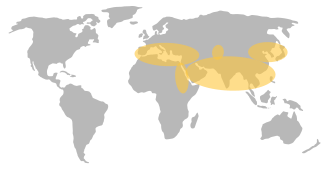

Common Rock Thrush


Blue Rock Thrush
Common Rock Thrush
Monticola saxatilis
Also known as: Rufous-Tailed Rock Thrush, Rock Thrush
Common Rock Thrush Description
General appearance: The Common Rock Thrush is a medium-sized bird known for its vibrant and striking plumage. The males typically showcase a brilliant combination of deep blue on the head and upper parts with a vivid orange on the underparts and rump. Their wings are predominantly brown with intricate white markings that add contrast. This bird exhibits a relatively elongated body with a medium-sized beak and a slightly forked tail. Male vs female: The male Common Rock Thrush is usually more brightly colored compared to its female counterpart, which often appears with more subdued hues. Females generally have a more muted color scheme with a predominantly brownish-grey coloration, subtle orange on the underparts, and faint streaks on the chest. This dimorphism is more pronounced during the breeding season when males display their brightest plumage to attract potential mates. Despite these differences, both sexes share a similar body shape and size. Juvenile: Juvenile Common Rock Thrushes are distinguished by their heavily streaked brown plumage, which provides excellent camouflage against predators. Their overall appearance is less vivid compared to adults, with duller and less distinct color patterns. Juveniles will gradually acquire their adult colors as they mature, leading to noticeable changes in their plumage over time. The transition is subtle yet becomes more evident as they approach adulthood.
Size
6.7 - 7.9 in/1.5 - 2.3 oz
There's more to learn about Common Rock Thrush
View full detailsBlue Rock Thrush
Monticola solitarius
General appearance
Presenting to you the Blue Rock Thrush- a charming ball of blue feathers, unlike any you've seen! Standing at 21-22 cm in length, this bird is perfectly proportioned for nifty maneuvers. Their distinctive bright blue hue with glimmers of purple combined with minimal black spots makes them really stand out in their rocky mountain habitats. Fun fact: they are nifty flyers known for their swift zigzag flights.
Male vs female
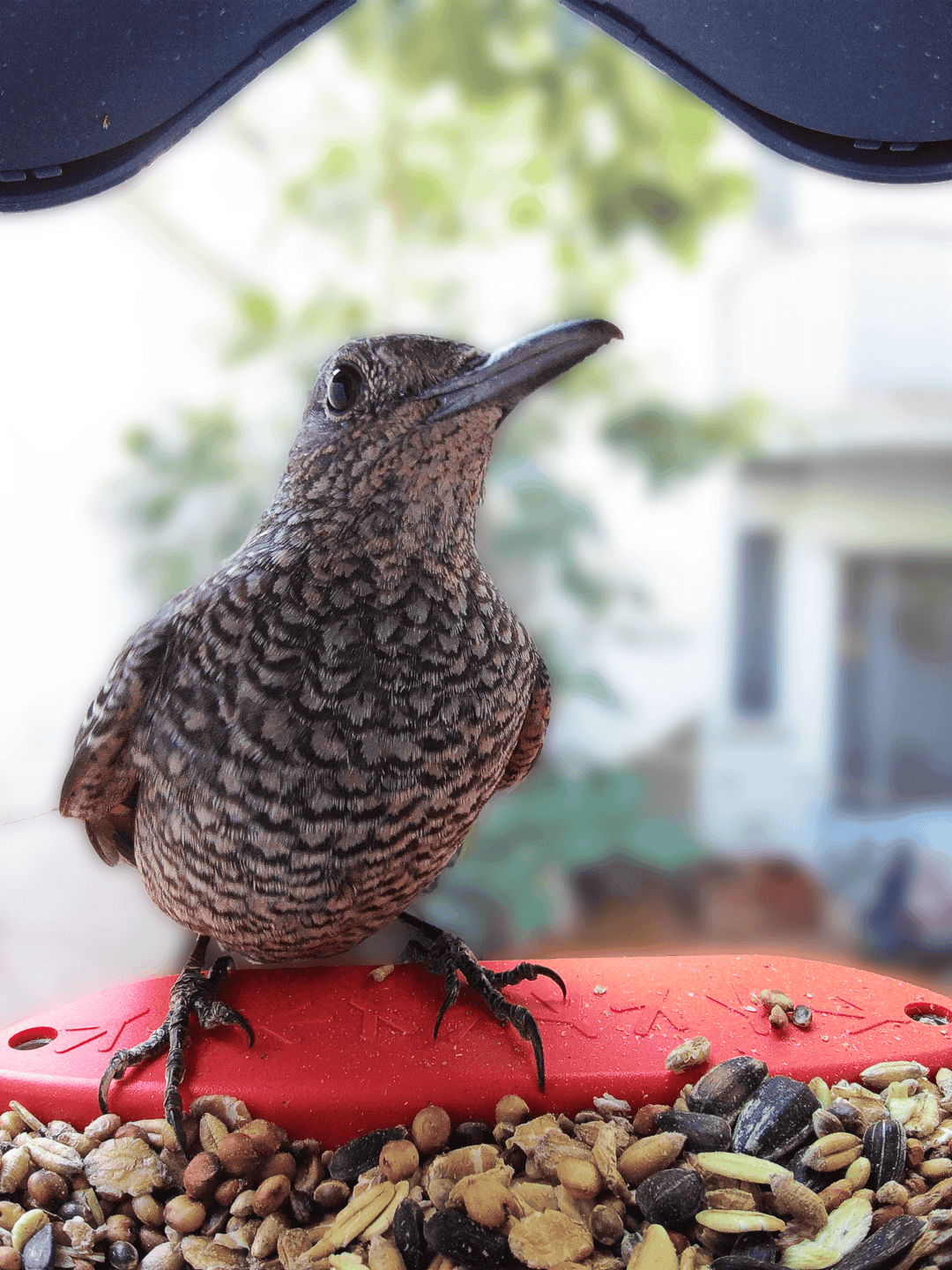
Look closely folks! The male Blue Rock Thrush pulls in extra style points in the bird kingdom with a glossy all-blue feathered coat and an eye-catching rusty-orange underbelly. However, the ladies are a bit more conservative with a predominantly brown outfit speckled with blue hints. Savvy birdwatchers know to tell the sexes apart by these subtle tint shades!
Juvenile
Let's not forget the little ones. Juvenile Blue Rock Thrushes enter the bird world wearing a browner jacket featuring a white streaky pattern- a far cry from their vibrant adult look. But don't worry, they take on the more uniform blue or brown plumage post their first winter. Puberty hits them hard, right?
Size
7.9 - 9.1 in/1.3 - 2.5 oz
There's more to learn about Blue Rock Thrush
View full detailsHow to tell the Common Rock Thrush from the Blue Rock Thrush
Visual differences
The Common Rock Thrush is smaller at 6.7-7.9 inches in length, compared to the Blue Rock Thrush at 8.3-9.1 inches. Male Common Rock Thrushes display vibrant orange underparts with a blue-grey head, while male Blue Rock Thrushes are uniformly bright blue with a rusty-orange underbelly. Females of both species are brown, but Blue Rock Thrush females have blue hints. Juveniles of both species appear browner, with varying streak patterns. The Blue Rock Thrush has a slightly longer, more slender beak, suitable for extracting prey from crevices.
Key differences and behavior
The Common Rock Thrush and Blue Rock Thrush exhibit distinct behavioral differences. The Common Rock Thrush favors high mountain areas and open rocky habitats, adapting to lower altitudes during migration, whereas the Blue Rock Thrush thrives in both rocky terrains and urban environments, utilizing buildings for nesting. Both species display elaborate courtship behaviors, with males singing from high perches. Their diets are insect-focused; however, the Blue Rock Thrush extends to consume small reptiles and amphibians. Both birds show adaptability with diet, consuming fruits in leaner seasons. In terms of nesting, both prefer rocky crevices, with Common Rock Thrush constructing cup-shaped nests using local materials. Parental care is similar, with both species sharing in chick rearing. The Common Rock Thrush prefers slopes with sparse vegetation, while the Blue Rock Thrush is adaptable, often seen in Mediterranean climates. Despite visual similarities, these behavioral differences make field identification based on habitat and nesting preferences possible.
Common Rock Thrush vs [Select a bird]


[Select a bird]
Pick a bird to compare
Blue Rock Thrush vs [Select a bird]
[Select a bird]
Pick a bird to compare