Brown-Headed Honeyeater or Brown Honeyeater?
Here's how to tell the difference

Brown-Headed Honeyeater

Brown Honeyeater
Brown-Headed Honeyeater
Melithreptus brevirostris
General appearance
The Brown-Headed Honeyeater is a small-sized bird notable for its distinctive plumage. It features a dusky brown head that blends seamlessly into its olive-green back and wings. The underparts are lighter, showing a soft buff coloration that provides a pleasing contrast. One of its most characteristic features is the light gray eye ring that sets it apart. The bill is slender, designed to aid in nectar feeding, and the legs are similarly delicate.
Male vs female
There is little sexual dimorphism in the Brown-Headed Honeyeater, meaning both males and females appear similar in coloration and size. Both sexes share the same brown head, gray eye ring, and olive-green plumage, making it difficult to distinguish between them in the field. Observational nuances such as behavior or subtle size differences are typically required for definitive identification.
Juvenile
Juvenile honeyeaters resemble their adult counterparts but have more muted and slightly duller plumage. The brown color of the head is less pronounced, taking on a softer hue. The eye ring, a distinctive adult feature, is less defined in juveniles, and their overall appearance might be more flecked or mottled compared to the clear patterns seen in adult birds. As they mature, these juveniles gradually develop the distinctive adult plumage.
Size
5.1 - 5.9 in/0.4 - 0.7 oz
There's more to learn about Brown-Headed Honeyeater
View full detailsBrown Honeyeater
Lichmera indistincta
Characteristics of the Brown Honeyeater
The Brown Honeyeater is a relatively small bird native to Australia, predominantly found in woodland and forest habitats. Its general appearance includes a primarily brown plumage, which gives it its name. The back, wings, and tail are a uniform shade of brown, while the underparts tend to be lighter, often appearing off-white, especially on the abdomen and breast. A distinctive feature is the small, yellow patch behind each eye, which stands out against their otherwise muted plumage. They possess a slender curved bill suited for nectar feeding, and their legs are dark and slender. In terms of sexual dimorphism, the Brown Honeyeater exhibits minimal differences between males and females. Both sexes share the same coloration and markings, with males being slightly larger than females, although this size difference is often not significant enough to distinguish at a glance in the field. Juvenile Brown Honeyeaters resemble the adults but can be differentiated by their slightly duller coloration. The yellow eye patches may appear less vibrant in juveniles, and their plumage can be fluffier until they fully mature. They lack the sharpness of color seen in adults, making them somewhat harder to distinguish from the surrounding environment in natural light.
Size
4.7 - 6.3 in/0.3 - 0.4 oz
There's more to learn about Brown Honeyeater
View full detailsHow to tell the Brown-Headed Honeyeater from the Brown Honeyeater
Visual differences
The Brown-Headed Honeyeater (5.1-5.9 in, 0.39-0.71 oz) is slightly larger and heavier than the Brown Honeyeater (4.7-6.3 in, 0.32-0.39 oz). The former has a dusky brown head, olive-green back, buff underparts, and a distinctive light gray eye ring. In contrast, the Brown Honeyeater has overall brown plumage with subtle variations, devoid of the contrasting head and eye ring. Both have slender bills, but the Brown-Headed's standout plumage patterns and eye ring provide the clearest differentiation.
Key differences and behavior
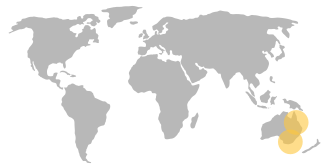
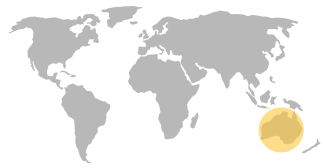
The Brown-Headed Honeyeater (11–20g, 5–6 in) and Brown Honeyeater (9–11g, 5–6.3 in) both feed primarily on nectar and insects, but differ in habitat and behavior. The Brown-Headed Honeyeater is lively, known for its relentless activity and acrobatics in southeastern Australian woodlands, often engaging in cooperative breeding. In contrast, the Brown Honeyeater, found along northern and eastern coasts, is celebrated for its melodious singing, attracting mates through song and aerial displays, indicative of their more solitary nature. Brown-Headed Honeyeaters actively steal nesting materials, while the Brown Honeyeater focuses on dense vegetation for nests, highlighting different nesting strategies. Both species adapt to urban environments, with the Brown Honeyeater embracing humid tropical climates and Brown-Headed Honeyeaters venturing into varied forest settings.
Still not sure? Here are more lookalikes!
Brown-Headed Honeyeater vs White-Naped Honeyeater


Brown-Headed Honeyeater vs White-Eared Honeyeater

Brown-Headed Honeyeater vs [Select a bird]

[Select a bird]
Pick a bird to compare
Brown Honeyeater vs [Select a bird]

[Select a bird]
Pick a bird to compare