Violaceous Euphonia or Bananaquit?
Here's how to tell the difference
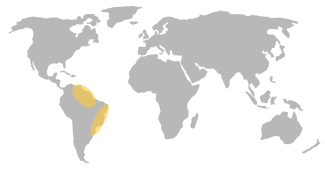
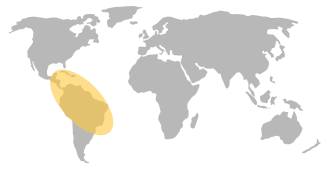

Violaceous Euphonia


Bananaquit
Violaceous Euphonia
Euphonia violacea
General appearance
The Violaceous Euphonia is a small, vibrant bird characterized by its striking coloration and compact build. The adult males are adorned with a rich, deep violet hue on their upperparts, including the head, back, and tail. The wings contrast beautifully with a mixture of dark violet and glossy black feathers. The underparts, extending from the throat to the belly, are a contrasting bright yellow. The bill is short and stout, with a slightly upturned shape that aids in fruit consumption. The eyes are dark and keen, complementing the bird's lively demeanor.
Male vs female
In this species, the differences between males and females are relatively subtle but noticeable upon closer inspection. Females lack the prominent violet coloration that distinguishes the males. Instead, they exhibit more subdued olive-green upperparts, which provides natural camouflage among the foliage. The underparts reveal a paler yellow than their male counterparts, maintaining gender-specific distinctions while still harmonizing within their natural habitat.
Juvenile
Juvenile Violaceous Euphonias present a combination of attributes from both adult males and females. Their plumage is generally duller, with less defined contrast between the upper and underparts. The back and wings display an olive tint similar to females, while the yellow on the underbelly is muted compared to adults. As they mature, juveniles gradually acquire the distinct adult coloration. Unlike adults, juveniles' feathers have less gloss and a more uniform tone until they reach full maturity.
Size
3.9 - 4.5 in/0.4 - 0.6 oz
There's more to learn about Violaceous Euphonia
View full detailsBananaquit
Coereba flaveola
General appearance
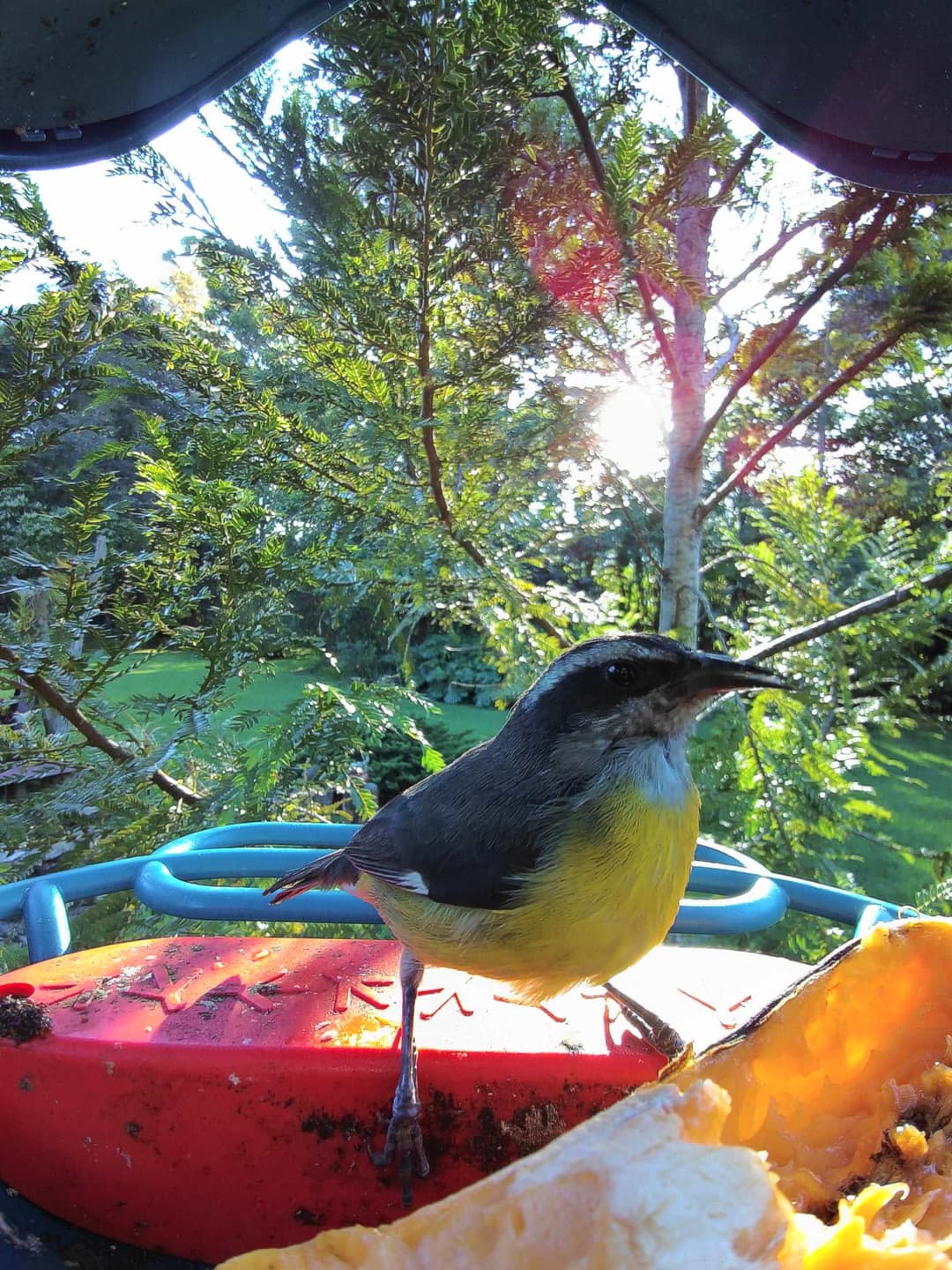
The bananaquit is small; about 4 1/2" (12 cm) in size, roughly the size of a sparrow. Its tail is short and squared at the tip. The bird has a white forehead extending to a white eyebrow and a yellow rump and chest. Its wings are broad and rounded. A distinctive feature is a spot of pink at the base of the thin, curved bill.
Male vs female
There are no significant differences visible between male and female bananaquits. Both genders share the same striking coloration: black, gray, red and white, with notable yellow parts. Hence, both males and females can be identified in the wild through these characteristics.
Juvenile
Young bananaquits, or juveniles, lack the vibrant coloration of the adults. They are generally duller in their coloration, which makes them less noticeable. As they mature, their vibrant adult colors start to show, making them easier to spot as they reach adulthood.
Size
3.9 - 4.3 in/0.2 - 0.5 oz
There's more to learn about Bananaquit
View full detailsHow to tell the Violaceous Euphonia from the Bananaquit
Visual differences
Violaceous Euphonia and Bananaquit differ in several visual aspects. The Euphonia measures about 4-4.5 inches, with males displaying deep violet upperparts contrasted by bright yellow underparts, while the Bananaquit stands at 4.5 inches, featuring a white forehead, eyebrow, and yellow rump. The Euphonia has a short, stout, slightly upturned bill, in contrast to the Bananaquit's thin, curved bill with a pink spot. Violaceous Euphonia females have olive-green upperparts, unlike Bananaquits, where both genders share similar black, gray, and yellow coloration.
Key differences and behavior
The Violaceous Euphonia and Bananaquit both inhabit tropical and subtropical regions, but the Euphonia prefers dense rainforests while the Bananaquit adapts to varied environments, including urban areas. In terms of behavior, the Euphonia is renowned for vocal mimicry to deter predators, while the Bananaquit engages in dynamic courtship chases. Diets differ as well; the Euphonia favors fruits and adapts seasonally by consuming insects, whereas the Bananaquit primarily consumes nectar and occasionally insects, akin to hummingbirds. Euphonia nests are hidden in dense foliage, and Bananaquit nests are globular with side entrances. Both species share monogamous breeding habits, although Violaceous Euphonias are more social. Finally, while both birds are similar in size (Euphonia: 4-4.5", Bananaquit: 4.5"), Euphonias tend to be slightly more robust in weight, benefiting from a fruit-centric diet versus the lighter Bananaquit.
Still not sure? Here are more lookalikes!
Violaceous Euphonia vs Yellow-Throated Euphonia


Violaceous Euphonia vs Orange-Bellied Euphonia

Violaceous Euphonia vs [Select a bird]

[Select a bird]
Pick a bird to compare
Bananaquit vs [Select a bird]
[Select a bird]
Pick a bird to compare