Aracari or Saffron Toucanet?
Here's how to tell the difference
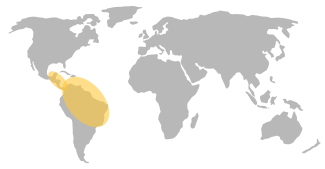

Aracari

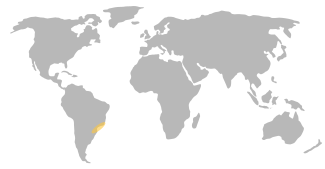
Saffron Toucanet
Aracari
Pteroglossus
Also known as: Araçari
General appearance
The aracari is a small to medium-sized toucan. They have vibrant coloration, with commonly observed colors being black, yellow, green, red, and white. They are known for their large, colorful bills that are lightweight despite their size.
Male vs female
Unlike some bird species, male and female aracaris are quite similar in appearance, with vibrant coloration and large bills. However, males tend to be slightly larger and may have longer bills. Females often have lighter, slightly duller feathers.
Juvenile
Juvenile aracaris share the vibrant coloration of adults, but their colors are often more muted. They also have shorter bills, which grow as they mature into adulthood. The colors of their plumage become more vibrant as they mature, representing a progression towards adult marking.
Size
11.8 - 18.9 in/3.9 - 11.5 oz
There's more to learn about Aracari
View full detailsSaffron Toucanet
Pteroglossus bailloni
General appearance
The Saffron Toucanet possesses a strikingly beautiful coloration, primarily of a rich saffron yellow hue. With a body length around 30-35 cm, they exhibit a unique long, curved bill in a darker shade of yellow, often almost green. They showcase dark eyes surrounded by a patch of blue skin, adding contrast to their features. Usually, there aren’t significant seasonal variations in their appearance.
Male vs female
Sexual dimorphism, difference in appearance between genders, is slightly perceived in Saffron Toucanets. Males are slightly larger than females and also have longer bills. Occasionally, male's throat and chest may be slightly reddish. However, these differences are subtle, making it challenging to distinguish between the sexes based on appearance alone.
Juvenile
Juvenile Saffron Toucanets have a duller overall coloration than adults, often looking more greenish than the lustrous saffron yellow of adults. Their bill is noticeably shorter and also less curved, which grows in size and curve as they mature. Additionally, the blue skin around their eyes is not as vibrant in juveniles and gradually develops with age.
Size
13.8 - 15.4 in/4.6 - 6.0 oz
There's more to learn about Saffron Toucanet
View full detailsHow to tell the Aracari from the Saffron Toucanet
Visual differences
The Aracari, generally larger at 12-19 inches, flaunts vibrant multicolors including black, yellow, green, red, and white with a sizable, colorful bill. In contrast, the Saffron Toucanet, at 12-15 inches, is predominantly saffron yellow with a darker, long curved bill, often yellow-green. The Saffron Toucanet has dark eyes encircled by blue skin, unlike the varied Aracari eye features. The Aracari showcases a more diverse palette and bill color, while the Saffron Toucanet is marked by its monochrome yellow hue and subtle blue eye accents.
Key differences and behavior
Aracaris and Saffron Toucanets, both members of the toucan family, display notable behavioral and ecological distinctions. Aracaris inhabit tropical and subtropical rainforests across Central and South America, adapting to disturbed areas, while Saffron Toucanets are primarily found in humid forests of Argentina, Brazil, and Paraguay, showing less adaptability to altered habitats. Both species nest in tree cavities, engaging in mutual preening and food offerings during courtship. Aracaris often roost socially year-round, unlike the more solitary Saffron Toucanets. Both birds primarily consume fruits, supplemented by insects and small vertebrates, but Saffron Toucanets are more inclined to forage on forest edges. Saffron Toucanets' diet overlaps at feeders with similar fruit preferences. Weighing 3.9-11.5 oz, Aracaris are larger yet generally display communal behaviors, differing from the 4.5-6 oz Saffron Toucanets, which play crucial roles in seed dispersal and face conservation challenges due to habitat loss.
Still not sure? Here are more lookalikes!


Aracari vs [Select a bird]

[Select a bird]
Pick a bird to compare
Saffron Toucanet vs [Select a bird]

[Select a bird]
Pick a bird to compare