African Silverbill or Indian Silverbill?
Here's how to tell the difference
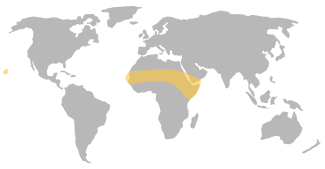


African Silverbill


Indian Silverbill
African Silverbill
Euodice cantans
General appearance
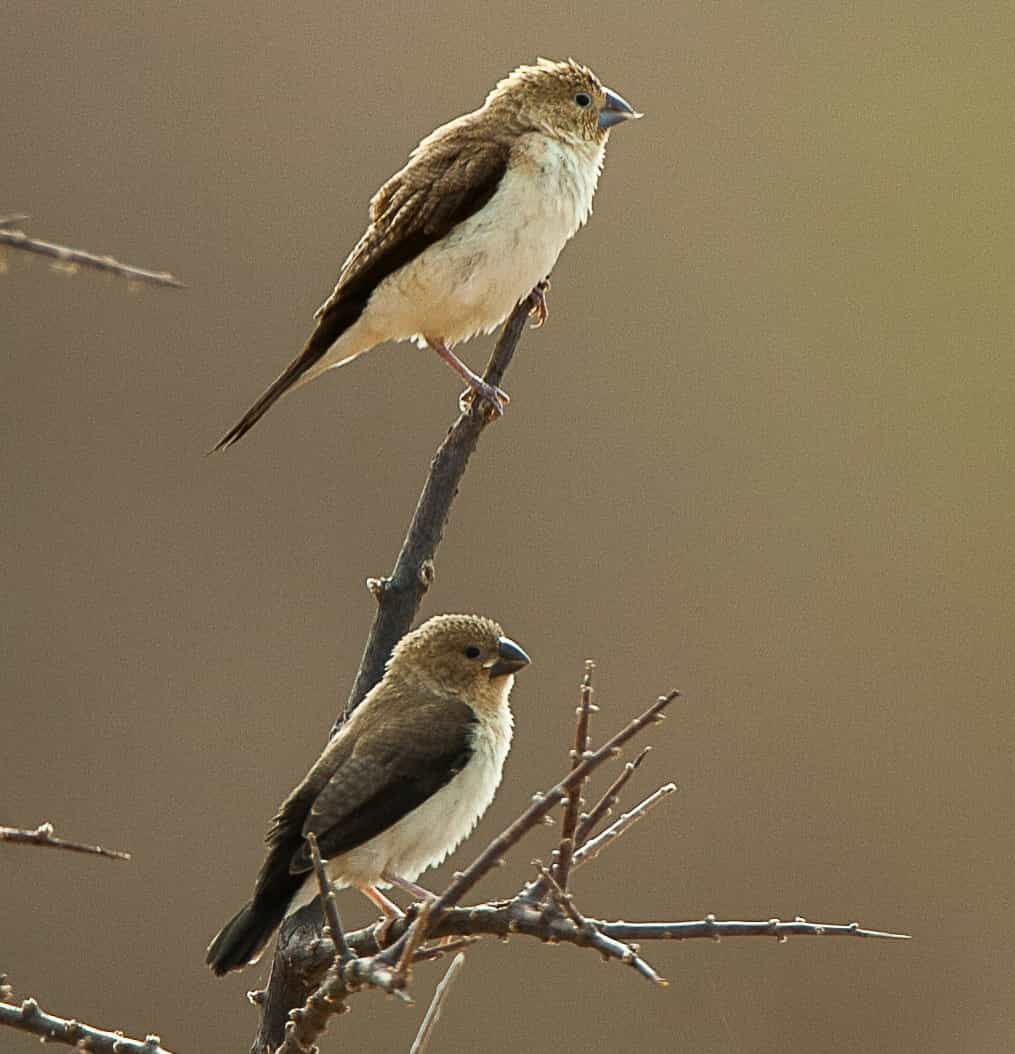
The African Silverbill, also known as Lonchura cantans, is a small bird that stands out with its silver-gray plumage and sharply pointed tail feathers. Measuring 10-11 cm, it possesses a modest, conical beak, and pale pink legs.
Male vs female
Identifying the gender of an African Silverbill can be difficult due to their equal size and lack of visible sexual dimorphism. Both sexes share the same coloration, with no observable differences in the plumage. Males can be discerned by their song, a unique series of twittering notes and trills, not present in females.
Juvenile
Juvenile African Silverbills resemble adult birds, but feature duller plumage. Their tails are notably shorter and less pointy. As the juveniles mature into adulthood, their coloration brightens, and their tail feathers elongate, fully developed by the time they reach six months.
Size
3.9 - 4.3 in/0.4 - 0.5 oz
There's more to learn about African Silverbill
View full detailsIndian Silverbill
Euodice malabarica
Also known as: White-Throated Munia
General appearance
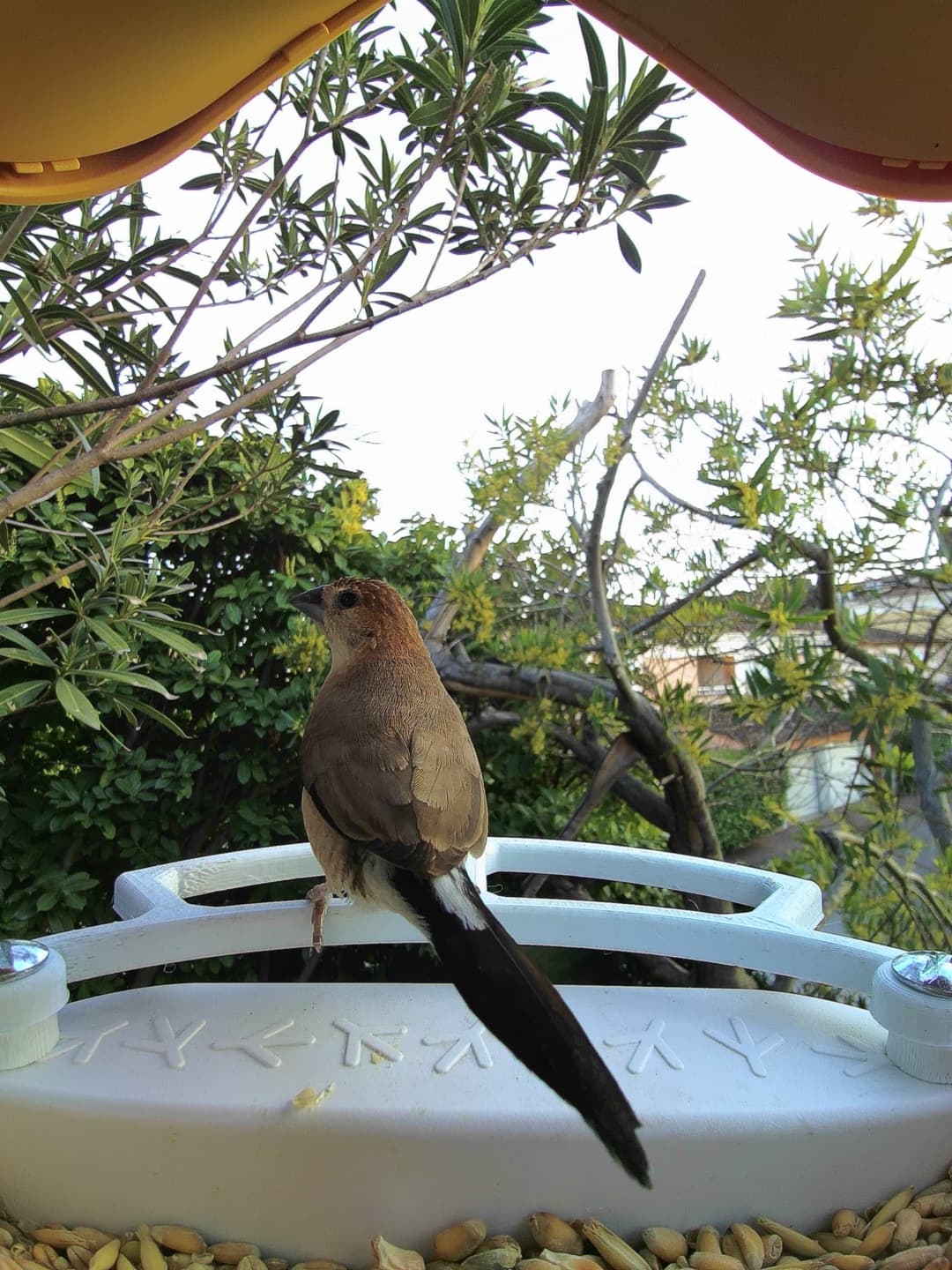
An Indian silverbill is a small passerine bird from the Estrildid finch family. It has an overall pale grey color and a conical silver-grey bill. The upper parts are brownish, while the underparts are whitish, with a subtle difference in their shades. They present a pointed tail with dark feathers and grow up to 11 to 11.5 cm in length. Splashes of white can be seen at the end of tail feathers. Sometimes, spotting is more common during the non-breeding season.
Male vs female
Male and female Indian silverbills are similar in appearance, both possessing the same greyish coloration and size. They exhibit no sexual dimorphism, making it challenging to distinguish between the two. Both sexes share equally in the care of hatchlings, but typically, only the males perform song displays.
Juvenile
Juvenile Indian Silverbills resemble adults but have a darker, more brownish-grey coloration. Their bills are dark initially, gradually getting paler as they mature. The tail might be slightly shorter and rounded, compared to the pointed tail in adults. Generally, juveniles lack the white tail tips present in adult birds.
Size
4.1 - 4.5 in/0.4 oz
There's more to learn about Indian Silverbill
View full detailsHow to tell the African Silverbill from the Indian Silverbill
Visual differences
The African Silverbill measures 4-4.3 inches and displays silver-gray plumage with sharply pointed tail feathers and a modest, conical beak. The Indian Silverbill, slightly longer at 4.3-4.5 inches, has pale gray upperparts, whitish underparts, and a strong, silver-gray beak. It also possesses a pointed tail with dark feathers and white tips, creating a contrasting appearance. Juveniles of both species have duller plumage, but Indian Silverbills display more brownish-gray tones. Beak color in juveniles darkens before lightening with age in Indian Silverbills, whereas African Silverbill beaks are consistently conical.
Key differences and behavior
The African Silverbill (Euodice cantans) and Indian Silverbill (Euodice malabarica) both display sociable behavior but differ in subtle ways. The African Silverbill is notably "chill," perching lazily in dense flocks, thriving in open grasslands and savannas, often near water. In contrast, the Indian Silverbill is resourceful, reusing old nests, inhabiting dry scrubs, farmland, and even cooler regions. African Silverbills forage for seeds and insects primarily from grasses, whereas Indian Silverbills do so actively on the ground, sometimes preferring small insects. Both breeds share similar breeding habits, with Indian Silverbills creating untidy dome nests and African Silverbills constructing their nests in trees and shrubs. Both species participate in parental care, though the Indian is more active post-fledging. In size, they're nearly identical, weighing around 0.35-0.49 oz and measuring 4-4.5 inches. Recognizing them in the field often depends on specific behavioral and habitat contexts rather than appearance.
African Silverbill vs [Select a bird]

[Select a bird]
Pick a bird to compare
Indian Silverbill vs [Select a bird]
[Select a bird]
Pick a bird to compare