
Violet Sabrewing
Violet Sabrewing
Campylopterus hemileucurus
Quick Identification guide
Quick Identification guide
- •
The iridescent violet plumage covering most of its body makes the Violet Sabrewing stand out vividly
- •
Features a robust, decurved black bill, which is quite distinct among hummingbirds
- •
Its large size and long wings coupled with a contrasting white abdomen help in easy identification
What does a violet sabrewing sound like?
The Violet Sabrewing, a large hummingbird species, has vocalizations characterized by high-pitched, rapid-fire notes in sequences. Its chittering calls are sharp and penetrating. During courtship displays, males produce an array of complex sounds, including twitters and buzzes. The songs are rhythmic and quite musical, often composed of sequences of squeaky "tsi-tsi-tsi" notes. The vocalizations are often accompanied by a loud, fast wing-beat sound.
Description
Violet sabrewings are the largest Central American hummingbirds. These big and bossy birds do not like sharing: once they find a feeding spot they like, nobody stands a chance of getting near it. That includes your backyard nectar feeder! They are, however, okay with sharing some of the spotlight. During courtship, they will get together with as many as 10 of their buddies for a group performance.
The violet sabrewing can weigh between 11.2to13.3grams and be from14to15centimeters tall.
The Violet Sabrewing typically lives for around 5 to 7 years. This lifespan is relatively long for a hummingbird species, with some related species like the Ruby-throated Hummingbird living around 3 to 5 years. These lifespans can vary based on factors such as predation and habitat conditions.
Did you know?
Most popular questions about violet sabrewing
How to recognise a violet sabrewing?
General appearance
The Violet Sabrewing is a large, striking hummingbird endemic to Central America. It is characterized by its vibrant purple-blue plumage that covers most of its body. With a long, decurved bill and white, feathery underparts, it measures around 5.5 inches in length. The strong wings of this species, from which its name is derived, have black- or green-tipped secondary feathers.
Male vs female
Violet Sabrewing males stand out with their dazzling, iridescent blue-violet feathers, particularly in the breeding season. Females, though more subdued, bear a greenish-blue hue in good light, but are mainly greyish-brown. Whilst males have full white underparts, females display a white-striped belly against a greyish background. Males also boast slightly longer tails.
Juvenile
Juvenile Violet Sabrewings resemble females but are dimmer with a shorter, straighter bill. As they age, the iridescence starts appearing and they grow into the sweeping curves of the adult form. Young males develop their full, bright violet-blue coloration after maturing over time.
Breeding and nesting habits of the violet sabrewing
Mating behaviors
Violet sabrewings engage in elaborate courtship displays. Males perform aerial displays while vocalizing to attract females. Display territories are defended aggressively, showcasing their iridescent plumage.
Nesting details
Nests are typically built in sheltered locations like under hanging vegetation or on rocky ledges. Constructed using plant fibers, moss, and spider webs, they are cup-shaped and camouflaged. In gardens, providing dense foliage and protection from wind can encourage nesting.
Eggs and chick-rearing
The female incubates two white eggs for about 17-19 days. After hatching, chicks are fed and cared for solely by the mother. They fledge approximately 20-26 days post-hatching, depending on food availability and safety of surroundings.
What does a violet sabrewing like to eat?
Insects
Nectar
Spiders
Natural diet
The violet sabrewing primarily feeds on nectar from a variety of flowering plants, particularly those with tubular flowers that match its long bill. It also consumes small insects and spiders, supplementing its diet with these protein sources, which are typically caught in flight.
Bird feeders
At bird feeders, the violet sabrewing is attracted to sugar water and nectar substitutes, often found in hummingbird feeders. They may also occasionally consume small insects attracted to the feeders.
Attracting the violet sabrewing
Violet Sabrewings, with their irredescent plumage and large size, are a wonderful bird to attract to your yard. They are highly attracted to brightly colored flowers and sugary nectar. Planting tubular flowers, such as fuchsia, begonias, or salvia can be an effective and beautiful way to tempt these birds to visit.
Feeding the violet sabrewing
Feeders with red accents and filled with a four parts water to one part white granulated sugar mixture can mimic the natural nectar Violet Sabrewings would find in flowers. Avoid using honey, artificial sweeteners, or food coloring as these can be harmful. Be sure to change the nectar once it begins to cloud to prevent mould from forming. Additionally, using Bird Buddy seeds will give the best results as they are chosen by experts for the season.
Fun hacks to encourage visits
If you want to increase the chances of these birds coming by, try tying a red ribbon around your feeder or place it close to a window for easy viewing. Due to their social and territorial nature, having multiple feeders can encourage more birds to visit. Also, playing bird songs can sometimes encourage these entertaining visitors to join in, creating a fun sing-along for everyone involved!
Where can you find violet sabrewings?
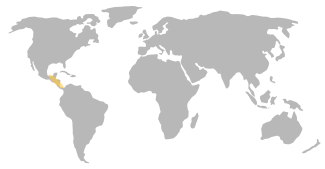
Primary habitat
The Violet Sabrewing typically inhabits humid forests and secondary woods in Central and South America, from southern Mexico to Panama.
Additional range
It can adapt to unexpected environments including gardens and high-altitude habitats, up to 7,500 feet.
Do they migrate?
The violet sabrewing (Campylopterus hemileucurus) is a large hummingbird found primarily in Central America. Unlike many bird species, the violet sabrewing does not migrate. It is a resident species throughout its range, which includes regions from southern Mexico through Costa Rica and into western Panama. These birds thrive in humid tropical forests, coffee plantations, and gardens at elevations ranging from sea level to about 2,400 meters. Their non-migratory nature is supported by their adaptability to various forest habitats and their ability to exploit a wide range of nectar sources. Violet sabrewings are known to establish year-round territories where they defend feeding areas within their habitats. These territories are maintained through aggressive interactions with other nectarivores, ensuring a steady food supply in their local environments. Therefore, the violet sabrewing remains in one place throughout the year, without any specific migration route, timing, or key locations typically associated with migratory species.
What is the role of violet sabrewings in nature and how to protect them?
Conservation status
The violet sabrewing is currently classified as "Least Concern" by the IUCN, indicating it is relatively common and not immediately at risk. This large hummingbird is found in several countries across Central America. Key threats include habitat loss due to deforestation and agricultural expansion. Conservation efforts focus on preserving its natural habitats, such as cloud forests and subtropical or tropical moist lowland forests. Although the species is generally adaptable, continued habitat conservation is essential to maintaining its population levels and stability in the face of ongoing environmental change.
Ecological role of violet sabrewings
Its role in the ecosystem
The Violet Sabrewing (Campylopterus hemileucurus) is a species of hummingbird that has significant ecological roles, particularly in polli nization and pest control. These large hummingbirds primarily feed on nectar, contributing to the pollination of various plant species. This is critical for the reproduction and survival of these plants and the propagation of biodiversity within their ecosystems. They occasionally eat insects and spiders, aiding in natural pest control by limiting these populations. Specifically, they regulate pest species that could potentially harm human agriculture or native plant life. The Violet Sabrewing may also contribute to seed dispersal, further promoting plant biodiversity. Their droppings can fertilize the soil, benefiting plants and impacting the wider food web. Finally, as a prey species, the Violet Sabrewing forms part of the diet of larger predators, contributing to the overall ecological balance within their habitat. They play an integral role in the maintenance and functioning of their ecosystems in Central America.
How to help protect violet sabrewings
Preservation tips
Habitat preservation strategies
Promote preservation of humid forest habitats; the natural environment of the Violet Sabrewing. Advocate for responsible forestry practices and land use to prevent deforestation. Create protected areas or reserves, particularly in regions identified as having high populations of Violet Sabrewing.
Community science initiatives
Encourage local communities to participate in citizen science initiatives to monitor the Violet Sabrewing population. This could involve simple bird watching, recording sightings, or more structured survey work. Educational programs could raise awareness about the importance of hummingbirds and their habitats. Support initiatives that create 'bird-friendly' environments such as planting native flowering plants that serve as food sources.