
Varied Thrush
Varied Thrush
Ixoreus naevius


Quick Identification guide
Quick Identification guide
- •
Features a bold black band across the orange breast, creating a striking contrast
- •
Displays dark blue-gray upperparts with a distinguishable orange stripe above the eye
- •
Possesses a rounded body and a relatively short tail, typical of thrushes
What does a varied thrush sound like?
The varied thrush typically communicates with buzz and chirp-like calls, along with trill and whistle sounds. Its song primarily consists of 2 or 3 buzzy whistles, which are drawn out until they naturally fade away, interrupted by short moments of silence in between. The bird's call often has a low 'took' sound, in a pattern that remains flat. Overall, the varied thrush’s vocalizations exhibit a blend of trills, whistles, buzzes, and low, flat calls.


Description
These little guys are pretty feisty and will create small territories around bird feeders, defending them fiercely. Be on the lookout for a rare variant of the varied thrush where all the orange bits are white instead! A group of these birds is known as a hermitage or a mutation of thrushes.
The varied thrush can weigh between 65to100grams and be from19to26.5centimeters tall.
The typical lifespan of a Varied Thrush is around 3 years. This is short compared to related species; for instance, American Robins can live up to 14 years, and Blackbirds for a decade. The Varied Thrush's shorter lifespan is likely due to higher predation levels and possibly disease.
Did you know?
Most popular questions about varied thrush
How to recognise a varied thrush?
General appearance
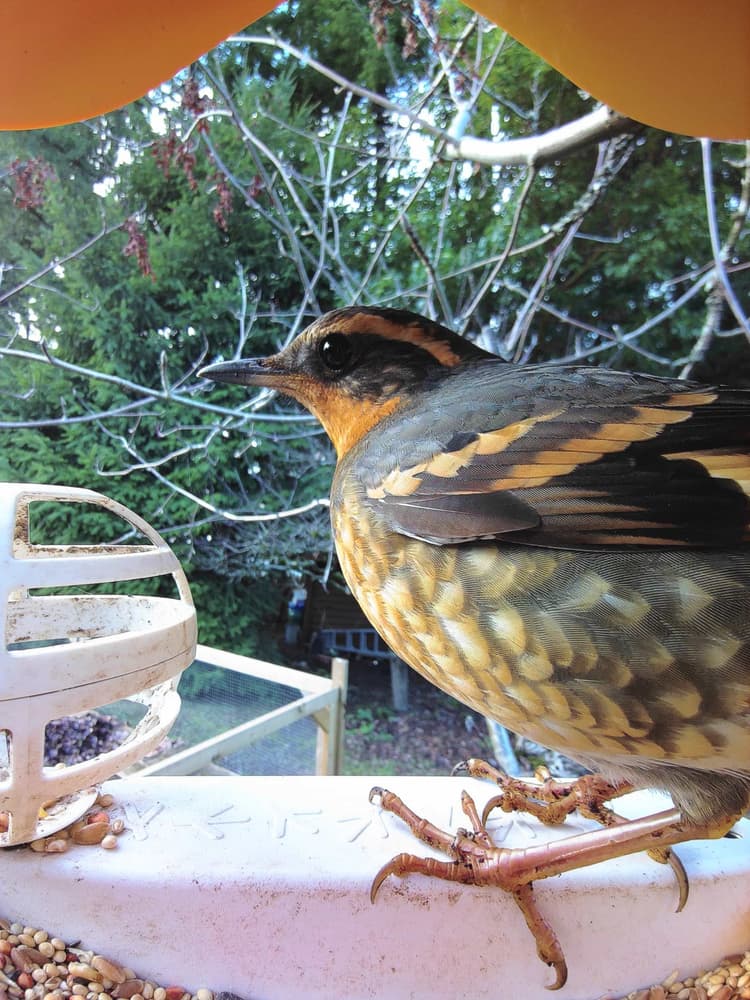
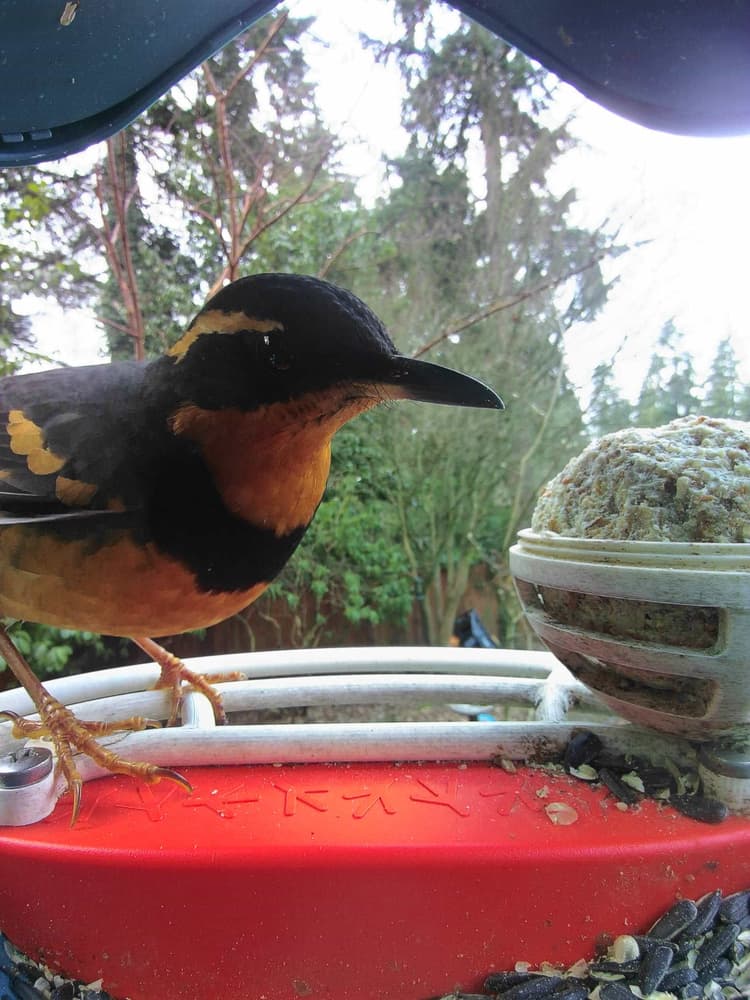
The Varied Thrush is about the size of a Robin, measuring between 9-10 inches (23-25 cm). Distinctive features include an orange throat and eyebrow, a dark chest band, and extensive orange markings on the wings. The bird has a black, blue, brown, and gray coloration. Lastly, its tail shape can vary between rounded to square-tipped.
Male vs female
The male and female Varied Thrush have slight distinctions. The female is duller than the male in terms of coloration. While both sexes have the same varying palette of black, blue, brown, gray, and orange, the female's upperparts are conspicuously paler in comparison.
Juvenile
Juvenile Varied Thrushes exhibit mottling on their chests, but their wing pattern is identical to that of adults. Despite not having fully adopted their adult colorations, the orange wing markings are already prominent, aiding in their identification in the wild.
Often mistaken for
American Robin vs Varied Thrush
The Varied Thrush is often mistaken for the American Robin due to its similar size and shape. However, the Varied Thrush sports a distinctive black band across its chest, contrasting with the Robin's plain red-orange breast. The Varied Thrush also has a striking blue-gray back and wings with bold black and orange facial markings. In contrast, the Robin is more uniformly brown with a white eye ring. Habitat can also help: Varied Thrushes are often found in dense, moist forests, while Robins are more adaptable and appear in a variety of open habitats.

Breeding and nesting habits of the varied thrush
Mating behaviors
The male varied thrush sings during spring to defend its territory, with vocalizations most frequent at dawn, dusk, and after rain, likely to attract mates and establish dominance.
Nesting details
Varied thrush nests are typically built by the female and placed in conifers, at the base of branches against the trunk, 5-15 feet above ground. In northern regions, nests may be located very low in deciduous thickets or on the ground. The nests are bulky open cups made of twigs, moss, leaves, and bark fibers, and lined with grass and rootlets.
Eggs and chick-rearing
The female likely lays and incubates the eggs. Once hatched, both parents aid in feeding the chicks until they are ready to fledge. Creating a suitable habitat involves planting native shrubs and trees, providing shelter and natural food resources.
What does a varied thrush like to eat?
Berries
Fruits
Insects
Nuts
Seeds
Natural diet
The varied thrush primarily feeds on insects and berries. During summer, it consumes a wide variety of insects such as beetles, ants, caterpillars, crickets, and many others. It also includes millipedes, sowbugs, snails, earthworms, spiders, and other invertebrates in its diet. In winter, the diet shifts mostly to berries and wild fruits, supplemented by seeds and acorns.
Bird feeders
The varied thrush is less commonly seen at bird feeders compared to other birds. However, when visiting feeders, it may consume similar items to those in its natural diet, such as seeds and fruits.
Attracting varied thrushes with unique feeders
Varied Thrushes are ground feeders, which means they prefer to eat off the ground rather than from a hanging feeder. To attract them to your yard, consider placing a platform feeder directly on the ground or a few inches above it. Fill the feeder with Bird Buddy seeds, which are selected by experts for the season, and you are more likely to see these beautiful birds visiting your yard.
Favourite snacks of varied thrushes
Varied Thrushes enjoy a diet consisting of insects, fruits, and seeds - make your yard a buffet for them! Put out a variety of fruits like apples, oranges, and pears. However, make sure to pair these with Bird Buddy seeds, which are sure to attract these fantastic birds due to its perfect blend of their favorite seeds that matches the season demands.
Fun tricks to keep thrushes around
Invest in a birdbath or a water fountain to make your yard more attractive to Varied Thrushes. They like water sources where they can bathe and drink. Also, consider planting native fruit-bearing plants and trees. Not only will this provide a food source but also an attractive habitat for them. And remember, nothing draws these birds better than a regular supply of Bird Buddy seeds!
Where can you find varied thrushes?
Primary habitat
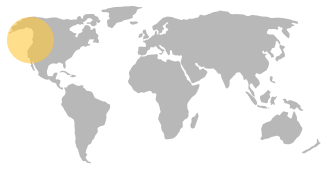
The varied thrush breeds in coniferous forests, typically dense, wet coastal areas with fir, hemlock, and spruce trees.
Additional range
During migration and winter, it favors coniferous woods but is adaptable, occupying undergrowth in other forests, especially near streams.
Do they migrate?
The varied thrush is a migratory bird. It migrates relatively late in the fall and returns early in the spring. During migration, these birds travel from their breeding grounds in the northwestern parts of North America to their wintering areas, primarily located in the southern regions of the continent. The specific timing and exact routes can vary, but they tend to follow a general north-to-south trajectory as temperatures drop and food availability changes. In the fall, as they move to their wintering areas, some varied thrushes stray far to the east, with a few individuals reaching as far as New England. This suggests an irregular pattern where some birds undertake longer, possibly exploratory journeys beyond their usual range. The numbers of varied thrushes present in these southern wintering regions fluctuate significantly from year to year, indicating that food availability and environmental conditions greatly influence their migration and winter distribution. Thus, the varied thrush is not resident year-round in one location; instead, it participates in seasonal migrations that cover a broad geographic range, with its patterns exhibiting considerable annual variability.
What is the role of varied thrushes in nature and how to protect them?
Conservation status
The varied thrush is currently considered common, but it faces potential vulnerability due to habitat loss from the cutting of northwestern forests. While not yet endangered, the ongoing deforestation poses a significant threat to its habitat. Conservation efforts should focus on preserving these critical forest areas to ensure the species' continued abundance. Protecting and managing forest resources responsibly will be vital to preventing the varied thrush from moving towards a more threatened conservation status.
Ecological role of varied thrushes
Its role in the ecosystem
The varied thrush plays a crucial ecological role, particularly in pest control and seed dispersal. Its feeding behavior, which includes a diet mainly of insects and berries, documents its significance in maintaining a balance in the ecosystem. The consumption of beetles, ants, caterpillars, crickets among other insects contributes to pest control. Moreover, the ingestion of various invertebrates also aids in managing their populations. The bird's practice of feeding on berries and wild fruits, especially during winter, inadvertently aids in seed dispersal. As the bird travels, seeds are passed out in their droppings, helping in the spread and germination of these plant species. Additionally, their feeding habit on seeds and acorns also plays a part in the regulation of these plant populations. Therefore, the varied thrush exhibits a significant role in supporting the biodiversity and the overall health of its environment.
How to help protect varied thrushes
Preservation tips
Habitat preservation strategies for varied thrush conservation
Varied Thrushes inhabit dense and wet forests, thus preservation of these ecosystems is key. Implement policies against deforestation and encourage reforestation where necessary. Restrict harmful activities like irresponsible logging and pesticide use that degrade their habitat. Promote sustainable practices among local communities.
Community science initiatives for varied thrush conservation
Engage the public in citizen science initiatives to monitor varied thrush populations. Encourage reporting of sightings to local wildlife agencies. Promote educational programs about the varied thrush to increase awareness and advocacy for its conservation. Hold regular community clean-ups in thrush habitats, fostering a sense of preservation in local communities.