
Townsend’s Warbler
Townsend’s Warbler
Setophaga townsendi


Quick Identification guide
Quick Identification guide
Male
- •
bright yellow face with a distinctive black cap and black eye stripe
- •
Olive green back and wings with white wing bars
- •
Black throat contrasting with the yellow underparts
Female
- •
Muted yellow face with a less prominent black cap and softer eye stripe
- •
Dull olive back and wings with subtle wing bars
- •
Paler yellow underparts with a slightly streaked throat
What does a Townsend's warbler sound like?
The Townsend's Warbler has a distinct tune characterized by a rising series of notes, typically featuring two phrases— the first repeated 3-4 times followed by the second once or twice. Its common song patterns sound like "weazy weazy weazy weazy twea" or "dee dee dee-de de". Alongside its primary song, this bird has a soft, more muted call referred to as a "chip". The call pattern of the Townsend’s Warbler shifts between flat, rising, and undulating. The call types include buzz, chirp/chip, and whistle.


Description
You'd better not try and get between a Townsend's warbler and its honeydew! These little birds love the secretion so much that they will set up and fiercely protect any tree infested with the appropriate insects. When building the nest, a female might start building in one tree then change her mind and move the whole operation to another one.
The Townsend's warbler can weigh between 7.3to10.4grams and be from11to13centimeters tall.
The Townsend's Warbler typically lives for a maximum of 10 years. This is comparatively long-lived for a warbler. For instance, the lifespan of a similar species, the Yellow-rumped Warbler, is around 7 years. Factors for a Townsend's Warbler's longevity include its diet and migratory habits.
Did you know?
Most popular questions about Townsend's warbler
How to recognise a Townsend's warbler?
General appearance
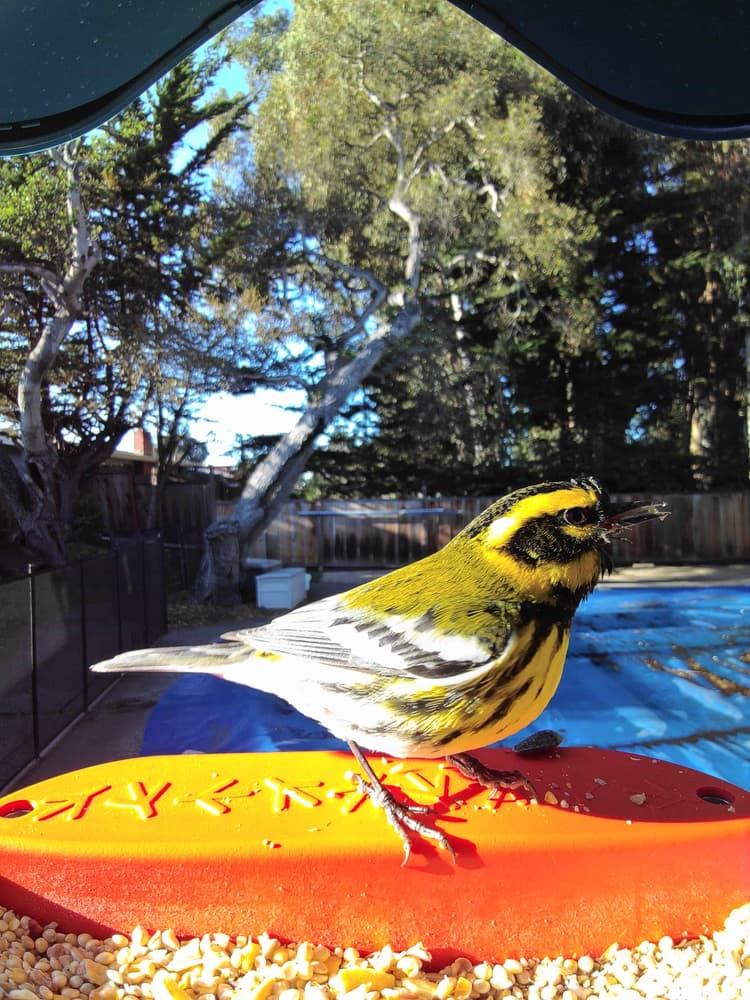
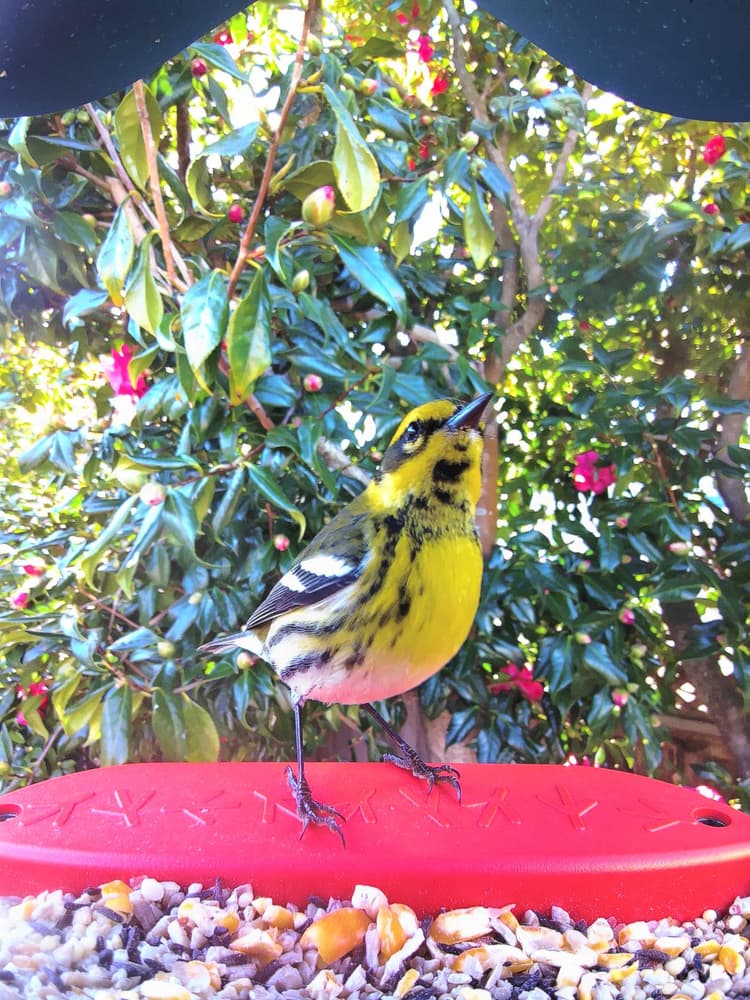
A Townsend’s warbler measures 4 1/4-5" or 11-13 cm, approximately the size of a Sparrow. This bird showcases a vibrant palette of Black, Green, White, and Yellow. It possesses a distinctive face pattern where bright yellow surrounds a dark cheek. Its back is green, while its chest is yellow, with white wing-bars and streaked sides. Its tail shape is notched and square-tipped.
Male vs female
In adults, there is a notable difference in the throat coloration between genders. Males sport a black throat, adding to their dynamic color pattern, whereas females have a predominantly yellow throat, ensuring differentiation in the wild.
Juvenile
Similar to females, young Townsend’s warblers also have a mostly yellow throat. This trait, paired with their size, may be helpful in distinguishing them from the black-throated adult males. As they grow and mature into adulthood, their features and colors will transform, giving them their distinctive adult appearance.
Breeding and nesting habits of the Townsend's warbler
Mating behaviors
Male Townsend's warblers arrive on the breeding grounds in late May and establish territories by singing, attracting potential mates.
Nesting details
The nest is placed directly on top of horizontal conifer branches, 7 to 60 feet above the ground. It is a large shallow cup built by both sexes using grass stems, mosses, cedar bark, and fir twigs, lined with moss, feathers, and hair. For gardens, provide dense conifers with accessible branches to encourage nesting.
Eggs and chick-rearing
The first eggs are laid by late June. Details on incubation and chick-rearing practices are not specified, but typically involve shared responsibilities between both parents in feeding and protecting the chicks until fledging.
What does a Townsend's warbler like to eat?
Honeydew
Insects
Plants
Seeds
Spiders
Natural diet
The Townsend's warbler primarily consumes a diet composed mostly of insects. During its nesting phase, it mainly feeds on insects such as caterpillars, true bugs, beetles, and leafhoppers. Additionally, it consumes a few spiders, seeds, and plant galls. When on its tropical wintering grounds, the diet expands to include some berries and nectar.
Bird feeders
While the Townsend’s warbler is not primarily known to feed extensively at bird feeders, it might occasionally consume offerings commonly found in feeders like seeds and suet, especially during migration or in winter months when its natural insect diet might be less accessible.
Attracting townsend's warblers: food suggestions
Townsend's warblers are fond of a variety of insect-based foods and fruits, which you can supply in your yard. Regularly serving suet (a type of animal fat), sunflower seeds, and fruits such as oranges can be a feast for them. But for the best results, offer Bird Buddy seeds. Chosen by experts according to the season, Bird Buddy seeds can provide the most nutritious and appealing food sources for Townsend’s warblers.
Feeder types and placement for townsend's warblers
Select a feeder designed for smaller bird species. Platform feeders and suet boxes are recommended as they allow these birds to comfortably feed. Position your feeders near natural cover, such as bushes or trees. This gives Townsend's warblers a sense of security while they're dining, and provides a quick escape route from predators.
Fun tricks to encourage visits
Adding a birdbath or a water feature to your yard can make it more appealing to Townsend's warblers, as these birds enjoy bathing and require water for drinking. To have them stay longer, you can play soft bird calls or songs. Always remember not to play these sounds too loud or too often to prevent stressing the birds.
Where can you find Townsend’s warblers?
Primary habitat
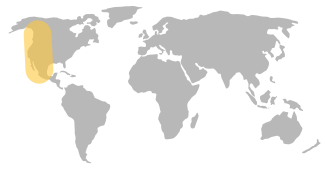
The Townsend’s warbler selects tall, dense coniferous forests in the Pacific Northwest, inhabiting both the humid coastal belt and the mountains.
Additional range
In winter, it favors oaks, madrones, and laurels. In the tropics, it resides in mountain forests of pine, oak, and alder, and along the California coast, it seeks out oak woods and conifers. It can also be found in mountain conifer forests and streamside trees in lowlands during migration periods.
Do they migrate?
The Townsend’s warbler (Setophaga townsendi) is a migratory bird species, following distinct routes during its migration periods in both spring and fall. During the spring migration, these warblers travel north from their wintering grounds to their breeding territories. They winter predominantly along the West Coast of the United States, from southern California extending into Mexico, and as far south as Central America. Migration in the spring commences around late March to early April, as they head toward their breeding habitat in the coniferous forests of the Pacific Northwest, including Washington, Oregon, western Canada, and southern Alaska. The timing of this migration is gradual, stretching over several weeks, aligning with the availability of resources along their route. In fall, around August to September, Townsend’s warblers undertake their southward journey back to their wintering grounds. During this period, they are noted to occur at all elevations in the Southwest, though they are most commonly observed in mountainous regions. Key locations during their migration include forested mountain regions that provide essential stopover sites for resting and foraging. The clear elevational preference during migration helps ensure they find suitable habitats and food sources as they travel between their breeding and wintering areas.
What is the role of Townsend’s warblers in nature and how to protect them?
Conservation status
The Townsend's warbler is currently considered "still common and widespread," indicating it is not classified as vulnerable or endangered. This species maintains stable populations across its range, benefiting from its adaptability to various habitats. Key conservation efforts focus on habitat preservation, especially in breeding and wintering areas, to ensure continued stability. While there are no significant immediate threats, potential concerns include habitat loss due to logging and climate change. Overall, the Townsend's warbler does not face immediate risk but requires ongoing monitoring to address any future challenges.
Ecological role of Townsend’s warblers
Its role in the ecosystem
The Townsend’s warbler contributes significantly to ecosystem functionality. Its feeding behavior, primarily on insects, helps regulate the insect population, assisting in pest control, especially of caterpillars, bugs, beetles, leafhoppers and the like. While this helps maintain ecological balance, it equally aids in the health and vibrancy of plants and trees by reducing potential damage caused by these insects. The warbler's consumption of seeds and plant galls also aids in seed dispersal. Lastly, on tropical wintering grounds, the warblers feed on berries and nectar, contributing to pollination. Their nesting behavior further aids in organic material turnover, as nests composed of various plant materials gradually decompose and enrich the soil after the nesting period. Overall, the Townsend’s warbler plays a multifunctional role in pest control, seed dispersal, pollination and nutrient cycling, thereby promoting biodiversity and ecosystem health.
How to help protect Townsend’s warblers
Preservation tips
Habitat preservation for townsend's warbler
The Townsend’s warbler habitats include coniferous forests, particularly those dominated by spruce and hemlock trees. To support its conservation, protect such forests from deforestation and fragmentation. Encourage responsible forest management that promotes the growth of native trees. Lobby for policies that regulate logging practices and maintain old growth forests that are critical for nesting and winter survival.
Community science initiatives
Promote participation in citizen science programs that monitor bird populations, such as the Christmas Bird Count and eBird. Conduct local workshops to educate communities about the Townsend’s warbler, identifying distinguishing features, and how to report sightings. Invest in programs that inspire young nature enthusiasts and develop their interest in ornithology. Encourage community plantings of native tree species that attract the Townsend’s warbler, help in reducing greenhouse gas emissions, and increase the resilience of local ecosystems.