
Swallow-tailed Hummingbird
Swallow-tailed Hummingbird
Eupetomena macroura


Quick Identification guide
Quick Identification guide
- •
Showcases a dazzling iridescent green-blue body contrasted with a dark blue head and throat
- •
Features a notably long, forked tail that is immediately recognizable during flight
- •
Equipped with a straight, slender black bill perfectly suited for nectar feeding


Description
With its dazzling iridescent blues and greens and a tail that splits elegantly like a pair of scissors, the Swallow-tailed Hummingbird is truly a sight to behold! This vibrant little bird flits through tropical gardens and forests, sipping nectar with expert precision and defending its favorite feeding spots with surprising tenacity. Agile and fearless, it moves like a tiny jewel in the air, leaving a trail of rapid, high-pitched chirps that hint at its presence. Spotting one feels like catching a glimpse of living art in motion!
The swallow-tailed hummingbird can weigh between 6to9grams and be from15to18centimeters tall.
The Swallow-tailed Hummingbird typically has a lifespan of up to 5 years. This is shorter when compared to other species like the Ruby-throated Hummingbird, which can live up to 9 years, and longer in comparison to the Bee Hummingbird, with a lifespan of around 7 years. Factors such as environment, predation, and food availability influence their lifespan.
Did you know?
Most popular questions about swallow-tailed hummingbird
How to recognise a swallow-tailed hummingbird?
General appearance
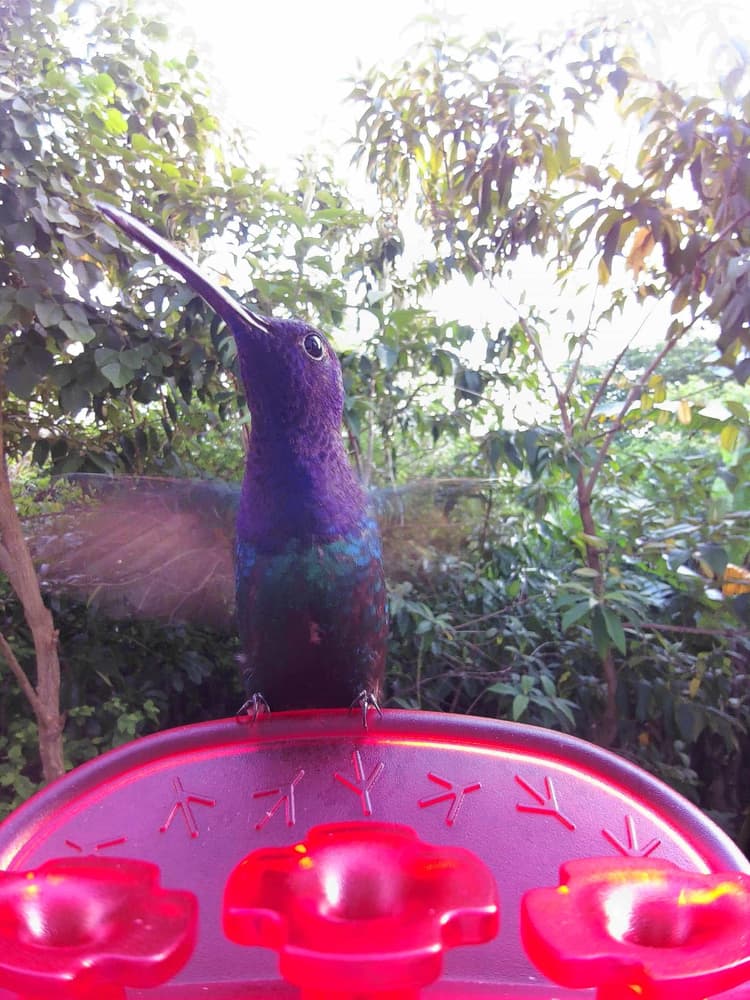
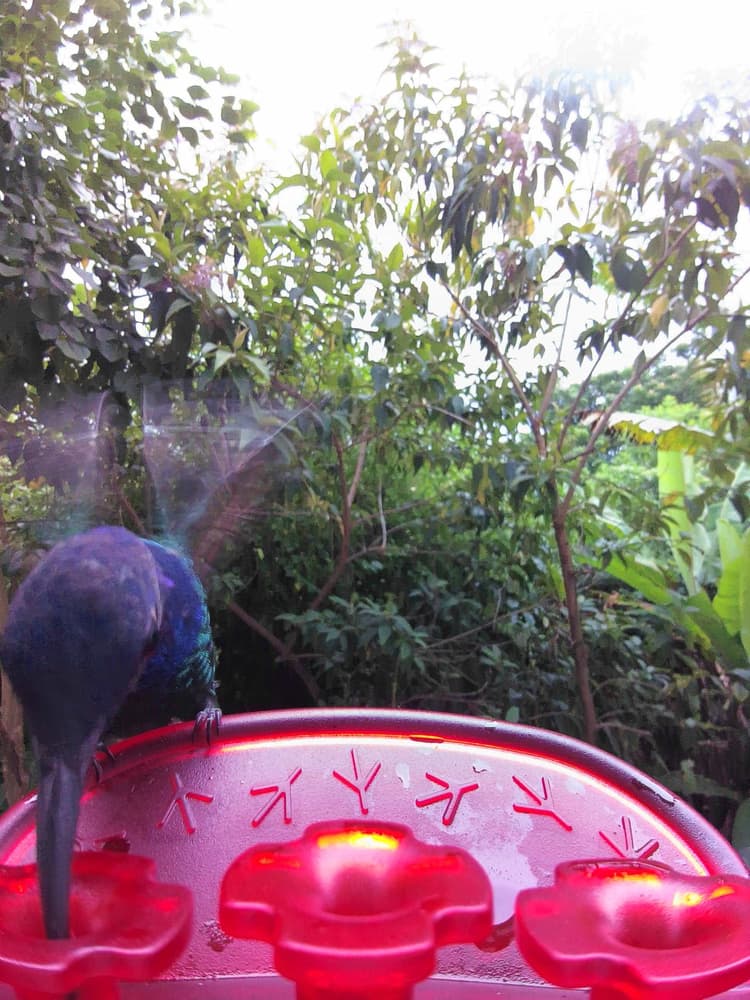
The Swallow-tailed Hummingbird is one of the largest hummingbirds, measuring up to 17 cm in length, including its long, forked tail. The bird's distinctive traits are its iridescent green body, bluish head, and red throat. The tail feathers are deep blue with a white band. The beak is straight, thin, and long.
Male vs female
Males and females of this species look alike, with similar vibrant coloration. The main difference is size, as the male is typically larger than the female. Additionally, the female's tail is slightly shorter and less forked than the male's.
Juvenile
Juvenile Swallow-tailed Hummingbirds resemble adults but have duller colors and less pronounced tail forks. The immature birds undergo progressive changes until they attain the adult plumage. They also have a less iridescent throat.
Breeding and nesting habits of the swallow-tailed hummingbird
Mating behaviors
Swallow-tailed hummingbirds engage in aerial displays to attract mates. Males perform dives and fast zigzag flights to showcase their vibrant plumage and agility, often accompanied by vocalizations to establish dominance.
Nesting details
These hummingbirds prefer nesting in open scrublands, savannas, and gardens. They construct cup-shaped nests using plant fibers, spider silk, and lichens to camouflage. Nests are typically placed on horizontal branches at moderate heights.
Eggs and chick-rearing
Females lay two small, white eggs and incubate them alone for about 15-16 days. Once hatched, chicks are fed a diet of insects and nectar. The chicks fledge approximately 20-25 days after hatching. Providing flowering plants and avoiding pesticides in gardens can support nesting.
What does a swallow-tailed hummingbird like to eat?
Insects
Nectar
Natural diet
Swallow-tailed Hummingbirds primarily feed on nectar from a variety of flowering plants. They prefer flowers with high sugar content and are particularly attracted to vibrant colors such as red, orange, and yellow. In addition to nectar, they consume small insects and spiders, which provide essential proteins and nutrients, helping them in hunting and feeding their young.
Bird feeders
At bird feeders, Swallow-tailed Hummingbirds are drawn to sugar water solutions that mimic flower nectar, typically prepared with four parts water to one part white sugar. They are attracted by brightly colored feeders, especially those with red components. The feeders offer an additional food source that complements their natural diet during scarce food supply times.
Select the right food
The Swallow-tailed hummingbird, like many hummingbirds, enjoy a sweet meal. Making your own nectar is simple, combining one part ordinary white cane sugar to four parts water. Boil the mixture for 1-2 minutes to get rid of any impurities, then cool before using. Next, adding bird-friendly seeds to your yard can provide an added temptation. For best results, try Bird Buddy seeds. They are chosen by experts for each season, ensuring that your yard always has an attractive food source.
Choose a suitable feeder
Swallow-tailed hummingbirds are attracted to red and orange colors, so choose a feeder in these colors. The feeder should be cleaned at least once a week. In hotter weather, it may need to be cleaned more frequently to prevent mold or bacteria from forming. Keep the feeder out of direct sunlight to prevent the nectar from fermenting too fast. Additionally, having more than one feeder can prevent territory disputes among the hummingbirds.
Create a welcoming environment
Hummingbirds, including the Swallow-tailed species, are attracted to water features, such an as small bird bath or a misting sprinkler. You can also attract them with bright flowers such as hibiscus and honeysuckle. Keep your yard safe for these delightful visitors by not using pesticides that can harm them.
Where can you find Swallow-tailed Hummingbirds?
Primary habitat
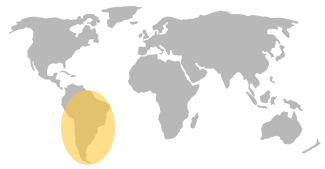
The Swallow-tailed Hummingbird prefers semi-open areas, gardens, and forest edges. They are typically found in the Atlantic forest in South-east Brazil.
Additional range
Surprisingly, these hummingbirds can also exist in urban areas, taking advantage of flowering gardens. They are found in Brazil, Paraguay, Bolivia and parts of Argentina.
Do they migrate?
The Swallow-tailed Hummingbird (Eupetomena macroura) is primarily a resident species and does not undertake long migratory journeys like some other hummingbird species. It is found mainly in eastern and central South America, with its range covering countries such as Brazil, Bolivia, Paraguay, and northern Argentina. Instead of migrating, the Swallow-tailed Hummingbird may exhibit local movements in response to the availability of food resources. These movements are generally short-range and dictated by environmental conditions and flowering patterns of plants they feed on. While they might move to different areas within their range to find rich feeding grounds, these are not considered true migrations. The hummingbird thrives in a variety of habitats, including gardens, savannas, and semi-open areas, showing a preference for areas with abundant flowering plants. Its ability to adapt to different environments aids its survival without the need for long-distance migration. Therefore, the Swallow-tailed Hummingbird remains relatively stationary throughout the year, with local dispersal mainly driven by ecological factors.
What is the role of Swallow-tailed Hummingbirds in nature and how to protect them?
Conservation status
The Swallow-tailed Hummingbird is currently classified as "Least Concern," indicating it is relatively common and not at immediate risk of extinction. It thrives in a variety of habitats across eastern and central South America. However, deforestation and habitat degradation pose significant threats, potentially impacting its population in the long term. Key conservation efforts focus on habitat preservation and reforestation initiatives. Maintaining protected areas and promoting sustainable land use are crucial to ensuring the species' continued stability.
Ecological role of Swallow-tailed Hummingbirds
Its role in the ecosystem
The Swallow-tailed Hummingbird holds a vital position in the ecosystem. As pollinators in tropical and subtropical areas, they play a crucial role in maintaining biodiversity by assisting in the reproductive processes of certain types of flora; their long beaks and tongues allow them to reach nectar at the base of long-cupped flowers, thereby facilitating cross-pollination. This contribution towards plant reproduction also aids in seed dispersal that generates growth of new floras. Their diet, largely composed of insects and spiders in addition to nectar, makes them a critical part of pest control within their ecosystems. Their role as prey for larger species also offers a check within the food chain. Thus, the Swallow-tailed Hummingbird contributes significantly to ecosystem balance and diversity.
How to help protect Swallow-tailed Hummingbirds
Preservation tips
Habitat preservation strategies
Maintain and restore native habitats, particularly those with flowering plants, which are crucial for the survival of Swallow-tailed Hummingbirds as it provides them nectar. Purchase land and set them aside to create nature reserves. Support initiatives aimed to reduce deforestation and initiate tree planting activities in urban and rural areas. Consider sustainable farming practices that don't harm these birds' environments.
Community science initiatives
Join birdwatching groups and participate in bird count surveys to help track Swallow-tailed Hummingbird populations. Report sightings to local wildlife groups. Participate in bird tagging programs as this enables researchers to study behavior, migration patterns and lifespan. Raise awareness in your community about the importance of conserving this species and its habitat. Support local organizations focused on conserving wildlife, particularly hummingbirds.