
Red Wattlebird
Red Wattlebird
Anthochaera carunculata


Quick Identification guide
Quick Identification guide
- •
Features a distinctive yellow wattle near the base of the neck, visible against its grayish-brown plumage
- •
Exhibits streaked white and brown feathers throughout its body and a reddish patch near the rump
- •
Possesses a slender, slightly curved beak and a long pointed tail that provides a sleek appearance
What does a red Wattlebird sound like?
The Red Wattlebird is known for its distinctive, raucous vocalizations. Its calls are typically loud, harsh, and guttural; resembling coughs, yelps and rattles. Some common calls include "chokk", "chokk-a-chokk", or a repetitious "wok-wok". It often repeats these calls repeatedly, and with great volume. Its songs, intricate and varied, involve the repetition of notes intermixed with standard calls, imitating other bird species too. The bird is most vocal at dawn or throughout the day while searching for food or during mating season.


Description
Red wattlebirds are big: one of the largest of the Australian honeyeaters and one of the largest nectar-eaters in the world! These territorial and aggressive birds are known for being noisy, so it is unsurprising that there is a host of onomatopoeic local indigenous names to refer to them.
The red Wattlebird can weigh between 82to140grams and be from33to37centimeters tall.
Red wattlebirds have an average lifespan of about 15 years in the wild. Compared to related species, such as the Little Wattlebird that typically lives up to 10 years, the Red Wattlebird tends to live for a longer duration. However, the larger Yellow Wattlebird outlives both, with a lifespan reaching up to 20 years.
Did you know?
Most popular questions about red Wattlebird
How to recognise a red Wattlebird?
General appearance
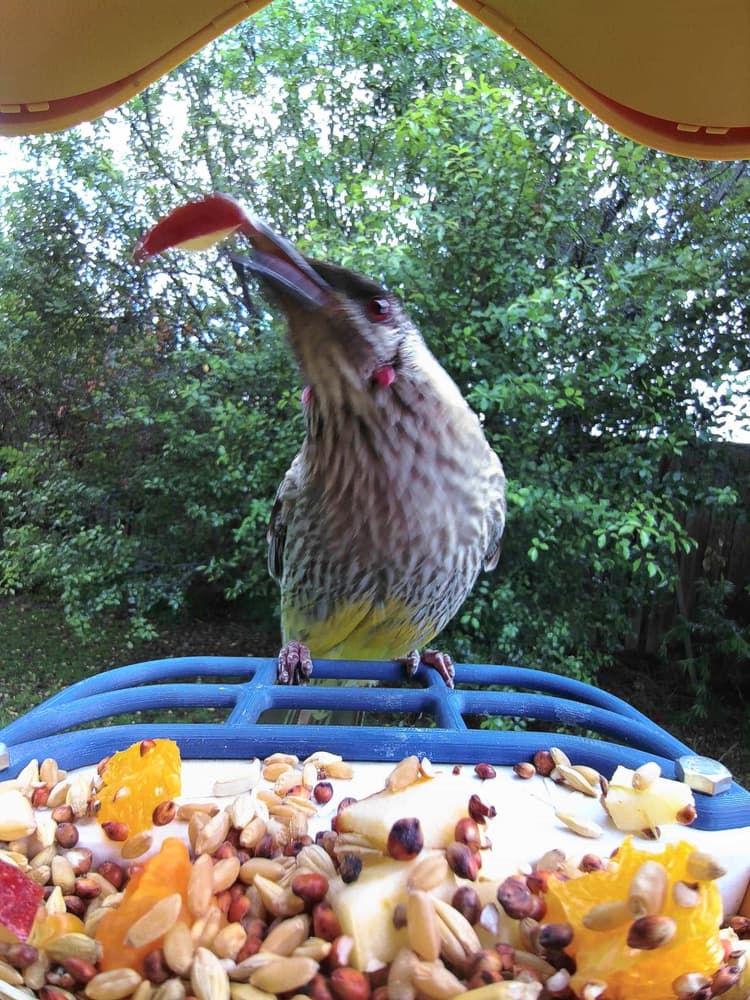
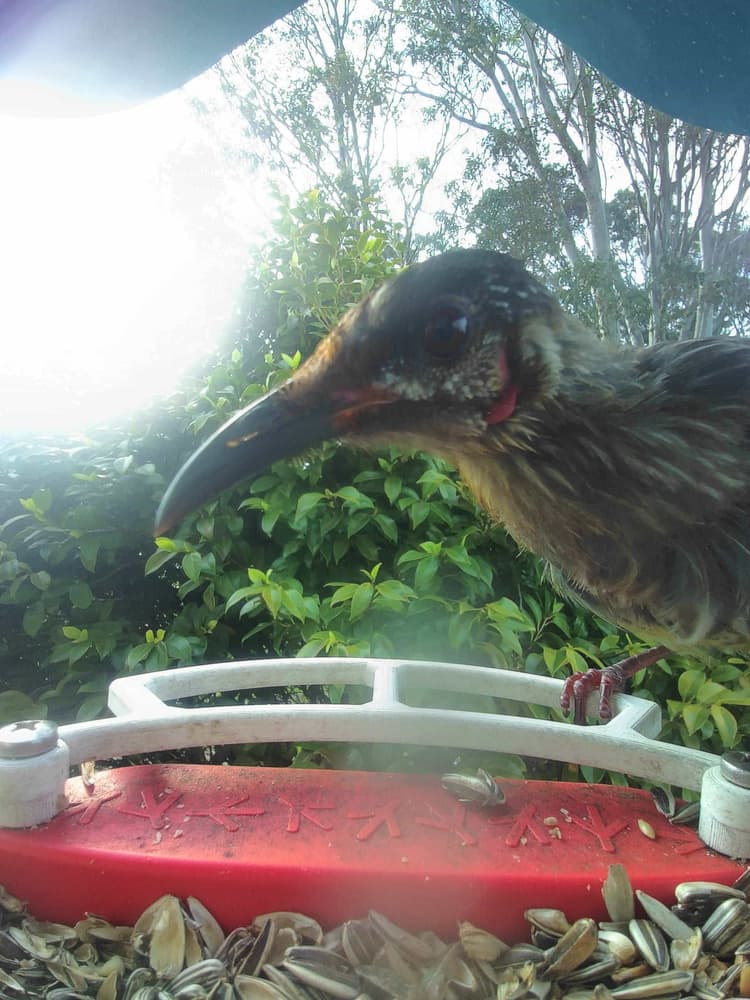
The red wattlebird is a large, greyish-brown Australian honeyeater with distinctive fleshy, reddish wattle on the side of the neck. Their underparts are often streaked with white, and tail feathers are tipped with white. The bill is robust, long, and slightly curved. Its wings possess a striking pattern of black, white, and a reddish-brown patch.
Male vs female
Male and female red wattlebirds are similar in appearance, and it is hard to distinguish them based on coloration or physical traits as both possess the same colors and distinctive wattles. Size varies slightly with males usually being larger than females, however, it's not a definitive determining factor.
Juvenile
Juvenile red wattlebirds are similar to adults but with slightly duller coloration. The key difference is that juveniles lack the distinctive red wattle, which develops as they mature. Instead, they have a small pinkish bare patch of skin. The streaking on their underparts is also less defined.
Breeding and nesting habits of the red Wattlebird
Mating behaviors
Red wattlebirds engage in elaborate courtship rituals, including synchronized flight displays and vocalizations. Males often chase females in a performance to establish pair bonds.
Nesting details
They build cup-shaped nests using twigs, bark, and grasses. Nests are located in the forks of trees or shrubs, often in suburban gardens. Dense foliage offers protection from predators.
Eggs and chick-rearing
Females lay 2-3 eggs, incubating them for about 16 days. Both parents feed the chicks a diet of insects and nectar. Chick rearing lasts around 14 days until fledging.
What does a red Wattlebird like to eat?
Bird eggs
Fruits
Honeydew
Insects
Lerp
Manna
Nectar
Small animals
Natural diet
The red wattlebird primarily feeds on nectar, which it obtains from a variety of flowering plants such as eucalypts, banksias, and grevilleas. They have a particular dependence on eucalypt nectar. In addition to nectar, red wattlebirds consume insects and other small arthropods, which provide essential proteins and nutrients. Fruits and berries also form part of their diet when available.
Bird feeders
At bird feeders, red wattlebirds are often attracted to sugar water solutions, resembling the nectar they naturally consume. They may also eat offerings like sliced fruits or jelly if provided. Commercial nectar mixes specifically designed for honeyeaters can attract them, replicating the high-energy source they seek from flowers.
Attracting red wattlebird with the right feeder
Red Wattlebirds are attracted to large and robust feeders as they are a fairly sizeable bird species. They enjoy feeders that hang from trees or stands with plenty of perching space. The most effective feeders have ample room for multiple birds and provide a stable platform for the wattlebirds to feed safely. Try to position your feeder in a quiet, secluded area, as wattlebirds prefer peaceful surroundings.
Preferred snacks for red wattlebird
Red Wattlebirds are honeyeaters and feed primarily on nectar. They also enjoy fruits, insects and seeds. Including these in your bird feeder will make it more appealing to them. Bird Buddy seeds are highly recommended as they are expertly chosen depending on the season, something that Red Wattlebird greatly appreciates.
Fun tricks to encourage the bird to visit
Plant native flowering shrubs and trees that produce nectar, as this will attract the red wattlebird. Consider installing a bird bath, as wattlebirds enjoy a good splash. And, of course, keeping a regular supply of Bird Buddy seeds will keep them coming back. With patience and these strategies, you could have a red wattlebird joining you for a song before too long.
Where can you find red wattlebirds?
Primary habitat
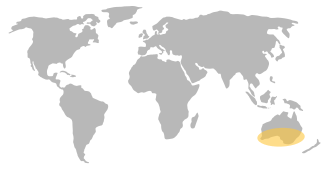
The red wattlebird primarily inhabits open forest, woodlands, and gardens in coastal and mountainous regions in South Australia and Victoria.
Additional range
Outside of its preferred habitats, this species can be found in cultivated lands and urban areas, adapting to unexpected environments within its typical range in Australia.
Do they migrate?
The red wattlebird is a predominantly resident species, which means it typically does not undertake long-distance migrations. Instead, it is known for its local and seasonal movements primarily driven by the availability of food resources, particularly nectar. These movements occur within their range in southern and southeastern Australia, including regions in New South Wales, Victoria, South Australia, Queensland, and Tasmania. In some areas, red wattlebirds may shift locally from inland regions to coastal areas or move to lower altitudes during colder months to find suitable foraging opportunities. These shifts are generally not extensive and are considered nomadic rather than true migration. Though there is no well-defined migratory route for red wattlebirds, they tend to follow the flowering patterns of native plants. The timing of these movements varies as they coincide with the bloom periods of key nectar-producing flora. As such, red wattlebirds can be found in greater numbers in regions that currently have abundant flowering, demonstrating their adaptability to changing environmental conditions and resource availability.
What is the role of red wattlebirds in nature and how to protect them?
Conservation status
The red wattlebird is classified as a common species and is not currently considered vulnerable or endangered. It has a wide distribution across southern Australia, thriving in various habitats including urban areas. Key conservation efforts are minimal due to its stable population, but maintaining natural habitats and urban green spaces supports their well-being. Significant threats include habitat loss due to land development and predation by introduced species such as cats and foxes. Conservation strategies focus on habitat preservation and minimizing these threats, ensuring the red wattlebird remains a thriving part of Australia’s avian diversity.
Ecological role of red wattlebirds
Its role in the ecosystem
The Red Wattlebird, a species of honeyeater found in Australia, plays a crucial role in the ecosystem. It is a prominent pollinator, as it feeds on nectar from a variety of flowering plants. This feeding habit results in effective cross-pollination between different flower species, playing a fundamental role in the reproductive cycle of these plants. Because of the Red Wattlebird's broad diet - which includes not only nectar, but also insects - it also contributes to pest control by feeding on insect population in their habitat. Furthermore, the Red Wattlebird is also believed to assist in seed dispersal through its feeding habits, thus facilitating plant distribution and biodiversity. Its existence contributes to the overall balance in the ecosystem, affecting both flora and fauna, demonstrating the ecological significance of the Red Wattlebird.
How to help protect red wattlebirds
Preservation tips
Habitat preservation strategies
Establish protected areas and promote natural resource management techniques in key habitats, ensuring controlled development. Launch reforestation initiatives in degraded regions, focusing on native flora. Limit disturbance by minimizing noise levels, controlling pet access, and reducing pesticide usage in these habitats.
Community science initiatives
Create community awareness programs regarding the importance of red wattlebird conservation. Engage citizen scientists to monitor bird movements, numbers, and breeding success. Promote participation in bird watching societies and encourage reporting sightings on platforms like 'eBird'. These collected data can be used by researchers to understand trends and make informed decisions.