
Oriental Pied Hornbill
Oriental Pied Hornbill
Anthracoceros albirostris
Quick Identification guide
Quick Identification guide
- •
Features a large, black-and-white beak with a distinct casque on top, characteristic of hornbills
- •
Displays glossy black plumage on the body contrasted with white underparts and wing tips
- •
Has a white throat patch and eye ring, enhancing its striking appearance
What does an Oriental pied-hornbill sound like?
The Oriental pied hornbill vocalizes a variety of sounds, often deep and harsh, including barks, roars, squawks, grunts, and repeated cackling laughter. These vocalizations often sound distinctly melodious, given the echoing quality of its calls. Its primary call is typically a coarse 'kok-kok-kok' or 'kak-kak-kak.' The Oriental pied hornbill does not have typical bird songs, as its vocal repertoire mainly consists of these loud and resonating calls.
Description
Oriental pied-hornbills have an interesting nesting strategy. A female will seal herself in a nest hole, leaving only a small opening. She will stay inside with her chicks for months, until they are ready to fledge. Meanwhile, her partner will bring her and the babies food!
The Oriental pied-hornbill can weigh between 570to910grams and be from55to60centimeters tall.
The Oriental Pied Hornbill typically has a lifespan of about 25-30 years in the wild, although it can live up to 50 years in captivity. Relative to their cousins, Great Hornbills which can live up to 50 years in the wild and 60 in captivity, they have shorter lifespans on average. Similarly, the Indian Grey Hornbill and the African Grey Hornbill typically live less than 20 years, showing a shorter lifespans than the Oriental Pied Hornbill.
Did you know?
Most popular questions about Oriental pied-hornbill
How to recognise an Oriental pied-hornbill?
General appearance
The Oriental Pied Hornbill is a large bird, sporting a striking coloration of black and white. Its back, wings, tail and crown are black, while the underside is white. For the most distinctive feature, it has a yellowish-brown bill accentuated by a black base and a large, hollow casque on top.
Male vs female
Male and female Oriental Pied Hornbills show slight sexual dimorphism. Males are generally larger and their iris colors range from deep red to orange, while females have smaller bodies and their iris color is typically white or pale blue. The black base on the bill of a male extends onto the face, a distinction absent in the female.
Juvenile
Juveniles have physical traits similar to adults, although they're smaller in size. The casque on their bill is less developed or absent and the coloration of their plumage is not as bold. The iris color of juveniles is dark, gradually gaining adult hues as they mature.
Breeding and nesting habits of the Oriental pied-hornbill
Mating behaviors
Oriental pied hornbills engage in courtship displays featuring the male presenting food to the female. This behavior helps strengthen pair bonds before nesting begins.
Nesting details
Nest usually found in tree cavities, selected by the female. They often choose high, safe locations to avoid predators. The nest is sealed with mud and droppings, leaving only a small slit. In gardens, provide large trees or artificial nest boxes at elevated spots, mimicking natural cavities.
Eggs and chick-rearing
The female lays 2-4 eggs and stays sealed inside the nest with the chicks, relying on the male to provide food. After hatching, chicks are fed regurgitated food by both parents until they fledge and leave the nest cavity.
What does an Oriental pied-hornbill like to eat?
Aquatic animals
Birds
Fruits
Insects
Small animals
Snails
Spiders
Worms
Natural diet
The oriental pied hornbill primarily feeds on a variety of fruits such as figs, berries, and other tropical fruits. This bird is also known to consume small animals, including insects, lizards, and occasionally small birds and eggs. Its diet is diverse and adapts based on food availability in its habitat, particularly favoring fruit-rich diets during breeding seasons for energy.
Bird feeders
While not commonly attracted to typical bird feeders, oriental pied hornbills can be drawn to feeders offering fruits. They may consume bananas, papayas, and occasionally oranges. Supplementing their diet with these fruits can support their nutritional needs when natural sources are scarce or during local habitat disturbances.
Attracting the oriental pied hornbill
Oriental Pied Hornbills are fruit-loving birds, so attracting them to your yard or feeder can be as simple as setting out some of their favourite fruits. Figs, berries, and bananas are at the top of their diet list. You can use specific fruit feeders or simply scatter the fruits in strategic places across your yard.
Feeder types and tricks for hornbills
Use big, sturdy feeders as Hornbills are large birds. A platform feeder or a large seed feeder would work well. Hornbills are also intrigued by colorful objects. You can hang colorful toys or ribbons near your feeder to catch their attention. Also, ensure the feeder area is quiet and safe to make it more inviting for the Hornbill to drop by and maybe stay for a sing-along.
Best bird seed for the hornbills - bird buddy
If you'd prefer to use bird seed, Bird Buddy is highly recommended. The seeds are chosen by experts for the season, ensuring they are appropriate and nutritious for the visiting bird species, including the Oriental Pied Hornbill. These seeds can be placed in the bird feeder or scattered across the yard, offering additional options for attracting these magnificent birds to pay a visit.
Where can you find oriental pied hornbills?
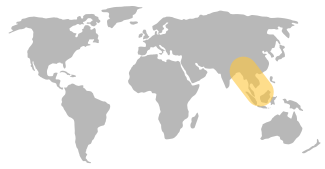
Primary habitat
The Oriental Pied Hornbill is typically found in subtropical or tropical moist lowland and mountain forests across Southeast Asia, including India, Vietnam, Malaysia, Indonesia, and Thailand.
Additional range
Unexpectedly, these birds are also spotted in populated areas, semi-urban settings and cultivated regions when sufficient fruit trees are available for their diet.
Do they migrate?
The oriental pied hornbill is generally a resident bird and does not undertake long-distance migrations. It inhabits a range of habitats throughout the year, primarily in regions across the Indian subcontinent and Southeast Asia, including India, Nepal, Bhutan, Bangladesh, Myanmar, Thailand, Malaysia, Singapore, and Indonesia. While the oriental pied hornbill is not migratory, it may exhibit some local movements in response to seasonal changes, particularly in search of food or breeding sites. These movements are not extensive and typically involve short distances within their established home range. This bird favors subtropical or tropical moist lowland forests, secondary forests, and plantations. It adapts well to human-modified environments, which helps it maintain stable populations across various landscapes. The absence of migratory patterns is due to the bird's ability to find adequate food and habitat throughout the year in its range, relying on a diet primarily composed of fruits, insects, and small animals. Conservation of its habitats is crucial to ensure the oriental pied hornbill's continued stability in its native regions.
What is the role of oriental pied hornbills in nature and how to protect them?
Conservation status
The oriental pied hornbill is currently classified as "Least Concern" by the IUCN, indicating it is relatively common. However, its populations face threats from habitat loss due to deforestation and human encroachment. In some regions, they are affected by hunting and trapping for the pet trade. Key conservation efforts include habitat protection and restoration, as well as legal protections against hunting and trade. Community engagement and education programs also aim to raise awareness about the importance of preserving their habitats and preventing illegal activities that threaten their survival.
Ecological role of oriental pied hornbills
Its role in the ecosystem
The Oriental Pied Hornbill plays a crucial ecological role as both a predator and a seed disperser. Its diverse diet includes fruits, insects and small animals, aiding in pest control in its habitat. The Hornbill's feeding habits can regulate populations of potentially harmful insects, providing a natural pesticide service to forests and nearby agricultural areas. Furthermore, as a frugivore, the Oriental Pied Hornbill contributes significantly to seed dispersal. It consumes a wide range of fruits and excretes the seeds at a considerable distance from the parent plant, assisting in the propagation and genetic diversity of many plant species. This activity ensures the continuance of forest regeneration and growth. Additionally, through their nesting habits, they effectively recycle nutrients in their ecosystem. Thus, the Oriental Pied Hornbill offers indispensable contributions to tropical forest ecosystems, promoting biodiversity, controlling pests, and supporting forest regeneration and sustenance.
How to help protect oriental pied hornbills
Preservation tips
Habitat preservation strategies
Preserving and restoring natural habitats is crucial for the survival of the Oriental Pied Hornbill. This could include implementing stricter regulations on deforestation and land degradation, planting native fruit trees to increase food sources, and creating 'green corridors' to connect fragmented habitats. Public and private partnerships can support these efforts.
Community science initiatives
Involve local communities and schools in citizen science initiatives which focus on monitoring or breeding programs. Educate them about the importance of conserving the Oriental Pied Hornbill. Organize workshops, awareness campaigns, and birdwatching events to garner interest and support. Encourage reporting of hornbill sightings to monitoring initiatives, providing crucial data for conservation.