
Green Jay
Green Jay
Cyanocorax luxuosus


Quick Identification guide
Quick Identification guide
- •
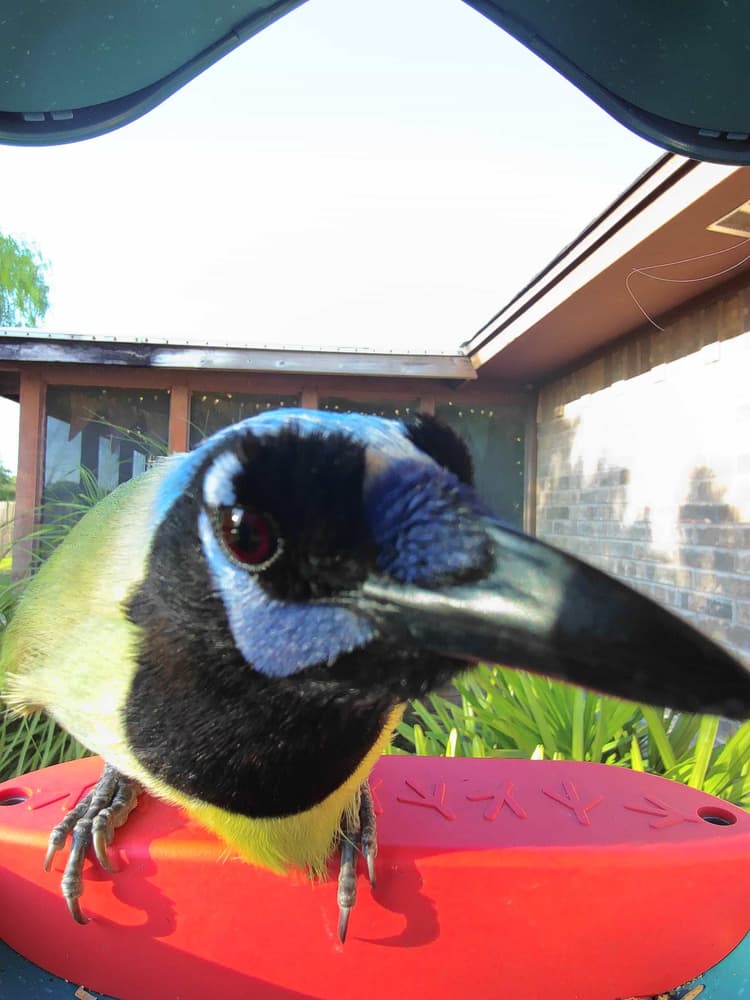
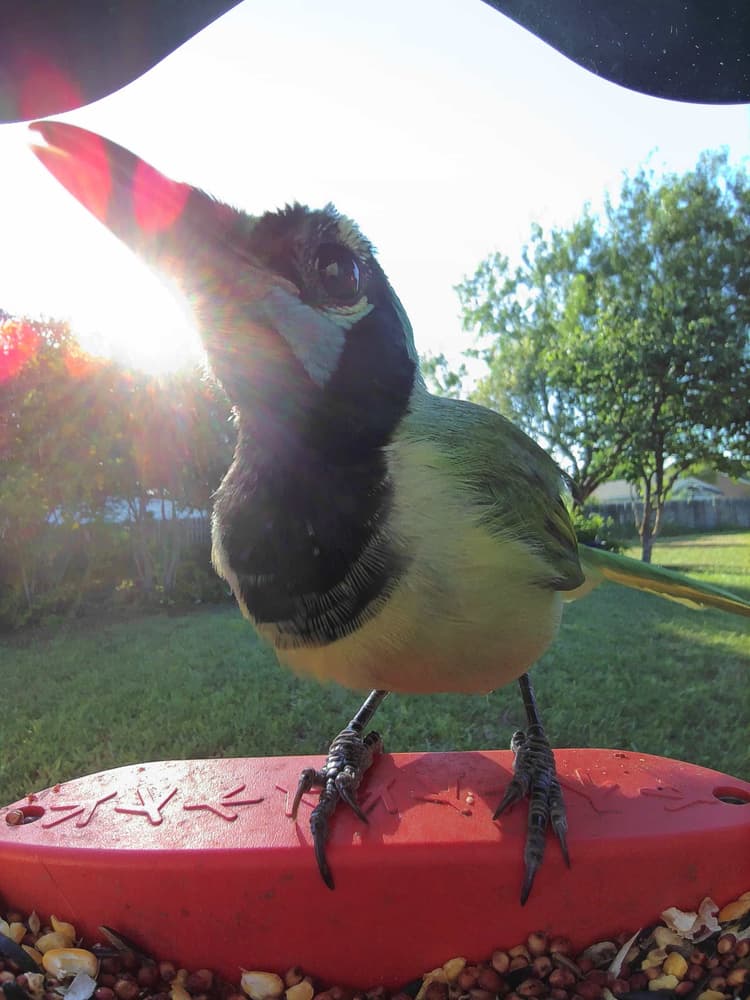
Features bright green plumage on the back and vivid blue on the crown and wings, creating a striking contrast
- •
Displays a distinctive yellowish-green underbelly that brightens its overall appearance
- •
Possesses a black mask across the eyes and short, stout beak, adding to its distinctive look
What does a green jay sound like?
The Green Jay, known for its wide array of vocalizations, makes a variety of calls, consisting of whistles, squeaks, rattle sounds, and even mimicry of other birds. Their primary call is a loud, harsh "cheh-cheh-cheh-cheh" or "kraa-kraa-kraa". They also communicate with melodious whistles and growling sounds. Their songs are not the typical melodic sounds, but rather a complex mix of different types of calls. Mimicry is less developed than in other jay species. Often sociable, they're heard before they're seen, signalling their presence with loud squawks and screeches.


Description
Did you know green jays are one of the few North American birds that use tools? These smart birds are spread out over two populations. In South America, they're slightly larger and males sport a cool-looking crest over their eyes. These colourful birds are excellent mimics and like to move about as a family. Family is everything, after all.
The green jay can weigh between 66to110grams and be from25to29centimeters tall.
The green jay typically lives for approximately 11-12 years in the wild. This lifespan is quite comparable to other jay species, such as the blue jay which often lives around 7 years, but can live up to 26 years in captivity. Lifespan can be influenced by factors such as predation, disease, and environmental changes.
Did you know?
Most popular questions about green jay
How to recognise a green jay?
General appearance
The Green Jay is a vibrant bird, predominantly displaying a blend of electric green, blue, and yellow hues. It sports a striking blue head and crest, contrasting with a yellowish-green back and bright yellow underparts. The wings are blue-turquoise and the tail is long, boasting blue-black and green-yellowish bands. One distinctive feature is their black bill and eyes circled with yellowish skin.
Male vs female
Males and females possess similar plumage, making it difficult to differentiate based on coloration alone. Both genders boast the distinctive green, blue, and yellow coloration. However, males are generally larger and can display more distinctive courtship behaviors.
Juvenile
Juvenile Green Jays exhibit duller colors compared to adults, with more dispersed blue tones and less distinct body patterns. Their iris is brownish instead of the adult's white. The change gradually occurs during their growth into adult plumage.
Breeding and nesting habits of the green jay
Mating behaviors
Green jays engage in elaborate courtship displays that include vocalizations and aerial displays. Males often present food to females as part of the bonding process.
Nesting details
Green jays build cup-shaped nests using twigs, grass, and roots, commonly placed several meters above the ground in trees or large shrubs. They also adapt to gardens with dense foliage.
Eggs and chick-rearing
The female lays 3-5 eggs, incubating them for about 17 days. Both parents feed the chicks, which fledge after 24 days. A suitable habitat includes native trees and shrubs for nesting.
What does a green jay like to eat?
Bird eggs
Fruits
Insects
Nuts
Plants
Small animals
Spiders
Natural diet
The green jay primarily feeds on insects, fruits, and seeds found in its native habitat. It actively searches for caterpillars, beetles, grasshoppers, and other small invertebrates. In addition, it consumes various wild fruits and berries, including those from the palm and ficus trees, as well as acorns and other nuts.
Bird feeders
At bird feeders, the green jay is known to consume seeds such as sunflower seeds, peanuts, and corn. It may also be attracted to suet and fruits like oranges or apples provided in bird-friendly yards. The green jay's adaptable eating habits make it a frequent visitor to well-stocked feeders.
Choosing the right feeder
Green Jays are attracted to feeders that are sturdy and stable. A hanging feeder or a platform feeder are ideal as they provide easy access and plenty of room for these large birds. Try to position the feeder near a tree or shrub, as Green Jays prefer having a safe place to retreat nearby.
Selecting the best food
On their menu, Green Jays enjoy a variety of foods. They love peanuts, corn, sunflower seeds, and suet. For the highest attraction rate, consider Bird Buddy seeds. Chosen by experts for the season, these seeds have been proven to yield the best results in attracting Green Jays to your yard.
Additional tricks
Green Jays are known for their intelligence and curiosity. By adding a bit of novelty to your yard, such as a bird bath or a swinging feeder, you can pique their interest and encourage longer visits. Remember, the more enjoyable you make your yard, the more likely Green Jays will drop by for a visit (and maybe even a sing-along).
Where can you find green jays?

Primary habitat
Green jays are native to the tropics, particularly in the Americas - Mexico, Central America, and South America. They enjoy subtropical and tropical dry forest, humid lowland forest, and heavily degraded former forest areas.
Additional range
Uniquely, these birds have expanded their range north and can be found in south Texas, often congregating in dense thickets and near human habitation.
Do they migrate?
The green jay is generally a non-migratory bird, meaning it tends to stay in one place year-round. It is primarily found in two distinct populations: one in Central and South America, and the other in southern Texas and northeastern Mexico. These birds inhabit subtropical and tropical forests, woodlands, and scrub areas, where they have access to a stable food supply throughout the year. The population in South Texas represents the northernmost range of the green jay, and even here, they do not typically migrate. Instead, they may exhibit some local movements based on food availability or environmental conditions but generally do not undertake long-distance migrations like some other bird species. They remain resident in their preferred habitats, taking advantage of the consistent climate and resources. In summary, while the green jay may show some local movement, it is primarily sedentary and does not migrate over long distances. This behavior allows them to maintain stable populations in their established territories year-round.
What is the role of green jays in nature and how to protect them?
Conservation status
The green jay is listed as a species of Least Concern, indicating it is currently common and not at immediate risk of decline. It inhabits a range extending from southern Texas through Central America. Key conservation efforts focus on habitat protection, as deforestation and habitat loss pose significant threats. Maintaining healthy forest ecosystems is crucial for its survival, yet overall, the species is adaptable to different environments and benefits from protected areas. Continued vigilance in habitat conservation and monitoring is necessary to ensure the green jay remains common and resilient against future challenges.
Ecological role of green jays
Its role in the ecosystem
The Green Jay, a vibrantly colored bird primarily found in Texas but also extends to Central and South America, plays several vital roles in its ecosystem. First, it serves as a pest controller. Green Jays feed on various insects, including those that can be considered pests. Therefore, their presence can help reduce pest populations, indirectly aiding in plant preservation. Secondarily, they play a vital role in seed dispersal. Green Jays are known to hoard seeds, hiding them in various locations across their territory. Often, they forget these caches, leaving the seeds to potentially germinate and contribute to plant biodiversity. Lastly, as prey, Green Jays serve as a food source for larger predators, helping to maintain the ecological balance. Overall, Green Jays contribute significantly to lowering pest populations, increasing plant diversity, and supporting the food chain.
How to help protect green jays
Preservation tips
Habitat preservation strategies
Preserve and restore the habitat of the Green Jay, primarily consisting of dense, scrubby forests and woodlands. Avoid deforestation and illegal logging. Develop green corridors to provide safe passage between fragmented habitats. Implement strict laws for preservation of their nesting sites, especially during breeding season.
Community science initiatives
Encourage community participation in monitoring Green Jay populations and reporting sightings. Organize educational programs in schools and community centers to raise awareness about the importance of Green Jays to the ecosystem. Collaborate with local academics and researchers to conduct studies on Green Jay habitats and behaviors. Use data from citizen science platforms to better understand the bird's conservation needs.