
Eurasian Wryneck
Eurasian Wryneck
Also known as: Northern Wryneck
Jynx torquilla

Quick Identification guide
Quick Identification guide
- •
Features a brown and grey streaked plumage that provides excellent camouflage against tree bark
- •
Possesses a long, slightly curved beak suited for probing into crevices
- •
Displays a short neck and compact body, with a distinctively cryptic pattern across its feathers
What does an Eurasian wryneck sound like?
The Eurasian Wryneck primarily vocalizes with a distinctive repetitive "zhee-zhee-zhee" or "tschurr" sound, which is often mistaken for an insect. Their song generally consists of a drawn-out, warbling "prrrr-t-t-t-t-t." During courtship, their calls become more shrill and rapid. Alarm calls are sharp, high pitched "pee-pee-pee" notes. This bird typically vocalizes from a prominent perch or during flight.

Description
Did you know wrynecks can turn their head almost 180 degrees? Usually while also hissing angrily! No need for an exorcism, it's just their display when they’re threatened! This led to them being used in witchcraft. Heard of putting a jinx on someone? The word comes from iunx, wrynecks' Greek name. Thefact is the Ancient Romans and Greeks thought the bird was the sorceress Iynx, turned into an animal for daring to cast a spell on the mighty Zeus!
The Eurasian wryneck can weigh between 30to50grams and be from16to18centimeters tall.
The Eurasian wryneck, a unique member of the woodpecker family, typically lives for about 2-5 years. This lifespan is relatively short compared to some related woodpecker species, such as the Great Spotted Woodpecker, which can live up to 10 years. Eurasian wrynecks, like most woodpeckers, are subject to relatively high rates of predation and other life-limiting factors.
Did you know?
Most popular questions about Eurasian wryneck
How to recognise an Eurasian wryneck?
General appearance
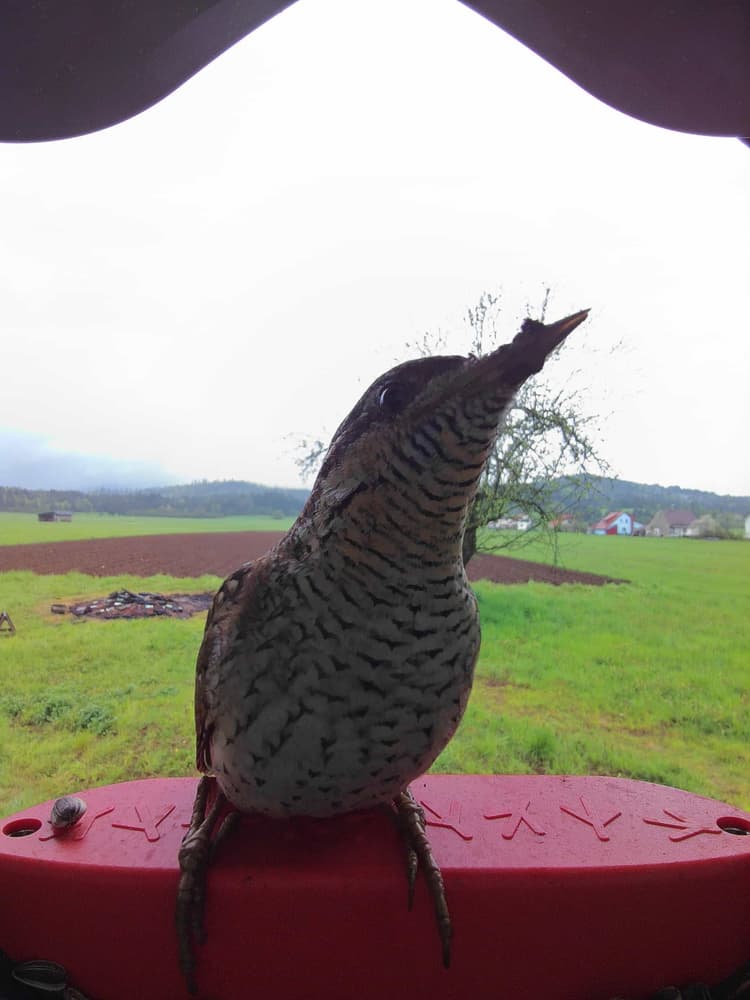
The Eurasian wryneck, a bird species, has a body length of 16.5cm to 18cm with a wingspan between 25cm and 27cm. The bird exhibits a mottled brown coloration providing excellent camouflage. It possesses a short, slightly down-curved bill and a long tongue used for extracting food. The wryneck is renowned for its ability to rotate its head to nearly 180 degrees.
Male vs female
There isn't much sexual dimorphism between male and female wrynecks. Both sexes exhibit the same mottled brown coloration and physical characteristics. However, males often have more pronounced barring on their undersides and slight variations in bill size may be observable, with females usually having slightly longer bills.
Juvenile
Juvenile Eurasian wrynecks are similar in appearance to adults, but they generally have a more dull and less contrasting plumage compared to the adults. The barring on the undersides of juveniles might not be as pronounced as in adults. The coloration pattern improves with each moult till adulthood.
Breeding and nesting habits of the Eurasian wryneck
Mating behaviors
Eurasian wrynecks perform courtship displays involving head bobbing, wing flicking, and calls. Males sing to attract females, and mutual preening signifies pair bonding.
Nesting details
Wrynecks use existing cavities in trees for nesting, avoiding construction. They prefer deciduous woodlands, orchards, and sometimes gardens. Suitable nesting sites can be created by providing nest boxes with a small entrance hole to simulate natural cavities.
Eggs and chick-rearing
Clutches usually consist of 7-10 white eggs. Both parents incubate the eggs for about 12 days. After hatching, chicks are fed by both parents using a diet of ants and insects until they fledge approximately three weeks later.
What does an Eurasian wryneck like to eat?
Aquatic animals
Berries
Bird eggs
Insects
Spiders
Natural diet
The Eurasian wryneck primarily feeds on ants and their larvae. It uses its long, sticky tongue to extract these insects from nests or crevices. Besides ants, it may also consume other insects such as beetles, caterpillars, and spiders. The bird's diet is heavily reliant on its ability to forage on the ground and in trees, where it can find insect-rich environments.
Bird feeders
At bird feeders, Eurasian wrynecks are less commonly seen compared to some other species. However, when they do visit feeders, they may consume suet, peanut butter mixtures, or mealworms. Due to their preference for insects, they are more inclined to visit feeders that provide protein-rich offerings rather than typical seed-based feeds.
Setting up the perfect eurasian wryneck snack station
To entice these charming birds, select a shady spot in your yard for a bird feeder. The Eurasian wryneck is known for its love of ants, but they also enjoy a variety of seeds. Consider filling your feeder with Bird Buddy seeds, as these are specially chosen by experts for the season. This should provide a tempting snack for any wandering wryneck.
Choosing the right feeder for a eurasian wryneck
Wrynecks prefer feeders that offer a perch to sit and eat at leisure. An enclosed feeder with sufficient openings for these small birds to get in and out would be the ideal choice. Remember to keep your feeder clean and well-stocked with fresh seeds to keep these birds coming back.
Fun tricks to entice the eurasian wryneck
In addition to setting up an enticing feeder, consider setting up a bird bath or water source as Eurasian wrynecks are drawn to water. The lure of a splash can often prove irresistible to these birds. Also, try mimicking their intriguing 'drumming' song, you might just get a beautiful sing-along.
Why choose bird buddy seeds for your eurasian wryneck
Selecting the right type of birdseed is crucial to attract specific birds to your yard. Bird Buddy seeds have been shown to be highly effective in attracting the Eurasian Wryneck; these seeds are expertly selected with the bird's preference and the season in mind, thus fetching best results.
Where can you find Eurasian wrynecks?
Primary habitat
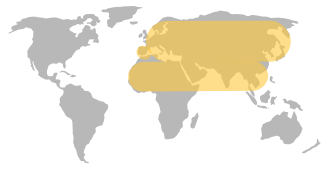
The Eurasian wryneck typically inhabits open woodland, orchards, and parkland throughout Europe and Asia.
Additional range
During migration, it prefers warm climates and can also be found in East Africa.
Do they migrate?
The Eurasian wryneck is a migratory bird species. It breeds across much of Europe and parts of Asia and undertakes seasonal migrations to avoid the cold winter months. In the autumn, wrynecks migrate from their breeding grounds in Europe and western Asia to their wintering areas in sub-Saharan Africa. Their routes generally follow a southward trajectory through Europe, crossing the Mediterranean and into Africa. Key resting and feeding stopovers include southern Spain, Italy, and parts of the Balkans. The timing of migration varies slightly depending on the location of their breeding grounds. Departures typically begin in late August and continue through September. The migration concludes with their arrival in their winter habitats by late October. In spring, the reverse migration occurs. The birds leave their African wintering areas in March and April, making their way back to their breeding territories. They arrive at these northern locations from late April to early May. These long-distance movements are characterized by the use of diverse habitats along the way, including woodlands, orchards, and bushy areas, where they can forage for ants and other small invertebrates during their journey.
What is the role of Eurasian wrynecks in nature and how to protect them?
Conservation status
The Eurasian wryneck is currently classified as "Least Concern" by the IUCN, indicating it is relatively common and not immediately at risk. However, its populations are experiencing declines in some areas due to habitat loss, primarily from agricultural intensification and deforestation, which reduce nest sites and food availability. Conservation efforts focus on preserving natural habitats and promoting traditional, low-intensity farming practices to sustain their environment. Monitoring programs are critical in tracking population trends and implementing timely conservation actions to prevent future vulnerability.
Ecological role of Eurasian wrynecks
Its role in the ecosystem
The Eurasian wryneck (jynx torquilla) is a forest-dwelling bird species native to Eurasia. It performs an important ecological role through its diet, extending to pest control, as it predominately consumes insects and their larvae, including potentially damaging species such as beetles and ants. In this way, the wryneck acts as a form of natural pest regulation, supporting the health of forest ecosystems by controlling insect populations, and indirectly aiding in the preservation of tree cover. Furthermore, this bird helps in seed dispersal and contributes to forest regeneration, as the indigestible components of its diet are excreted, depositing seeds in different areas, thus promoting plant diversity and growth. As a prey species, it also supports predator populations such as foxes and large birds. To conclude, the Eurasian wryneck's role in pest control, seed dispersal, and as a food source for predators contributes significantly to maintaining the health and diversity of its woodland ecosystems.
How to help protect Eurasian wrynecks
Preservation tips
Habitat preservation strategies
Preserve the natural habitat of the Eurasian wryneck by resisting deforestation and irresponsible urbanization in their dwelling areas. Encourage sustainable farming practices to prevent destruction of their habitat. Establish legal protections in areas where this species is known to breed and reside. Plant native trees or wooden poles within grasslands to provide potential nesting areas.
Community science initiatives
Invite local communities to participate in bird watching initiatives to collect data on the Eurasian wryneck’s behavior, migration habits, and population trends. Organize educational drives about the importance of protecting this bird species. Promote citizen science projects which can monitor the Eurasian wryneck, particularly during breeding seasons. Report sightings to relevant wildlife authorities for tracking purposes.