
Curve-Billed Thrasher
Curve-Billed Thrasher
Toxostoma curvirostre


Quick Identification guide
Quick Identification guide
- •
Features a long, slightly curved bill that is distinctively downturned
- •
Boasts grayish-brown plumage with speckled breast, providing camouflaged coloring against desert backgrounds
- •
Displays yellow-orange eyes set against a uniform gray face, enhancing its piercing gaze
What does a curve-billed thrasher sound like?
The curve-billed thrasher produces vocalizations characterized by a quick succession of musical notes and phrases, often forming its unique song. Its call stands out with a sharp, whistled 'whit-wheet', exhibiting a pattern that starts on a high note and then rises. The bird's call types can be categorized as chirps or chips, and whistles.


Description
Curved-billed thrashers haven't got the most curved bills of all the thrashers. It's just because when John Swainson discovered them, he hadn't managed to see all the other members of the family! Want to know if one is around? Listen for a strong whistle! Like someone hailing a cab. Their strong legs and long bills make them the perfect hunters of desert insects.
The curve-billed thrasher can weigh between 56.8to93.6grams and be from27to28centimeters tall.
The Curve-billed Thrasher typically lives about 10–15 years. Compared to similar species, this lifespan is quite moderate; for instance, the Brown Thrasher lives about 11–12 years, while some Mockingbirds can live up to 20 years. However, survival rates may vary depending on environmental conditions and natural threats.
Did you know?
Most popular questions about curve-billed thrasher
How to recognise a curve-billed thrasher?
General appearance
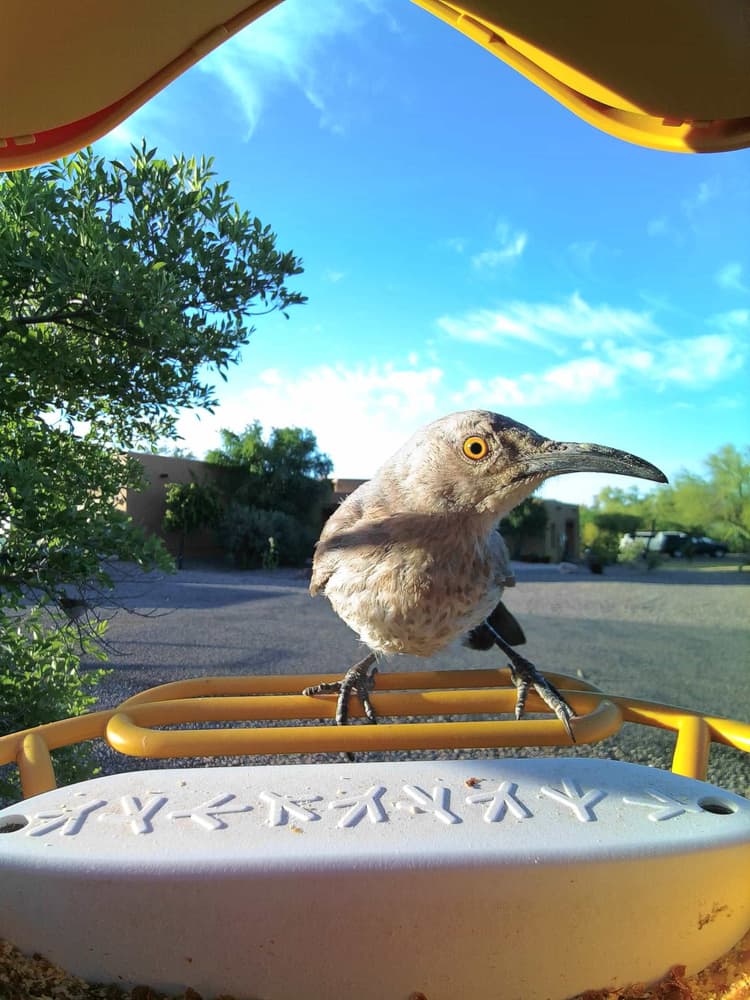
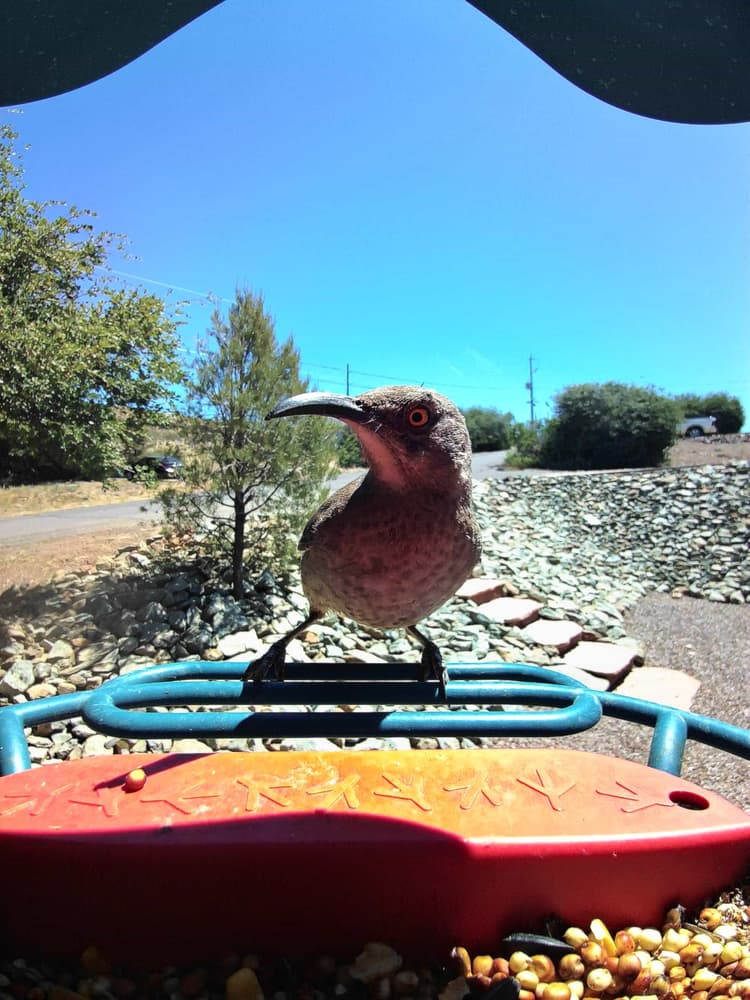
The Curve-billed Thrasher measures between 9.5 to 11.5 inches, equivalent to 24-29 cm, with similar sizes of a Crow. It has a broad wing shape and a long, rounded, and wedge-shaped tail. The overall color profile is a dull gray-brown featuring a black, moderately curved bill. Its eyes are distinctive with a yellow-orange coloration. In Texas specifically, they have more visible chest spots.
Male vs female
Unlike some bird species, the male and female Curve-billed Thrashers do not exhibit any noticeable physical differences in coloration, size, or marking. Both sexes possess the same dull gray-brown coloration, yellow-orange eyes, and the distinctive moderately curved black bill.
Juvenile
The juvenile Curve-billed Thrasher has a shorter bill compared to adults. Their upper chest carries sharper and more pronounced spots. Similar to their adult counterparts, they present with the same general color profile of gray-brown, though the coloring may slightly vary by season.
Often mistaken for
Crissal Thrasher vs Curve-Billed Thrasher
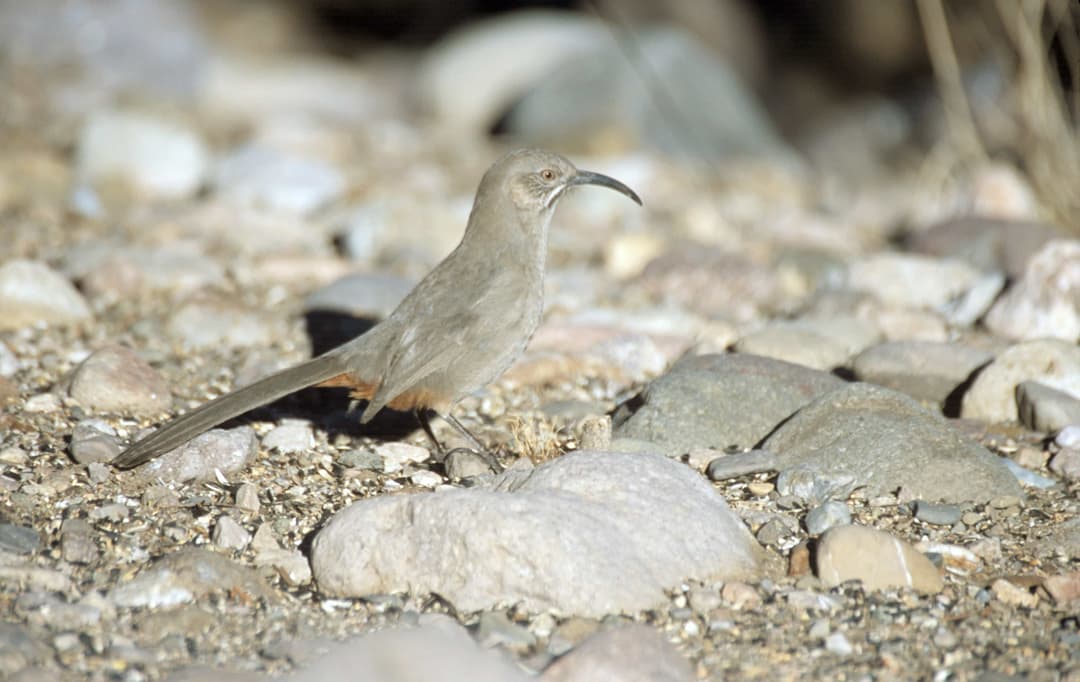
The Curve-Billed Thrasher is generally more robust with a slightly curved bill, while the Crissal Thrasher has a longer, more decurved bill. Look for the distinctive pale belly and the blackish breast and undertail coverts of the Crissal Thrasher, contrasting with the Curve-Billed Thrasher's more uniform grayish-brown coloration. The Curve-Billed has striking orange eyes; the Crissal Thrasher has dark eyes. Pay attention to the habitat; Curve-Billed Thrashers prefer open arid areas with cacti, whereas Crissal Thrashers are typically found in dense brushy wash areas.
Breeding and nesting habits of the curve-billed thrasher
Mating behaviors
Curve-billed thrashers engage in courtship displays to attract mates, often characterized by singing and physical posturing by males. Pairs may perform mutual preening and engage in call-and-response vocalizations as part of the bonding process.
Nesting details
They typically build nests in cactus plants or low shrubs, using twigs and grasses to construct a loosely woven structure. In urban areas, curve-billed thrashers may nest in garden shrubs, favoring locations that offer protection from predators. Providing a mixture of native plants, thorny bushes, and open ground can create a suitable environment for nesting.
Eggs and chick-rearing
The female usually lays 2 to 4 eggs, which are incubated for about 14 days. Both parents participate in feeding the chicks. The young fledge approximately two weeks after hatching, but parents continue to feed them for several days as they learn to forage independently.
What does a curve-billed thrasher like to eat?
Fruits
Insects
Seeds
Snails
Spiders
Natural diet
The curve-billed thrasher primarily feeds on a wide array of insects and their larvae, such as beetles, ants, grasshoppers, and wasps. It also consumes spiders, centipedes, snails, and sowbugs. In addition to these, the bird's diet includes various berries and heavily features the fruits and seeds of cactus, notably those from prickly-pear and saguaro.
Bird feeders
The curve-billed thrasher can occasionally visit bird feeders but is more attracted to natural food sources. When visiting feeders, it might consume seeds and suet. However, they are not as commonly seen at feeders compared to natural environments.
Get the right seeds
Use specially chosen seeds to attract Curve-billed Thrashers. We recommend Bird Buddy seeds, which are picked by experts for each season. They are nutritious and appealing to these birds.
Feeders matter
When it comes to feeders, select large, sturdy platforms or ground feeders. Curve-billed Thrashers are not adept at clinging to small feeders. The ideal choice is a tray that's easily accessible and big enough for them to forage and peck comfortably.
Provide their favorite snacks
For food, Thrashers are partial to fruits, insects, and meaty treats. Regularly supply your feeder with small pieces of apple, orange, and even soft, raw meat. Make sure the fruit is ripe and the meat is fresh to keep these birds coming back.
Create a thrasher-friendly environment
Plant native shrubs and trees in your yard for cover and nesting which will provide a safe and familiar environment. You can also include a birdbath or a shallow water dish for them to drink and bathe in.
Play a thrasher's melodies
For another fun trick, try playing songs that the Curve-billed Thrasher is known to create. Their rich, melodious song could attract others to your yard for a wonderful birdwatching, sing-along experience.
Where can you find curve-billed thrashers?

Primary habitat
The curve-billed thrasher primarily inhabits the Sonoran desert and dry, brushy regions, generally preferring lowlands with varied vegetation. It tends to avoid extremely arid desert conditions with sparse plant life.
Additional range
Unexpectedly, this bird is often found in suburban neighborhoods, especially where cholla cactus is present. In southern Texas, it resides in chaparral with prickly-pear cactus and sometimes on open grassland near cholla stands.
Do they migrate?
The curve-billed thrasher is primarily a permanent resident, meaning it generally stays in one place throughout the year. This bird species is commonly found in arid and semi-arid regions of the southwestern United States and northern Mexico, thriving in desert scrub and thorny brush landscapes. While it is mostly sedentary, some individuals may exhibit local movements, particularly in fall and winter, by slightly expanding their range to find food or suitable habitat conditions. These movements are typically not considered true migration, as they don't involve long-distance travel between distinct breeding and non-breeding grounds. There is no significant migratory route, timing, or key locations typically associated with the curve-billed thrasher's behavior. Instead, any observed wandering remains mainly local and limited. Thus, conservation efforts and observations focus on the species' adaptation to its core habitats primarily across areas like Arizona, New Mexico, Texas, and northern Mexican states. Understanding its habitat preferences and behaviors helps inform conservation strategies, particularly in maintaining the ecological conditions necessary for its survival year-round.
What is the role of curve-billed thrashers in nature and how to protect them?
Conservation status
The curve-billed thrasher's conservation status shows slight declines in Texas over recent decades, while it remains abundant farther west. The species is not currently considered vulnerable or endangered. Key conservation efforts focus on habitat preservation, particularly in areas experiencing urban development or agricultural expansion. Significant threats include habitat loss and fragmentation due to these activities. Although the thrasher remains common in many regions, ongoing monitoring and habitat protection are important to prevent further declines and ensure its continued abundance.
Ecological role of curve-billed thrashers
Its role in the ecosystem
The curve-billed thrasher plays a vital ecological role due to its feeding patterns and nesting behaviors. Its diet is composed mostly of insects, larvae, spiders, centipedes, snails, and sowbugs, thereby contributing to pest control by suppressing the population of these species. It also feeds heavily on berries, fruits, and seeds, especially those of prickly-pear and saguaro cacti. As such, it plays a significant role in seed dispersal, facilitating the propagation and expansion of these species in its environment. Additionally, it nests in a variety of plant species, including cholla cactus, yucca, prickly-pear, and shrubs, which indicates it contributes to the shaping of the plant realm in its environment. By reusing nests of the Cactus Wren, it takes part in recycling natural resources within the ecosystem. Overall, the curve-billed thrasher assists in maintaining a balanced and diverse ecosystem through pest control, seed dispersal, and habitat utilization.
How to help protect curve-billed thrashers
Preservation tips
Habitat preservation strategies for curve-billed thrasher
Put more emphasis on habitat preservation to support the curve-billed thrasher. Prioritize regions that have a large concentration of these birds. Limit residential and industrial development in these areas to reduce habitat destruction. Restoration efforts should focus on desert scrub environments, their preferred habitat. Endeavor to curb pesticide usage that directly reduces their insect food supply.
Community science initiatives for curve-billed thrasher conservation
Promote community science initiatives to gather ample data on curve-billed thrasher populations and behavior. Encourage residents to report sightings, nesting habits and unusual behavior. Use this data to inform future conservation policies. Proactively educate the local community about the importance of this species and the effects of habitat destruction. Rally local schools, organizations and individuals, translating their interest in nature into active conservation efforts.